







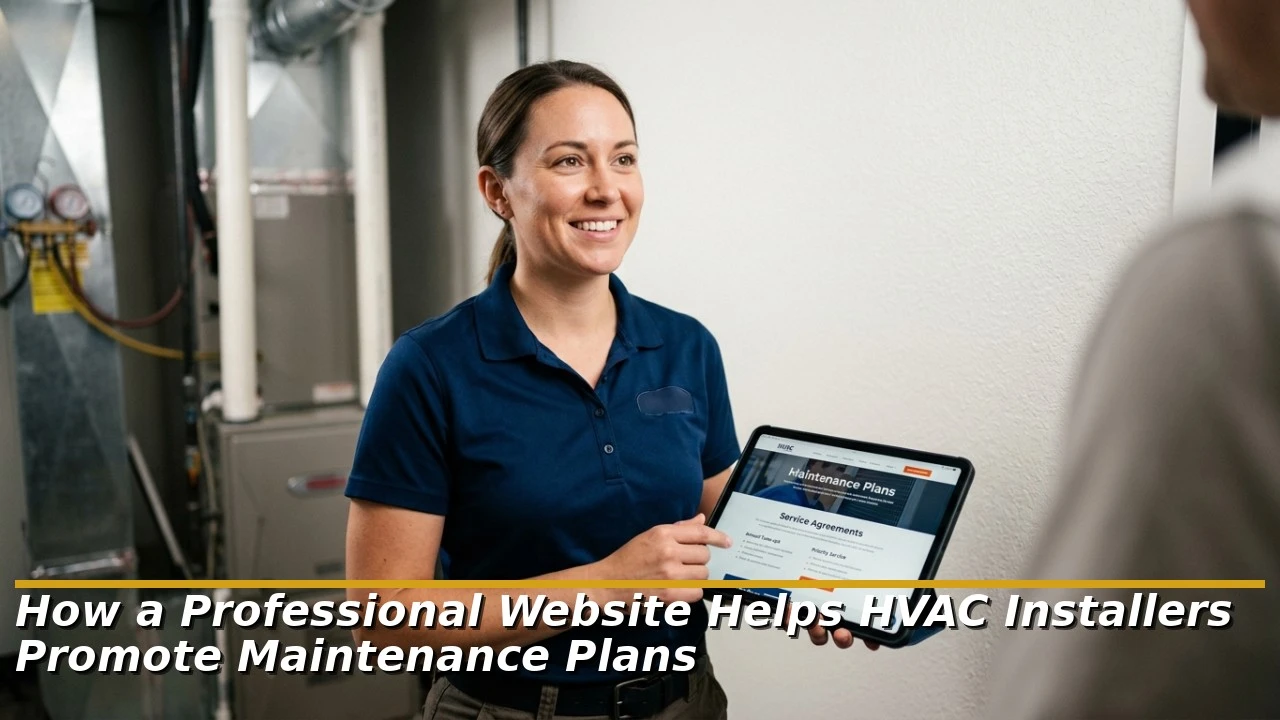
A homeowner in Woodbury dials an HVAC contractor in January because her furnace stopped working. The technician arrives, diagnoses a failed inducer motor, and completes the repair. Before leaving, he mentions a maintenance plan of two seasonal tune-ups per year, priority scheduling during peak season, and a discount on parts. The client is interested. Her follow-up question is about how to sign up. He hands over a flyer. She says she’ll consider.
She does not sign up. Not for lack of wanting the plan, but because nothing made it easy to act on. The contractor’s website had no maintenance plan page. It was missing online enrollment. Pricing wasn’t visible. By the time she reconsidered, the flyer was forgotten and her actions led to contacting a different firm for the fall tune-up.
Maintenance plan revenue is the most stable income stream an HVAC contractor can build. Retention rates for plan members exceed 85%, compared to 35% for one-time customers. Members generate 2.4 to 3.1 times higher lifetime value. They prioritize you for replacements when the time comes. But none of that happens if homeowners cannot find, understand, or enroll in the plan within a few seconds of visiting your website.
Key Takeaways
- Maintenance plan members retain at 85%+ versus 35% for one-time customers, making plan enrollment the highest-ROI retention investment available
- 40% of website conversions happen outside business hours: online enrollment captures plan sign-ups that a phone-dependent process permanently loses
- A neglected HVAC system can increase energy consumption by 15% or more; maintenance plans reduce this risk and give contractors a concrete savings argument
- Dedicated maintenance plan landing pages earn AI citations for search queries like “HVAC service plan in [city]” that a generic services page cannot rank for
- 81% of homeowners prefer self-service booking over phone-based intake: online plan enrollment removes the friction that kills after-hours sign-up intent
1. Why Maintenance Plans Are the Most Profitable Service Most HVAC Contractors Under-Sell
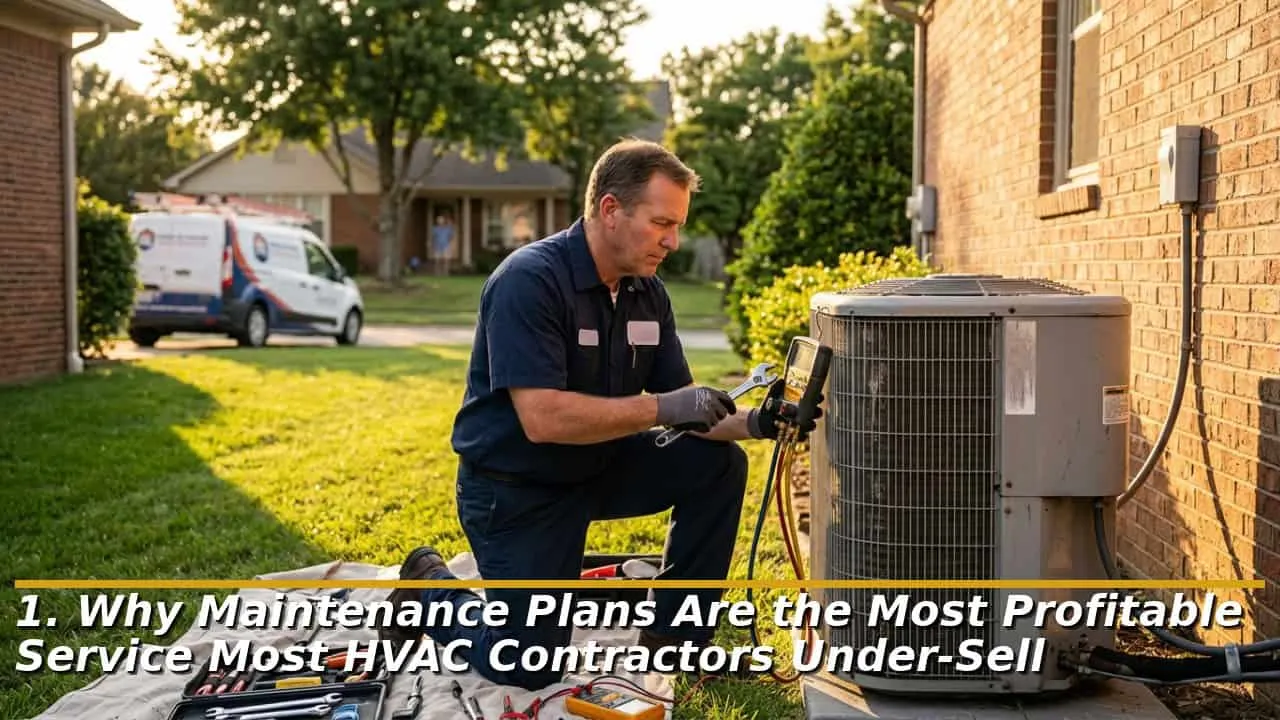
A single furnace installation generates revenue once. Maintenance plans generate this annually, for the life of the customer relationship. Businesses that derive 30% to 40% of their annual revenue from recurring service agreements see 50% less revenue volatility than those operating entirely on one-time work, according to HVAC industry financial analysis. They also carry significantly higher business valuations: when membership revenue falls below 15% of total income, analysts classify the business as high-volatility.
Profitability compounding is equally significant. Maintenance visits identify secondary needs, including indoor air quality upgrades, part replacements nearing failure, and systems approaching end of life. They stay at costs far below acquiring a new customer. Re-engaging an existing maintenance client is 60% less spending then generating an equivalent lead through paid search. And when a maintained system finally requires replacement, the homeowner connects with the contractor who has been servicing it for three years, not whoever ranks first in a panicked search.
The bottleneck is not demand. Consumers seek maintenance plans when the value is explained clearly. The bottleneck is presentation as most HVAC websites bury maintenance agreements in a list on the services page, provide no pricing, and require a phone call to enroll. That friction kills the conversion the technician just created in the field.
 Related article
How Local SEO for HVAC Installers Drives Year-Round Lead Generation in Minnesota
Most Minnesota HVAC installers know the J’s are their busiest months: January for furnaces, July for air conditioning. What many do not know is that the homeowners filling their July schedule began researching in February, and the contractor who appeared first in those early searches is almost certainly the one who booked the job. By […]
2. How a Website Sells Maintenance Plans While the Technician Is on the Next Job
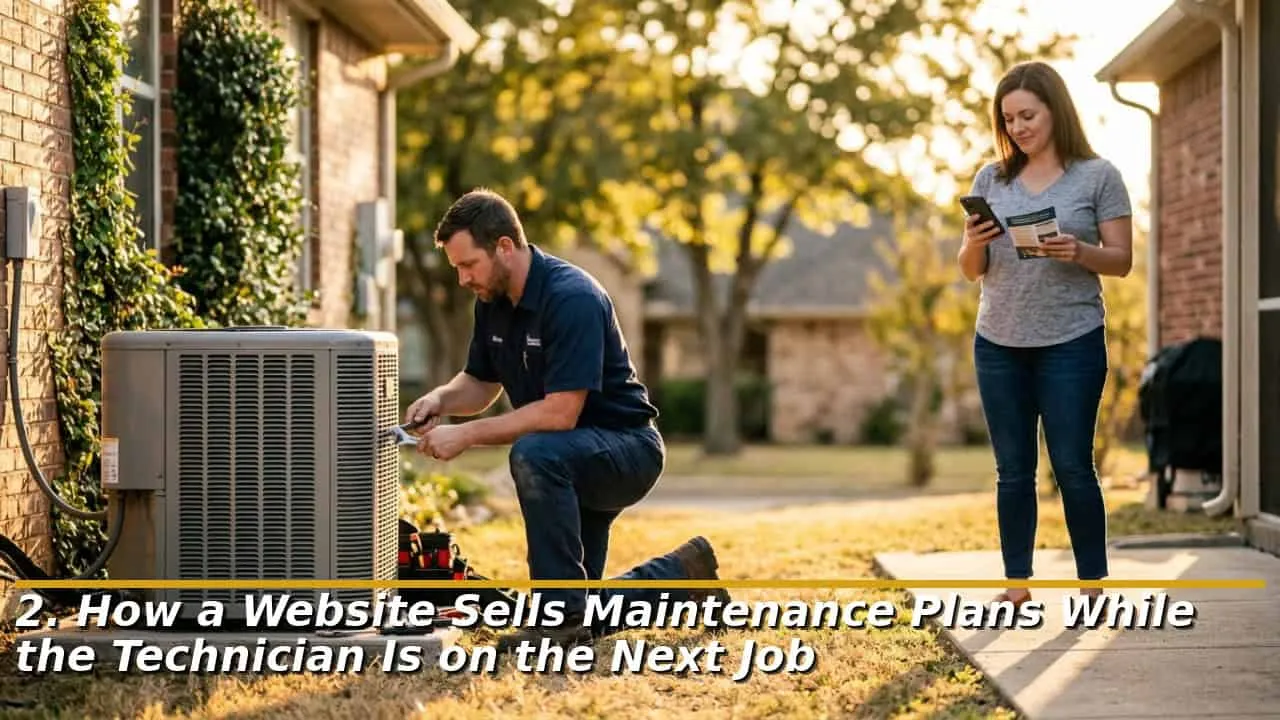
A well-structured maintenance plan page works for enrollment around the clock, capturing those arriving home from work at 8 PM and finally had time to look up the plan the technician mentioned, the spouse who was asked to “look into it,” and the homeowner who found the contractor through a search for “HVAC service plan in Maple Grove.” None of these conversions happen over the phone. They occur through a website that makes the path from interested to enrolled frictionless.
Structural requirements are specific. A dedicated maintenance plan page, separate from the main services page, allows the site to rank for plan-specific search queries and provides content the depth that AI search platforms use for local citations. Three-tier transparent pricing, showing a basic, mid-tier, and premium option with clear feature distinctions, guides homeowners toward the mid-tier option through well-established behavioral patterns without requiring a sales conversation. Online enrollment integrated with a CRM allows consumers to select a plan, pay, and choose their first appointment slot without any manual staff involvement.
According to research on consumer behavior in home services, 81% of homeowners prefer self-service booking options over phone-based intake, and 40% of website conversions happen outside standard business hours. Maintenance plan pages without online enrollment are effectively closed for business during those hours. Every enrollment that requires a callback is a conversion that relies on perfect follow-through from both the homeowner and the office, which does not always happen.
 Related article
HVAC Lead Generation Strategies: Turning Website Traffic into Installation Quotes and Tune-Up Bookings in the Age of AI Search
The landscape of digital marketing for contractors has reached a pivotal turning point. For the past decade, the goal was simple, rank in the blue links of Google. However, 2026 marks the definitive shift from traditional search to AI-powered discovery. Customers are no longer browsing lists of websites; they are receiving synthesized answers from AI […]
3. Seven Website Features That Drive Maintenance Plan Enrollment

A. A dedicated maintenance plan landing page, not a section on the services page. This page should target keywords like “HVAC maintenance plan in [city]” and “furnace service agreement [suburb].” It needs to stand alone with its own URL, schema markup, and call to action. A section buried in lengthy service pages cannot rank for those queries and does not provide the depth AI search platforms require to cite it in local recommendations.
B. Three-tier pricing structure with clear feature differentiation. Label tiers plainly: Basic, Plus, and Premium, or Comfort, Comfort+, and Comfort Elite. Make the middle tier visually prominent with a “Most Popular” badge. Each should describe exactly what is included like the number of tune-ups, priority scheduling status, labor discounts, and any included parts or free service calls. Vague plan descriptions kill enrollment. Transparent specifics earn it.
C. Online enrollment with integrated scheduling. Someone who cannot sign up and schedule their first tune-up on the spot is a homeowner who will “think about it” and not return. Integrate your enrollment page with your CRM, whether ServiceTitan, Housecall Pro, or an equivalent. Now, the entire process, selection, payment, and scheduling, completes without manual intervention.
D. Sticky click-to-call and a “Join Now” button in the header. On mobile, the phone number and plan enrollment path should be visible at every scroll position. Homeowners who find your maintenance page on a smartphone at 9 PM need one tap to either call or enroll, depending on their preference.
E. Reviews specifically mentioning the maintenance plan, displayed on the plan page. Reviews describing, “three years on the maintenance plan, never had an emergency call” or “technician caught a cracked heat exchanger during the fall tune-up before it became a winter emergency” convert research-phase homeowners at significantly higher rates than generic five-star ratings. Prompt every plan renewal or tune-up completion with a review request mentioning service type.
 Related article
How an HVAC Website Builds Trust During Emergency Service Situations in Minnesota
A homeowner in Burnsville wakes at 2am in the morning to a cold house. The furnace is silent. The outdoor temperature is minus five. She grabs her phone and searches for “emergency furnace repair near me.” Three results appear. One has a 4.9-star rating, 24/7 badge, tappable phone number, and a line reading “Licensed, bonded, […]
F. An answer-first FAQ section with FAQ Page schema markup. Common questions about maintenance plans, notably what is included, whether the plan transfers when a home is sold, and how priority scheduling works during peak demand, earn AI citations when structured with FAQ Page schema. AI-referred leads convert at 14.2%, five times higher than traditional organic traffic. Customers discovering your plan recommended by a Google Gemini response for, “is an HVAC maintenance plan worth it in Minnesota?” arrives pre-sold on the concept.
G. A Minnesota-specific value case for the maintenance plan. Minnesotan homeowners face conditions that make maintenance genuinely urgent like furnaces running at sustained capacity through months of sub-zero weather and air conditioners fighting high summer humidity. A paragraph acknowledging these specific demands, rather than generic “preventive maintenance is important” copy, resonates with homeowners who know their system works harder than average and want the protection to match.
| Website Element | Enrollment Barrier It Removes | Conversion Impact |
|---|---|---|
| Dedicated plan landing page | No findable plan info for searchers or AI | Rankable for plan-specific queries |
| Three-tier transparent pricing | Homeowner does not know what to expect or compare | Guides toward mid-tier without sales conversation |
| Online enrollment + scheduling | Phone-dependent process loses after-hours intent | 40% of conversions happen outside business hours |
| Sticky enrollment button on mobile | Homeowner cannot act immediately on mobile | One tap from anywhere on the page |
| Plan-specific reviews | No social proof for the recurring service model | Reduces skepticism about ongoing commitment |
| FAQ Page schema markup | AI platforms cannot cite the plan in recommendations | 14.2% AI lead conversion rate |
| MN-specific maintenance copy | Generic content does not resonate with local conditions | Builds trust with homeowners who know MN winters |
 Related article
Why HVAC Contractors Need a Website to Compete in Local Search Results in Minnesota
It is January in the Twin Cities. The temperature drops to minus 18 overnight. At the crack of dawn, a homeowner in Maple Grove discovers her furnace has stopped working. She opens Google, types “furnace repair near me,” and sees three results in the Map Pack. The first shows a 4.8-star rating, a 24/7 badge, […]
4. Two Contractors, Same Market, Different Enrollment Infrastructure

Both firms serve the same south metro suburbs. Each technician mentions the maintenance plan at the end of service calls.
Contractor A has no dedicated plan page. It’s bulleted on the services page. Enrollment requires calling the office. The conversion rate from technician mention to actual sign-up: under 12%. Most readers who were interested do not follow through, and the contractor never knows which ones. Technician downtime in shoulder months is consistent and expensive.
Contractor B launched a dedicated maintenance plan page with three-tier pricing, online enrollment integrated with their CRM, and a QR code technicians give to homeowners at the end of every service call that links directly to the plan page. Reviews mentioning the maintenance service are displayed prominently. The page ranks for “furnace maintenance plan Burnsville” and three adjacent suburbs. Enrollment rate from technician visits achieve over 30%. Shoulder months are now their most consistent revenue period. Technicians are scheduled on maintenance tune-ups through May and October.
The technician’s sales conversation is the same in both companies. The website determines whether that conversation produces revenue.
Conclusion
Maintenance plans are the most stable revenue stream available to an HVAC contractor. They protect against seasonal volatility, reduce customer acquisition costs, and create the ongoing relationship that converts into replacement installations years later. The technology and consumer preference to enroll online is abundant as 81% of homeowners prefer self-service booking, and 40% of conversions happen after business hours.
The only thing standing between an HVAC contractor and a growing base of enrolled maintenance plan members is a website that makes the plan findable, understandable, and enrollable in under three minutes. A dedicated plan page with transparent pricing, online sign-up, and Minnesota-specific value framing is the asset that turns a technician’s in-field mention into a recurring revenue relationship.
Is your maintenance plan generating the recurring revenue it should?
Search “HVAC maintenance plan” plus your top suburb right now. If your business does not appear and your plan is not enrollable online, you are losing conversions from every service call your technicians complete. Start this week: create a dedicated plan landing page with transparent three-tier pricing and a visible “Join Now” button. That single change will capture enrollments your current website is permanently losing. If you need help, contact our HVAC website design team today at (612) 590-8080.
 Related article
Local SEO for HVAC Installers: Optimizing for AI Search and Seasonal Intent
The competitive landscape for the heating, ventilation, and air conditioning (HVAC) industry in this year is defined by a fundamental shift from traditional link-based search to AI-driven discovery. Homeowners no longer browse a list of results; they ask Large Language Models (LLMs) like ChatGPT, Gemini, and Perplexity for direct recommendations. For contractors, local SEO has […]
FAQs About How a Professional Website Helps HVAC Installers Promote Maintenance Plans
1. Do HVAC manufacturer warranties require documented maintenance, and how does this affect plan value?
Many HVAC manufacturer warranties include language requiring the homeowner to maintain the system according to the manufacturer’s specifications. This means annual professional inspections and filter replacements. If a major component fails and the homeowner cannot demonstrate documented maintenance history, manufacturers may deny the warranty claim.
For those with relatively new systems under a 5 to 10-year parts warranty, this creates a concrete financial reason to enroll in a maintenance plan: the annual tune-up visit provides the documentation that protects their warranty coverage. HVAC contractors who explain this warranty documentation angle on their maintenance plan page, rather than relying solely on “prevents breakdowns” messaging, add a compelling layer of risk-reduction that resonates with homeowners who paid $8,000 to $18,000 for a new system and want to protect that investment.
2. How often should Minnesota homeowners service heat pumps compared to gas furnaces?
Gas furnaces and central air conditioners require two professional service visits per year being a fall furnace tune-up before the heating season and a spring cooling system inspection before summer. Heat pumps operate differently because they provide heating and cooling, running year-round rather than seasonally. Due to continuous operation, heat pumps are subject to more accumulated wear and are often recommended for inspection three times per year in climates with both extreme cold and warm summers, according to Blue Heating and Cooling’s maintenance frequency research.
For contractors in the North Star State building maintenance plan tiers, this creates a legitimate product differentiation opportunity: a standard two-visit plan for gas furnace and AC customers, and a three-visit plan specifically designed for heat pump owners. Displaying this distinction on the maintenance plan page helps homeowners self-select the right option and demonstrates expertise in the systems they are actually managing.
3. How does carbon monoxide risk factor into the value of HVAC maintenance plans in Minnesota?
The state’s extended heating season creates a heightened carbon monoxide risk relative to milder climates. Gas furnaces with cracked heat exchangers, a common failure mode in older or poorly maintained systems, can leak carbon monoxide into the living space while operating. Minnesota HVAC maintenance best practices, as outlined by multiple Twin Cities contractors, include visual and pressure testing of heat exchangers during every fall furnace inspection.
A cracked heat exchanger identified during a routine maintenance visit is a repair or replacement on the homeowner’s terms and timeline. A crack discovered during a January emergency call, when the house is already cold, is a crisis. Contractors who explain this specific risk on their maintenance plan page, framing the fall tune-up as a carbon monoxide safety check in addition to a performance inspection, give homeowners a safety argument for enrollment that goes beyond the standard energy savings messaging.
 Related article
Contractor Website vs. Lead Generation Platforms: Why HVAC Companies Should Own Their Online Presence
Most HVAC business owners feel like they are caught in a trap. To keep their trucks moving and phones ringing, they feel that industry leading middleman websites like Angi, HomeAdvisor, or Thumbtack have a chokehold on their leads, having to pay for work. It feels like paying rent to a landlord who keeps raising the […]
4. Can HVAC maintenance plan members get priority scheduling during Minnesota’s peak demand surges?
Priority scheduling is one of the most tangible benefits a maintenance plan can offer in a climate with Minnesota’s demand volatility. When furnace searches spike 137% in January and AC searches spike 266% in July, HVAC contractors’ schedules fill within days. Homeowners who do not have a service agreement often face multi-day waits during those surges, sometimes in genuinely unsafe conditions.
Maintenance plans explicitly guaranteeing priority dispatch within 24 hours for plan members, versus standard scheduling for non-members, gives the plan a concrete and emotionally resonant benefit. Contractors outlining this priority window clearly on the plan page, and who can demonstrate it in reviews mentioning fast response during a January cold snap, make the plan’s value tangible in the context of the conditions Minnesota homeowners actually experience.
5. How should HVAC contractors structure the QR code handoff to convert field visits into plan enrollments?
The gap between a homeowner’s in-person interest and their online enrollment is where most maintenance plan conversions are lost. A QR code that technicians hand to homeowners at the end of every service call, linking directly to the maintenance plan landing page, closes that gap by routing the homeowner to the enrollment page at the moment of highest interest: immediately after a successful service visit.
This should link to a page that loads in under 2 seconds on mobile, opens directly to the plan comparison section rather than the homepage, and includes the three-tier pricing and an inline enrollment button. Contractors who include a brief handwritten note with the QR code, such as “Join by [date] for this season’s price,” create a mild urgency without false pressure. Tracking enrollment rates by technician, comparing code link clicks to completed sign-ups, identifies where in the digital enrollment flow homeowners are dropping off and allows targeted improvements.