







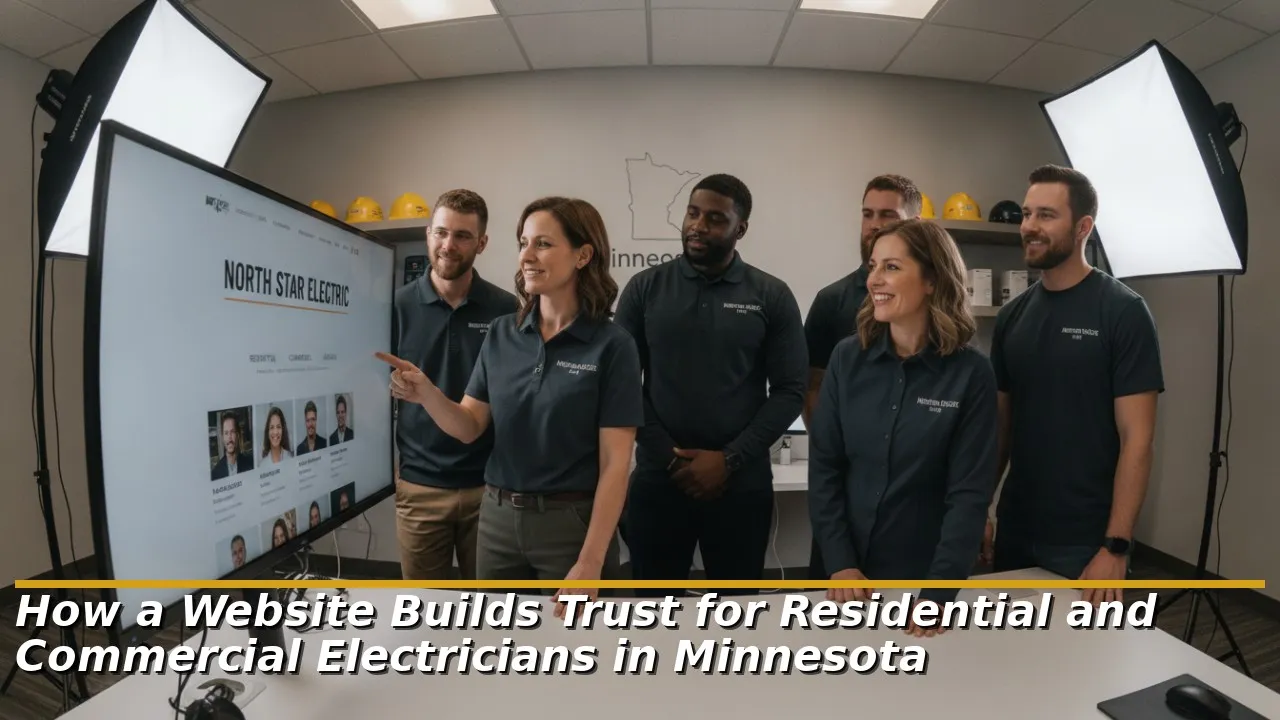
How a Website Builds Trust for Electricians in Minnesota: A facility manager at a Minneapolis commercial building is vetting two electricians for a panel upgrade. Both are licensed and carry adequate insurance. She opens their websites. The first includes real photos of the team in uniform, displays the firm’s DLI license number in the footer, lists a $1,000,000 liability policy, and has a downloadable maintenance checklist for commercial properties. The second loads to a homepage with a stock photo and contact form. She calls the first firm before taking her next sip of coffee.
That selection process now applies to residential homeowners too. Whether they are searching at midnight after a tripped breaker or a property manager is qualifying a contractor for a multi-site service agreement, decision-making happens online, and the website is what converts visibility into trust. For Minnesotan electricians serving both markets, the website must speak a different language to each, but it must speak both fluently.
Key Takeaways
- 90% of homeowners and facility managers search online to find an electrician before making contact
- 54% of consumers have chosen a more expensive contractor because that firm provided a better booking, communication, or documentation experience
- Faulty wiring causes approximately 51,000 residential fires annually, making safety credentials a primary conversion driver
- Displaying a DLI license number and proof of liability coverage is a baseline requirement for commercial client vetting
- Detailed, service-specific reviews are 6x more valuable for AI search visibility than generic star ratings
 Related article
Website Features Every Electrical Contractor Needs to Increase Conversions
Ranking in the Map Pack is only the first step. Once a potential customer clicks, your website must quickly build trust and make contacting you effortless. Fast load times, prominent phone numbers, visible reviews, and clear service information can determine whether a visitor becomes a lead. Since most homeowners choose an electrician within seconds of landing on a site, the right website features often make the difference between a full schedule and missed opportunities.
1. Why Electrical Work Demands a Higher Level of Trust
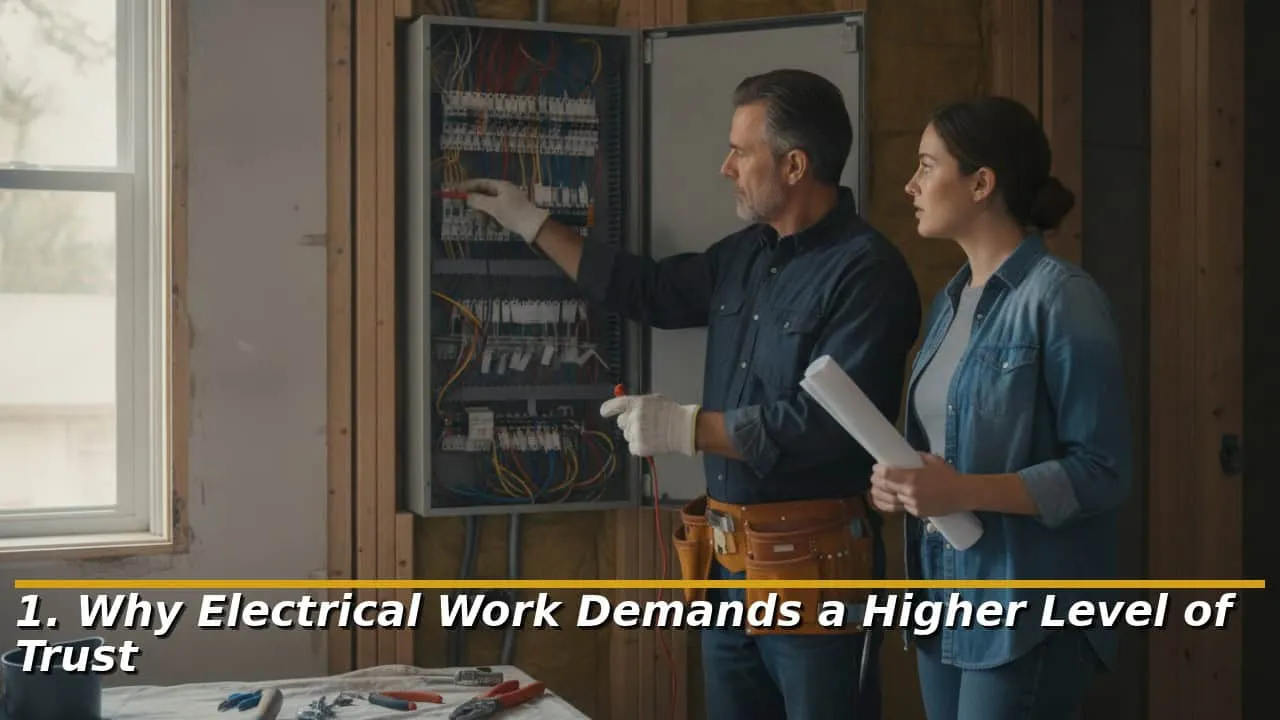
Most home services carry some risk. Electrical work pertains to a category of risk most others do not: the consequences of a mistake are invisible until they are catastrophic. Customers cannot look at a completed panel upgrade and verify it was done correctly. A facility manager is unable to assess from the invoice whether the wiring in a data center conduit meets NFPA 70B standards. They must take the contractor’s word for it.
This dependency on professional authority is what makes the website so consequential for electricians. Faulty wiring causes approximately 51,000 residential fires annually in the U.S. Homeowners know this, even if they cannot articulate it. When they search for an electrician, their underlying question is not “who can do this job?” It is “who can I trust not to put my family at risk?” Digital presences answering that question directly, through credentials, real team photos, and transparent process descriptions, converts at a fundamentally different rate than one that does not.
Research concluded that 54% of consumers have chosen a more expensive contractor specifically because that firm offered a better booking, communication, or documentation experience, paying an average of 15% above the lowest quote for that perceived reliability. For electricians, professional digital presentation is not a marketing nicety. It is the mechanism that supports premium pricing and reduces price-driven competition.
 Related article
Minnesota Electricians Capture More Panel Upgrade, EV Charger, and Generator Leads!
Minnesota homeowners are no longer calling an electrician simply to swap a fixture. Instead, North Star State residents are modernizing aging infrastructure to support electric vehicles, whole-home backup power, and higher-amp service panels. Each of those projects represents thousands of dollars in high-margin electrical contractor work, and every project begins with an online search. This […]
2. Residential vs. Commercial: Two Audiences, Two Trust Frameworks

The trust signals converting a residential homeowner are not the same ones that win a commercial contract. Well-structured electrician websites adhere to both, but in different sections and with tailored evidence.
| Audience | Primary Fear | Trust Signals That Resolve It |
|---|---|---|
| Residential homeowner | Safety risk to family and property | DLI license number, real team photos, safety process page, detailed reviews |
| Commercial facility manager | Liability and code compliance | $1M+ liability coverage, NFPA 70B familiarity, NECA membership, technical checklists |
| Emergency caller (both) | Immediate, unresolvable problem | Sticky click-to-call, 24/7 badge, response time statement, open status on GBP |
For residential clients, the most powerful trust signals are human: photos of the actual crew, named technicians with images and credentials, and reviews describing specific jobs in recognizable neighborhoods. Someone planning a knob-and-tube replacement in their 1950s Minneapolis home wants to see that you have done that exact job before, in a house like theirs, and that the client was satisfied enough to describe it specifically.
For commercial clients, the trust framework shifts toward documentation and specialization. Property managers and facility directors need to see proof of liability coverage ($1,000,000 minimum is a common procurement threshold), NECA membership or equivalent, and evidence of experience with the specific systems in their building. A page outlining your firm’s approach to preventive maintenance programs, power quality analysis, or thermal imaging inspections signals technical depth that generic, “we handle commercial too” copy cannot match.
 Related article
Why Every Electrician Needs a Professional Website to Capture “Electrician Near Me” Searches in Minnesota
The electrical contracting industry in Minnesota has evolved into a digital first battlefield. Traditional word of mouth is now overshadowed by a complex journey starting with a search engine. The “electrician near me” query is the modern homeowner’s first move during a winter power outage or a home renovation. For in-state contractors, professional websites have […]
3. The 5 Trust Signals Every Minnesota Electrician Website Needs

- DLI license number, visible in the footer and on every service page: Your Minnesota Class A Master or Journeyworker license number, such as EA002700, is a verifiable credential that homeowners can check against the DLI registry. Displaying it acts as a trust signal and differentiator from unlicensed competitors. For commercial clients, it is often a procurement requirement before a quote is considered.
- Real team photography and named technicians: Stock photos of generic workers are immediately recognizable as inauthentic and actively reduce trust. Real photos of your crew in branded uniforms, service vehicles, and completed job sites build the human connection that closes the gap between digital stranger and trusted professional. Named technician profiles with credentials and tenure extend that trust further.
- Substance-rich reviews with service and location specificity: A review that reads “They replaced the knob-and-tube wiring in our 1948 Edina home over two days, passed inspection on the first try, and the crew was meticulous about protecting our floors” is far more persuasive than a hundred generic five-star ratings. Detailed reviews mentioning specific services and neighborhoods are 6 times more valuable for AI search visibility, according to local SEO research, and are exponentially more persuasive to a homeowner researching the same type of job.
- Transparent pricing context and service guarantees: Most electricians are reluctant to publish pricing. The ones who provide starting ranges and cost guides for common jobs, such as EV charger installation typically ranging from $800 to $2,000 in the Twin Cities market, consistently see higher conversion rates because they set realistic expectations before the first call. Listing a workmanship guarantee and a clear policy on permits and inspections signals operational accountability.
- Answer-first content structured for AI extraction: AI platforms like ChatGPT and Google Gemini use your website content to generate local recommendations. Each service page should open with a direct 120 to 150-word response to the most common homeowner or facility manager question on that topic. FAQ Page schema markup makes those answers eligible for standalone AI citations, which convert at 14.2%, five times higher than traditional organic traffic, according to local SEO research.
 Related article
The Minnesota Small Business Website Checklist for 2026 (SEO + Conversions + Accessibility)
The digital landscape of this year for small businesses in Minnesota is more competitive and regulated than ever before. With state GDP growth currently at 1.6 percent (ranking 40th in the nation) and the highest corporate tax rate in the country at 9.8 percent, Minnesota business owners must ensure their digital presence is an efficient […]
4. How Technical Performance Signals Operational Reliability
A website that loads slowly does not only frustrate visitors. It tells them something about how the contractor operates. The subconscious inference is direct as businesses that cannot manage their digital systems are probably uninspiring at managing a complex wiring job or a commercial maintenance schedule.
Research consistently shows that a one-second delay in mobile load time produces a 20% drop in conversions. For emergency electrical searches, where a homeowner is already stressed and operating on a compressed timeline, dropping is more common. The standard for a high-converting electrical website in a competitive Minnesota market is a mobile load time under 2.0 seconds, a sticky click-to-call header visible without scrolling, and a clean layout guiding the eye from the trust signals to the phone number without requiring three clicks.
For commercial clients, technical performance extends to the content itself. A downloadable PDF maintenance checklist, a clear service agreement overview, and structured descriptions of specialized capabilities signal that the firm operates with systems, which is exactly what a property manager overseeing multiple buildings needs to believe before awarding a contract.
 Related article
How Your Contractor Website Should Prepare for Minnesota’s Spring Search Surge: A Seasonal SEO Checklist
Minnesota’s construction season is compressed into roughly six months, meaning the digital competition for spring projects is heavily front-loaded. By the time the ground thaws in April, the most in-demand contractors are already booked. Homeowners who fill those schedules started their search in February, and the contractors who captured them had websites that were optimized […]
5. Two Electricians, Same License, Different Websites
Both hold current Minnesota DLI licenses and serve the greater Twin Cities area. Each has comparable rates and crew sizes.
- Electrician A has a 2019 website with stock photos, no license number displayed, eight undetailed reviews, and a five-second mobile load time. Residential leads arrive skeptical and price-sensitive. Commercial inquiries rarely progress past the quote stage because the website does not demonstrate adequate liability coverage or commercial experience. Conversion rate: 1.8%. Cost per lead: $78 through aggregators.
- Electrician B rebuilt around trust architecture. Real crew photos. DLI license and $1,000,000 liability badge in the footer. Sixty-two reviews averaging 4.9 stars, most mentioning specific services and suburbs. A separate commercial page with a downloadable maintenance checklist and NECA membership logo. Mobile load time: 1.7 seconds. Residential readers are pre-convinced. Commercial inquiries arrive with specific technical questions rather than price challenges. Conversion rate: 4.3%. Cost per lead: $41.
The license is the same. The trust the website builds is not.
Conclusion
For electricians in the North Star State serving both residential and commercial clients, the website is the primary mechanism for earning trust before a conversation begins. Homeowners make safety-driven decisions. Facility managers make documentation-driven decisions. Websites addressing both through real credentials, authentic photography, service-specific social proof, and clear commercial capability, wins jobs from both markets at premium rates.
Every trust signal added, every review collected, and every service page structured for AI extraction compounds into a digital presence that generates qualified, exclusive leads around the clock. The electricians filling their schedules in the most competitive Minnesota markets are not necessarily the most talented. They are the ones homeowners and property managers trust before they even pick up the phone.
Does your website earn trust before the phone rings?
Open your website right now and ask three questions: Is your DLI license number visible without scrolling? Do your photos show your actual team or stock imagery? Does your most important service page open with a direct answer to the question a homeowner would ask? If any answer is no, that gap is costing you both residential and commercial electrician leads. Start with the license number and one real photo this week. Those two changes take less than an hour and immediately move the needle on trust. To start in the right direction, call our Minnesota website designers today at (612) 590.8080.
FAQs About How a Website Builds Trust for Residential and Commercial Electricians in Minnesota
1. Do electricians need a website if their Google Business Profile already generates calls?
Yes, and the reason is more urgent than many realize. Your GBP generates Map Pack visibility and initial clicks. Your website is what AI platforms like ChatGPT and Google Gemini use as their primary source for local citations. Without a structured website containing service-specific pages and FAQ Page schema, business is invisible to AI-driven search recommendations. Beyond AI search, 88% of consumers use the website as a verification tool after finding a business on the map, according to local search research. A GBP without a credible website behind it loses those verification visits.
2. What is the minimum a new electrical business needs on its website to build trust?
Four elements are non-negotiable from day one: your DLI license number displayed visibly, a phone number formatted as a tappable button in the header, at least one real photo of the technician or vehicle (not stock imagery), and a clear statement of service area naming specific suburbs. Beyond those, prioritize collecting your first 10 Google reviews quickly. Research confirms that crossing the 10-review threshold produces a measurable local ranking lift. After, include a dedicated page for each core service and a process page explaining what happens from the first call through permit sign-off.
3. How do you build trust for commercial electrical clients specifically?
Commercial clients vet differently than residential homeowners. They are looking for liability coverage documentation, evidence of experience with specific systems (NFPA 70B compliance, power quality analysis, thermal imaging), and references from comparable facilities. A dedicated commercial services page answering these specifically, listing your liability policy amount, NECA membership or equivalent, and the types of facilities you have served, satisfies procurement checklists before the first meeting. Downloadable assets such as a preventive maintenance checklist or a service agreement overview signal that your firm operates with the documentation standards commercial clients expect.
4. How important are reviews for electrical service trust, and how should they be collected?
Reviews are among the most consequential trust signals an electrician can build, for both human visitors and AI search platforms. Detailed, service-specific reviews carry 6 times greater AI visibility value than generic star ratings. The collection strategy matters: prompt every completed client by name, reference the specific job, and ask them to describe what was done, where, and what made the experience worth recommending. A review describing, “aluminum wiring remediation in a 1962 Plymouth ranch home” does more for trust and local rankings than countless vague endorsements. Aim for a consistent cadence of 10 to 20 new reviews per month rather than a one-time push.
5. Can a website help Minnesota electricians win knob-and-tube and older home rewiring jobs?
Directly. Older Minneapolis and St. Paul homes built before the 1940s commonly contain knob-and-tube wiring, which lacks a grounding conductor and poses a significant fire risk. Homeowners in these properties are highly motivated to act but also anxious about the scope and cost of a full rewiring. A service page focused on knob-and-tube replacement, written in plain language, that explains the safety risk, the Minnesota inspection process, what a typical rewiring timeline looks like, and how financing works positions the contractor as the regional expert in that specific need. It also earns local search visibility for queries like “knob and tube rewiring Minneapolis” that competitors with generic websites are not capturing.