






Two electricians rank side by side in the Map Pack. A homeowner taps the first result. Their page loads in four seconds. The phone number is in the footer. There are no reviews visible above the fold. She hits the back button and taps the second result. That site manifests in 1.6 seconds. This phone number is in a sticky header. Five recent reviews describe specific jobs in her neighborhood. She calls.
Getting into the Map Pack earns you a click. What your website does with that click determines whether you get the job. According to Proweb365’s electrician research, 90% of homeowners search online to find an electrician, and the decision to call is made within seconds of landing on a page. The features your website has, or lacks, are the variables defining which electrician fills their schedule and which one wonders where the calls went.
Key Takeaways
- 73% of electrical service searches happen on smartphones: mobile load time and click-to-call are the two features that matter most
- 53% of mobile users abandon a page that takes more than 3 seconds to load, making sub-2-second performance a revenue requirement
- A single dominant CTA consistently outperforms pages with multiple competing buttons in home service conversion research
- AI search platforms use structured website content for the majority of their local citations, making schema markup essential
- Websites with 50 or more detailed reviews boost conversion rates by 4.6%, compounding the value of every review collected
 Related article
Why Every Electrician Needs a Professional Website to Capture “Electrician Near Me” Searches in Minnesota
The electrical contracting industry in Minnesota has evolved into a digital first battlefield. Traditional word of mouth is now overshadowed by a complex journey starting with a search engine. The “electrician near me” query is the modern homeowner’s first move during a winter power outage or a home renovation. For in-state contractors, professional websites have […]
1. Why Most Electrical Contractor Websites Fail to Convert
The most common cause of low conversion on an electrical website is not poor design, but poor prioritization. Cluttered homepages listing 15 services with equal prominence creates decision paralysis. Research on Hick’s Law in home service marketing found that decision time increases logarithmically with the number of choices. A homeowner in a crisis or under time pressure defaults to the simplest available option: the competitor whose site made the path to a phone call obvious.
The second most common cause is speed. Even a one-second delay in mobile load time reduces conversions by 20%, according to HubSpot research. For an electrician whose average job ticket runs $300 to $1,500, each lost visit carries measurable revenue consequences. The features listed below address both problems by friction on the path to contact and increasing homeowner confidence that calling is the right decision.
 Related article
Minnesota Electricians Capture More Panel Upgrade, EV Charger, and Generator Leads!
Minnesota homeowners are no longer calling an electrician simply to swap a fixture. Instead, North Star State residents are modernizing aging infrastructure to support electric vehicles, whole-home backup power, and higher-amp service panels. Each of those projects represents thousands of dollars in high-margin electrical contractor work, and every project begins with an online search. This […]
2. The 8 Features That Drive Electrical Contractor Conversions

A. Sub-2-second mobile load time. This is the non-negotiable foundation. Target a Largest Contentful Paint (LCP) under 2 seconds on mobile. Achieve through compressed images in WebP format, a content delivery network, and a caching plugin such as WP Rocket. Sites loading instantly signal readiness before a word is read. One that lags at 4 seconds signals the opposite.
B. Persistent click-to-call button in a sticky header. On mobile, the phone number must be a tappable button following the user as they scroll, not a number buried in the footer. This is the single highest-impact conversion feature for emergency electrical searches, where someone with a tripped breaker or a burning outlet needs one tap between their problem and your phone.
C. Dedicated service pages for each high-value job type. One generic Services page cannot rank for, “EV charger installation Maple Grove” and “emergency panel upgrade Burnsville” simultaneously. Each major service needs its own page with local keywords, specific CTA (call to action), and LocalBusiness and Service schema markup. AI platforms leverage these structured pages for the majority of their local business citations.
D. A single dominant CTA per page. When visitors are presented with five competing buttons, Hick’s Law predicts many will choose none. Each page should have one primary call to action, worded matching the visitor’s intent. Those who arrived via an emergency search should see “Call Now for Emergency Service” not a generic “Contact Us.” Keyword-matched CTAs boost conversions by up to 87%, according to Cube Creative’s home services research.
E. License number, insurance badge, and real team photos above the fold. Your state license number and liability coverage should be visible without scrolling on every key page. Genuine photos of the actual crew, branded vehicles, and completed job sites convert significantly better than stock imagery. These three elements answer the reader’s foundational question before they ask it: can I trust this person in my home?
 Related article
Home Improvement Contractor Website Structure: Pages That Rank and Convert Local Homeowners
The way homeowners find contractors online is changing rapidly. For years, the goal of a construction company was simple: show up on the first page of Google. But today, we are in the thick of the era of AI search. People are no longer just sorting through a list of links. They are asking smart […]
F. Live review feed with service-specific descriptions. A live feed of Google reviews, showing recent feedback that mentions specific services and neighborhoods, provides real-time social proof. Websites with 50 or more detailed reviews show a 4.6% conversion rate boost. Prompt every client to mention the service type and their suburb as those details carry six times greater AI search visibility value than generic five-star ratings.
G. Answer-first FAQ sections with FAQPage schema markup. Structure FAQ sections with natural-language question headings like,“How much does a panel upgrade cost in Minneapolis?” and concise 120 to 150-word answers. FAQPage schema makes those answers eligible for AI citations from ChatGPT and Google Gemini, which convert at 14.2%, five times higher than traditional organic traffic.
H. Online booking or after-hours contact capture. Most electrical emergencies and project inquiries happen outside business hours. An online scheduling tool or a simple “Request a Callback” form with three fields captures those leads before a competitor answers the phone in the morning. Make sure the form only has three or four fields as every additional field reduces submission rate.
| Feature | Problem It Solves | Measurable Impact |
|---|---|---|
| Sub-2-sec mobile load | Panic-driven abandonment | 20% conversion loss per extra second |
| Sticky click-to-call | Buried contact info | Highest-impact emergency feature |
| Dedicated service pages | Generic ranking, low relevance | AI citation eligibility per service |
| Single dominant CTA | Decision paralysis | Up to 87% conversion boost (Cube Creative) |
| License + real photos | Trust gap before first call | Outperforms stock imagery on all trust metrics |
| Live review feed | Missing social proof | +4.6% conversion at 50+ detailed reviews |
| FAQ schema markup | AI search invisibility | 14.2% AI lead conversion rate |
| After-hours booking | Lost off-peak inquiries | Captures leads competitors miss overnight |
 Related article
What Homeowners Look for on a Home Builder’s Website Before Requesting a Quote
Homeowners preparing to invest four to six figures in new construction no longer rely on a single referral. They research. Before picking up the phone, most will spend ample time scouring a builder’s website looking for specific signals of competence, legitimacy, and trustworthiness. A polished homepage is the bare minimum. Big-game homeowners most worth winning […]
3. How These Features Work as a System
Each feature listed above solves a specific problem. But their real power is compounding. Clients locating a fast-loading site with a visible phone number, reads a review mentioning their neighborhood, confirms the DLI license number in the footer, and gets an immediate answer to their cost question via an FAQ section that has moved through most of the trust-building journey before initial contact.
That progression, from panicked visitor to confident caller, is the conversion architecture. SEO gets the homeowner to your site. These features determine whether they stay long enough to call. Local SEO and website optimization are not parallel strategies. They are sequential: one delivers traffic, the other converts it.
4. Same Market, Different Features, Different Results
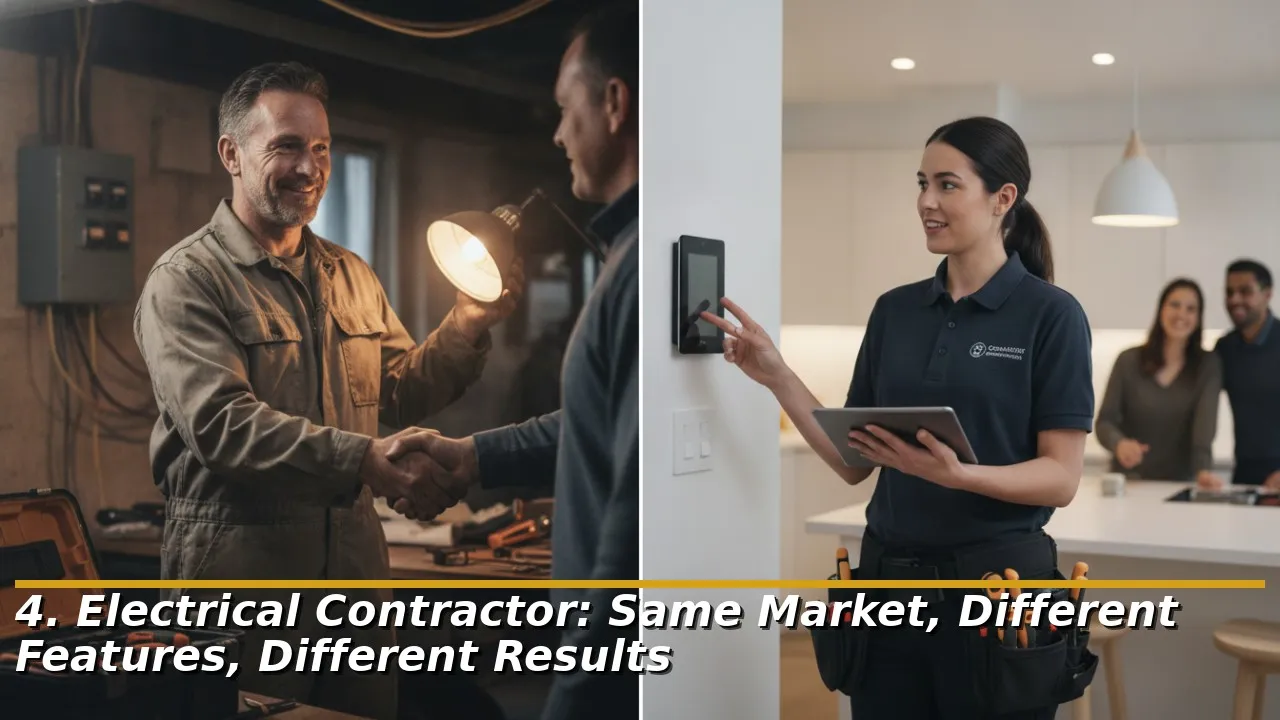
Both firms serve overlapping suburbs in a competitive metro market. Both hold current licenses and carry adequate insurance.
Electrician A’s site was built several years ago. It loads in 4.5 seconds on mobile. The phone number is in the footer. There are no reviews displayed. Service descriptions are combined on a single page. Conversion rate: 1.8%. Lead acquisition cost through aggregators: $78.
Electrician B implemented all eight features. Mobile load time: 1.7 seconds. Sticky click-to-call header. Sixty-three reviews displayed live, most with service and suburb details. Dedicated pages for every core service and suburb. A single above-the-fold CTA per page. FAQ sections with schema markup. Conversion rate: 4.3%. Organic lead cost: $41.
The same traffic, routed to two different websites, produces two completely different businesses.
| Metric | Electrician A | Electrician B |
|---|---|---|
| Mobile load time | 4.5 seconds | 1.7 seconds |
| Phone number | Footer only | Sticky header, tappable |
| Reviews displayed | None | 63 live, service-specific |
| Conversion rate | 1.8% | 4.3% |
| Cost per lead | $78 (aggregator) | $41 (organic) |
Conclusion
An electrical contractor’s website is not a digital brochure. This is the conversion engine that determines what percentage of your traffic becomes revenue. The eight features in this article address every stage of that conversion: the load speed that keeps visitors on the page, click-to-call button eliminating friction from the emergency call, trust signals closing the gap between digital stranger and hired professional, and schema markup earning AI search citations.
None of these features are technically complex or prohibitively expensive. All are measurable. Start with a PageSpeed Insights audit and a review of your homepage on mobile. What you find in those two tests will tell you exactly which features to prioritize first.
Audit your website against this checklist today.
Open your site on your phone right now. Time how long it takes to load. Find your phone number. Count the taps it takes to reach it. Check whether a review is visible without scrolling. Those three tests take under two minutes and will show you precisely which of the eight features your site is missing. Fix the load time and the sticky header first. Those two changes alone will move your conversion rate within 30 days.
 Related article
How Local SEO for Electricians Increases Service Calls and Emergency Leads in Minnesota
How Local SEO for Electricians Increases Service Calls and Emergency Leads in Minnesota: A homeowner in Edina smells something burning near her breaker panel at 11 p.m. She grabs her phone and types “emergency electrician near me.” Three names appear in the Map Pack. The first one that looks professional is dialed and they answer […]
FAQs About Website Features Every Electrical Contractor Needs to Increase Conversions
1. What is the single most important website feature for an electrical contractor?
Mobile load time, because it determines whether the homeowner stays long enough to see any other feature. With 73% of electrical service searches happening on smartphones, a site loading in over three seconds loses the majority of its highest-intent visitors before a single word renders. Target under 2 seconds. Achieve through image compression to WebP format, a caching plugin, and a reliable CDN. Every other feature on this list is irrelevant if the page does not load fast enough for a stressed homeowner to see it.
2. How much does a professional electrician website typically cost?
A basic DIY template starts around $500 but delivers limited conversion optimization and no local SEO architecture. A custom-built, conversion-focused site from a contractor-specialist agency typically runs $5,000 to $15,000, depending on the number of service and suburb pages required. The more relevant benchmark is cost per lead as a well-optimized $10,000 website generating organic leads at $15 each pays for itself in its first month at any reasonable call volume. Compared to aggregator platforms charging $40 to $125 per shared lead, fortune favors the website investment within six months for most firms.
3. Do these features matter differently for emergency calls versus planned project leads?
Yes, and understanding the difference shapes where you prioritize. Emergency visitors, dealing with a tripped breaker or a burning outlet at 11 p.m., need the phone number in one tap and nothing else in the way. For them, the sticky click-to-call button, the 24/7 availability badge, and load speed are the only variables that matter. Planned project visitors, researching an EV charger installation or a whole-home rewire, spend 2.5 hours comparing options. For them, the review feed, dedicated service pages, FAQ schema, and transparent pricing context do the heavy lifting. High-converting websites are designed with both paths in mind, routing each visitor type to the evidence they need without friction.
4. How often does website content need to be updated to stay competitive?
For local search rankings, freshness signals hold greater value than most electricians realize. Uploading new job photos to your Google Business Profile weekly and adding new reviews consistently tells Google that the business is active. For website content, updating your most important service pages when pricing, service offerings, or local market conditions change is more valuable than publishing generic blog posts on a schedule. The highest-priority update cadence: new review content continuously, GBP photos weekly, service page content reviewed quarterly, and suburb-specific pages added as you expand your service area.
5. Can these features help electricians appear in AI search results from ChatGPT and Google Gemini?
Directly. AI platforms generate local business recommendations from three sources: your Google Business Profile data, the text content of your customer reviews, and the structured data on your website. FAQPage schema markup and LocalBusiness schema are the specific technical features making your website eligible for AI citations. Answer-first FAQ sections with natural-language question headings give AI engines the extractable content they need to recommend you by name. Contractors implementing this structure consistently see increased citation frequency in AI search results, which convert at 14.2%, five times higher than traditional organic traffic.