





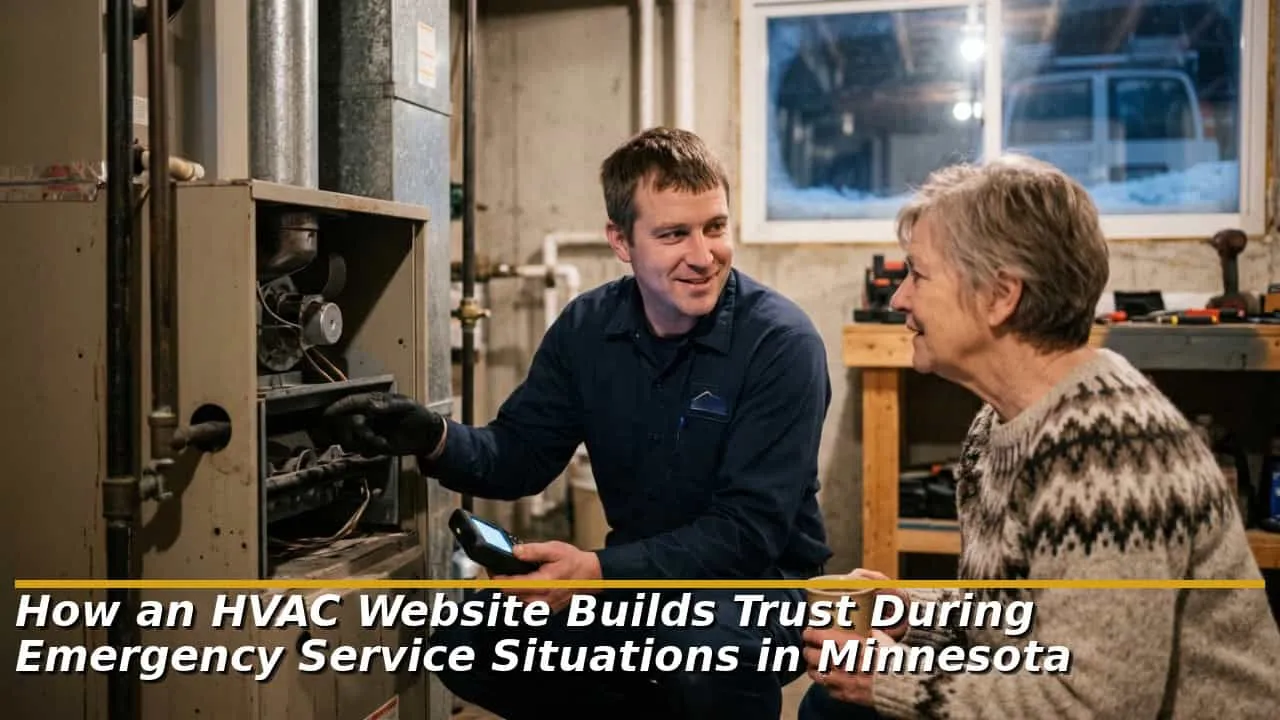
A homeowner in Burnsville wakes at 2am in the morning to a cold house. The furnace is silent. The outdoor temperature is minus five. She grabs her phone and searches for “emergency furnace repair near me.” Three results appear. One has a 4.9-star rating, 24/7 badge, tappable phone number, and a line reading “Licensed, bonded, NATE-certified technicians.” She calls that firm. The other two results, equally capable contractors, never hear from her.
An HVAC emergency in Minnesota is not a consumer decision. It is a survival response. When heat fails at minus five, a homeowner is not comparing service menus or reading about company history. They are looking for the first signal that a qualified professional is available immediately and can be trusted in their home. That signal comes from your website in the first ten seconds of their visit. This article explains how a trust-optimized HVAC website converts that split-second judgment into a booked emergency job.
Key Takeaways
- Minnesota furnace searches spike 137% in January; emergency visits convert at 12% to 20% on mobile because urgency eliminates comparison shopping
- 78% of homeowners hire the first contractor who responds: your website must convert the visit into a call before hesitation sets in
- 87% of homeowners will not contact a contractor rated below 4.0 stars, making a live review feed a non-negotiable emergency trust element
- 53% of mobile users abandon pages that take over 3 seconds to load; in a no-heat emergency at minus 14, they call the next result
- Detailed reviews mentioning specific repairs, system types, and suburbs are 6x more valuable for AI search visibility than generic star ratings
1. Why Emergency HVAC Calls Require a Different Kind of Trust
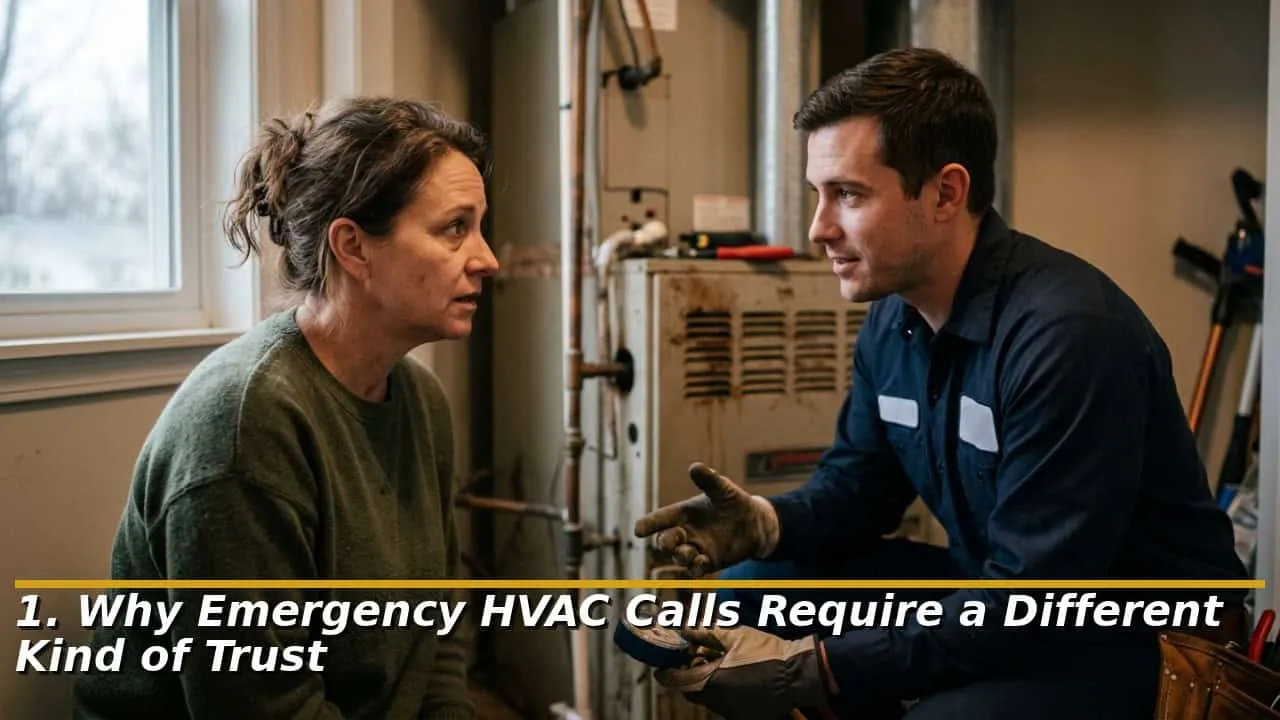
Every home service call involves some degree of trust because a homeowner is letting a stranger into their property. But an HVAC emergency in a Minnesota winter adds a layer of urgency that compresses the trust-evaluation window from hours to seconds. When heat fails at 2 AM in January, someone cannot afford to spend 45 minutes frantically researching five contractors. They make a decision based on whatever credibility signals are visible in the first few seconds of landing on a page.
Psychologists describe this state as a perceived loss of agency: the home, which is meant to be predictable and safe, has become a threat to the family’s comfort and safety. Under that stress, their decision-making shifts from rational comparison toward instinctive pattern recognition. A website that loads instantly, shows a 24/7 badge before any scrolling, and displays a tappable phone number triggers the pattern: “This is a professional who is ready and available.” One doing the opposite gives off the wrong message.
That pattern judgment happens within 50 milliseconds of landing on the page. Everything your website communicates before the homeowner takes a deliberate action is doing trust work, or failing to.
 Related article
HVAC Lead Generation Strategies: Turning Website Traffic into Installation Quotes and Tune-Up Bookings in the Age of AI Search
The landscape of digital marketing for contractors has reached a pivotal turning point. For the past decade, the goal was simple, rank in the blue links of Google. However, 2026 marks the definitive shift from traditional search to AI-powered discovery. Customers are no longer browsing lists of websites; they are receiving synthesized answers from AI […]
2. What a Stressed Homeowner Needs in the First Ten Seconds

| Trust Need | Website Element That Delivers It | What Happens Without It |
|---|---|---|
| I need help right now | 24/7 emergency badge in the hero section | Homeowner moves to the next result |
| I can reach you immediately | Sticky click-to-call button in the header | Homeowner cannot find the number under stress |
| You are nearby | Suburb name and service area in the hero | No location confidence; homeowner doubts response time |
| Other people trust you | Live review feed, 4.5+ stars visible above fold | 87% will not contact a sub-4.0 star business |
| You are qualified | DLI bond number, NATE badge, license info in footer | Homeowner cannot verify credentials before calling |
3. The 7 Trust Signals That Convert Emergency HVAC Visits
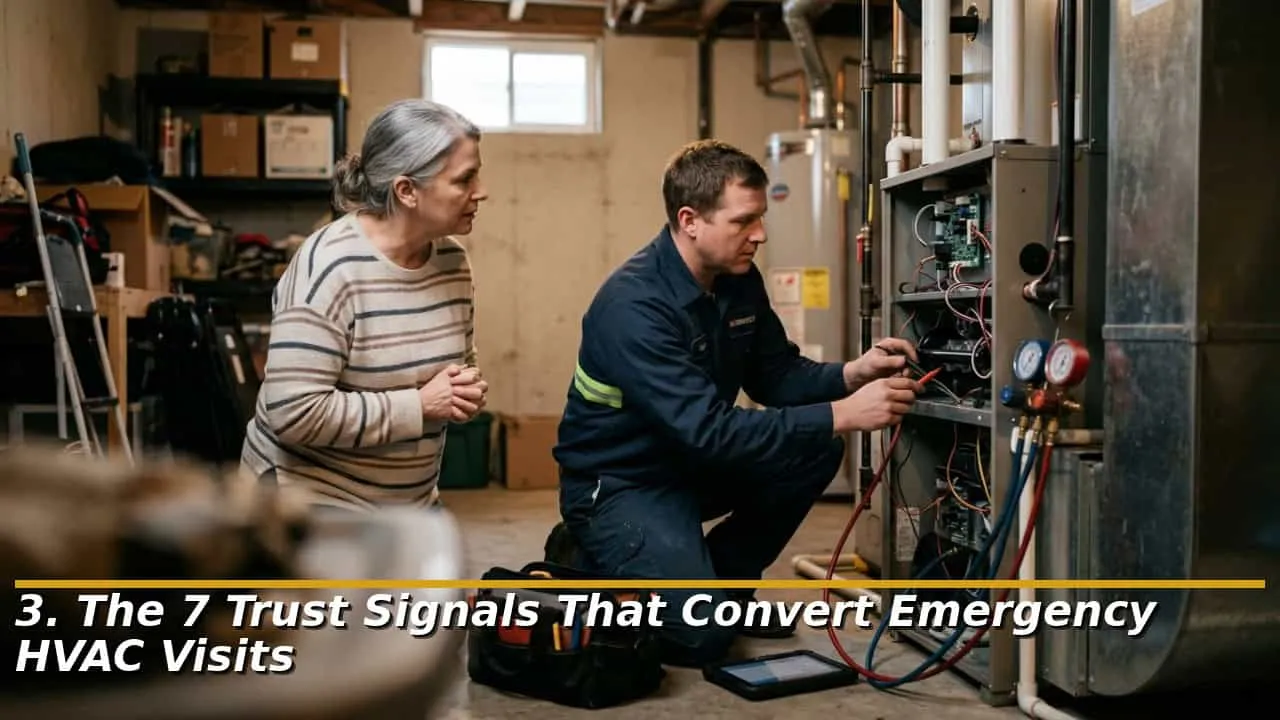
- Sub-2-second mobile load time: Speed is the first trust signal because it is processed before any content is read. A site loading in 1.5 seconds signals a business that is organized, operational, and ready. One taking 4 seconds signals the opposite. For emergency HVAC searches, where 73% of traffic arrives on smartphones during weather extremes, a one-second delay in load time drops conversions by 20%, according to HubSpot research on mobile performance.
- 24/7 emergency badge in the hero section (at the top of the page), before any scroll: This is the single most important content element for an emergency landing page. It removes the homeowner’s most immediate uncertainty: are you available right now? Place it in the hero section where it is visible on first load, not in a footer or sidebar.
- Sticky click-to-call header on mobile: The phone number must follow the visitor at every scroll position as a tappable button. A homeowner with a failed furnace around midnight will not navigate to a contact page or scroll to a footer. One tap from anywhere on the page is the standard.
- Live Google review feed with service and suburb specificity: Reviews describing specific system repairs and local neighborhoods carry 6 times more AI search visibility value than generic star ratings, and they carry proportionally more persuasive weight with emergency visitors. A review reading “emergency furnace repair in our Burnsville split-level, technician arrived in 90 minutes at midnight” converts a homeowner in the same suburb who found the site late at night in a way that a star average cannot.
- DLI mechanical bond number and NATE certification, visible in the footer and on the emergency page: The North Star State requires HVAC contractors to file a $25,000 Mechanical Contractor Bond with the Department of Labor and Industry (DLI). Displaying that bond number is a verifiable credential that distinguishes licensed professionals from unregistered operators. NATE certification, held by technicians who have passed rigorous knowledge and skills exams and recertify every two years, adds a third-party competency signal that 92% of homeowners say influences their decision to hire, according to a Home Comfort Survey cited by LennoxPros.
- Authentic team and fleet photography: Real photos of the actual technicians in branded uniforms, branded service vehicles, and real job sites in Minnesota neighborhoods eliminate the “stranger danger” barrier that stock photography cannot address. Clients decide early. whether to let a technician into their home respond to faces and recognizable local contexts.
- Transparent diagnostic fee, clearly stated: Stating the diagnostic or service call fee on the emergency page, including an $89 service call applied to any repair, removes the financial uncertainty that causes homeowners to hesitate before calling. It also pre-qualifies callers by setting accurate expectations before the first conversation. Contractors who publish this information convert at higher rates than those who require a call before disclosing any pricing.
 Related article
How Local SEO for HVAC Installers Drives Year-Round Lead Generation in Minnesota
Most Minnesota HVAC installers know the J’s are their busiest months: January for furnaces, July for air conditioning. What many do not know is that the homeowners filling their July schedule began researching in February, and the contractor who appeared first in those early searches is almost certainly the one who booked the job. By […]
4. How Conversion Architecture Guides the Emergency Visitor to a Call
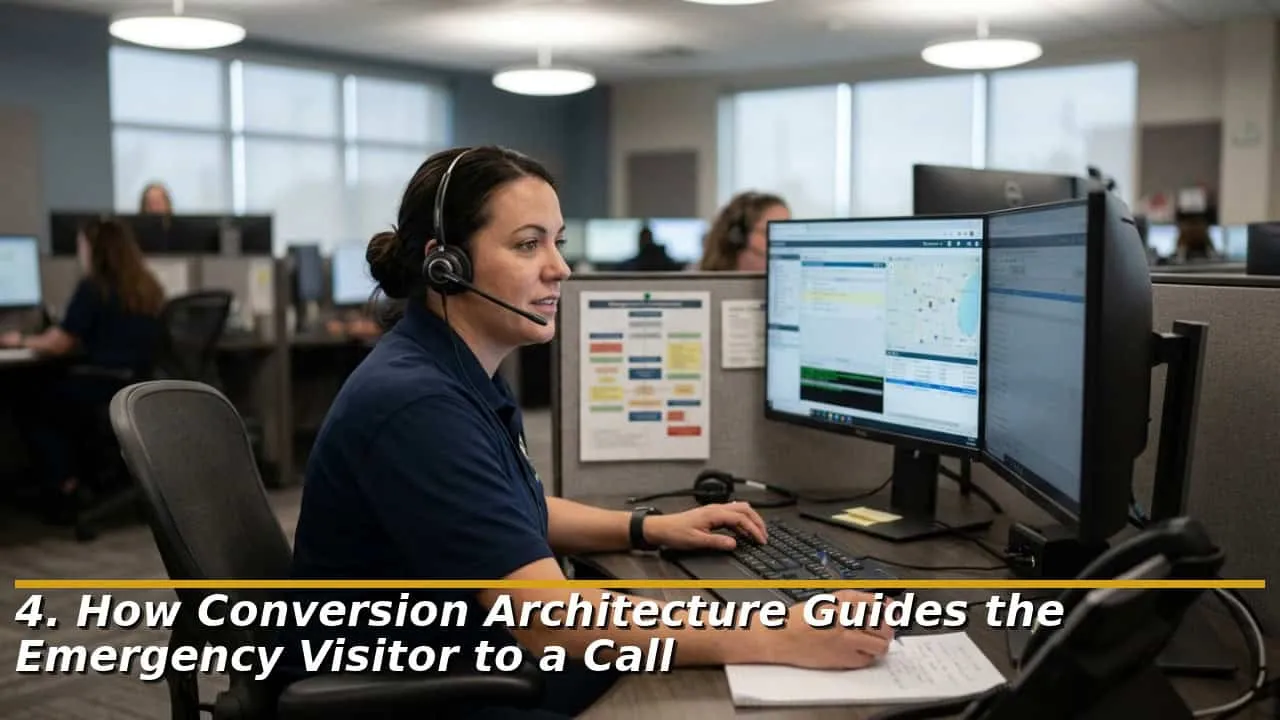
Trust signals earn attention. Conversion architecture directs it toward action. For emergency HVAC pages, the Z-Pattern layout is most effective as the eye moves from the logo at the top left across to the contact information at the top right, sweeps diagonally to the visual proof of expertise, and lands at the primary call-to-action button at the bottom right. This path is engineered to match the natural scanning behavior of a visitor in a hurry.
Color reinforces the journey. Blue in the site’s primary palette communicates stability and professionalism, calming the homeowner’s stress response. Sparingly implementing a red or high-contrast emergency call-to-action button for the primary “Call Now” action, signals urgency without amplifying anxiety. The combination, a calm and professional field interrupted by a single, clear call to action, consistently outperforms sites that use either color without the other, or that use high-contrast colors indiscriminately.
After-hours inquiries arriving through a contact form or chat widget should receive an automated SMS acknowledgment within minutes, confirming that the message was received and providing the emergency phone number again. Research on home service businesses concluded that response time is the single most influential variable in after-hours lead conversion: 78% of homeowners hire the first company that responds, and that pattern holds even when the response is an automated confirmation.
 Related article
How a Professional Website Helps HVAC Installers Promote Maintenance Plans
A homeowner in Woodbury dials an HVAC contractor in January because her furnace stopped working. The technician arrives, diagnoses a failed inducer motor, and completes the repair. Before leaving, he mentions a maintenance plan of two seasonal tune-ups per year, priority scheduling during peak season, and a discount on parts. The client is interested. Her […]
5. Two Contractors, Same Cold Snap, Different Outcomes

Both firms serve the same south metro suburbs. Both hold current DLI mechanical bonds and carry adequate insurance.
Contractor A has a 2019 website. Stock photos. Load time: 6 seconds. Phone number in the footer. Nine reviews with no service descriptions. No emergency badge. GBP hours show closed after 5 p.m. During the January furnace surge, they are invisible in the Map Pack for after-hours searches, and homeowners locating them through other channels land on a page that provides no immediate reassurance. Conversion rate: 1.8%. Cost per lead: $153 through aggregators.
Contractor B rebuilt around emergency trust architecture. Load time: 1.9 seconds. 24/7 emergency badge in the hero. Sticky click-to-call header. 65 reviews averaging 4.8 stars, most describing specific emergency jobs by system type and suburb. DLI bond number and NATE certification visible in the footer. GBP showing 24/7 availability. Transparent $89 diagnostic fee on the emergency page. Conversion rate: 4.3%. Organic lead cost: $74. Booked eleven emergency jobs in four days following a cold snap.
The qualifications are comparable. The digital trust architecture is not, and neither are the outcomes.
Conclusion
An HVAC emergency in a Minnesota winter does not provide a homeowner time to conduct thorough research. They make a trust judgment in seconds, based on what your website communicates before they scroll or click anything. Load speed signals readiness. The 24/7 badge answers the availability question. The review feed addresses the trust question. Their credentials answer the competence question. The tappable phone number completes the conversion.
Each of these trust signals requires a deliberate investment before a furnace fails. Contractors constructing this architecture before the first cold snap of the season capture the emergency calls that define their January revenue. Those who build it in February are already behind for that season, and the compound value of the reviews and rankings they missed does not recover in a single year.
Does your website earn trust in the first ten seconds?
Open your website on your phone right now as if you are a homeowner whose furnace just failed at 2 a.m. Is a 24/7 badge visible before you scroll? Is the phone number one tap away? Can you see a review describing an emergency repair in your top suburb? Those three questions identify the gaps costing you emergency calls tonight. Fix the emergency badge and the sticky header this week. Those two changes take under an hour and will move the needle before the next Minnesota cold snap. If you need a professional website design firm in Minnesota to help you establish this, please call (612) 59-8080.
 Related article
Why HVAC Contractors Need a Website to Compete in Local Search Results in Minnesota
It is January in the Twin Cities. The temperature drops to minus 18 overnight. At the crack of dawn, a homeowner in Maple Grove discovers her furnace has stopped working. She opens Google, types “furnace repair near me,” and sees three results in the Map Pack. The first shows a 4.8-star rating, a 24/7 badge, […]
FAQs About How an HVAC Website Builds Trust During Emergency Service Situations in Minnesota
1. What is Minnesota’s $25,000 Mechanical Contractor Bond, and why does displaying it build homeowner trust?
Minnesota does not issue a traditional state-level HVAC contractor license as it does for plumbers and electricians. Instead, HVAC businesses must file a $25,000 Mechanical Contractor Bond with the Minnesota Department of Labor and Industry (DLI) to legally perform HVACR work. This bond is a form of consumer protection because if the contractor causes damage or fails to complete work, the homeowner has a recourse mechanism.
Displaying the bond registration number on your website, particularly on emergency service pages and in the footer, showcases that your business is legally authorized to operate and financially accountable if something goes wrong. It is a verifiable credential, unlike a self-promotional claim, and it distinguishes a registered professional from an unregistered operator who cannot legally pull mechanical permits in Minnesota.
2. What is NATE certification, and how does it differ from being bonded with the DLI?
The DLI mechanical bond establishes that a contracting business is legally authorized to operate in the state. NATE certification, issued by North American Technician Excellence, establishes that individual technicians have demonstrated verified technical competence through rigorous knowledge and skills exams. To earn NATE certification, a technician must pass a core exam and at least one specialty exam covering areas such as gas heating, air conditioning, or heat pumps. Recertification is required every two years through continuing education or re-examination.
According to a Home Comfort Survey cited by LennoxPros, 92% of homeowners prefer to hire NATE-certified technicians. For customers making an emergency call at midnight, seeing both credentials on the same page, the legal authorization and the technical competence, answers both of their primary vetting questions simultaneously.
3. How does EPA Section 608 certification factor into HVAC contractor trust?
EPA Section 608 certification is a federally required credential for any HVAC technician who purchases, handles, or recovers refrigerants in the course of their work. The Clean Air Act prohibits technicians without this certification from performing refrigerant work on air conditioners, heat pumps, and refrigeration systems.
For those scheduling AC repairs or heat pump installations, confirming that technicians hold EPA 608 certification ensures that refrigerant handling will comply with environmental law and that the work will be performed correctly. Contractors who display EPA 608 compliance alongside their DLI bond number and NATE certification on their website close the full loop of credential verification for homeowners who conduct any level of due diligence before calling, even under emergency time pressure.
 Related article
Local SEO for HVAC Installers: Optimizing for AI Search and Seasonal Intent
The competitive landscape for the heating, ventilation, and air conditioning (HVAC) industry in this year is defined by a fundamental shift from traditional link-based search to AI-driven discovery. Homeowners no longer browse a list of results; they ask Large Language Models (LLMs) like ChatGPT, Gemini, and Perplexity for direct recommendations. For contractors, local SEO has […]
4. How should HVAC contractors handle after-hours emergency inquiries that arrive through the website rather than by phone?
Contact form submissions and chat widget messages that arrive after business hours represent leads that are easily lost to slower competitors. The most effective response protocol is an automated SMS sent within two to three minutes of form submission, confirming that an on-call technician will call back within a stated window, and including the emergency phone number again for homeowners who cannot wait.
Research on home service conversion consistently shows that response speed is the dominant variable in after-hours lead conversion as people who submitted a contact form and received a callback within five minutes converted at dramatically higher rates than those who waited until the next morning. An automated SMS acknowledgment keeps the lead warm and prevents the homeowner from calling a competitor in the gap between form submission and human callback.
5. What role do maintenance agreements play in building long-term digital trust beyond emergency visits?
Maintenance agreements, annual service contracts that cover scheduled tune-ups and priority emergency response, are both a revenue stream and a digital trust amplifier. A contractor whose website prominently features a maintenance plan with a named priority response guarantee signals to homeowners that the business is built for sustained customer relationships, not just transactional service calls.
Consumers who enroll in a maintenance plan are far more likely to leave detailed reviews after each service visit, providing a consistent flow of specific, service-level testimonials forming AI search visibility over time. They are also significantly more likely to call the same contractor when an emergency arises, because the relationship is already established. Featuring maintenance plans on the website, with transparent pricing and a clear description of what priority emergency access means in practice, attracts the segment of homeowners who want a contractor they can call without researching from scratch every time.