








A homeowner shortlists three kitchen remodeling contractors. All three come recommended by neighbors. Each holds a sound reputation in the community built over years of good work. She searches each one on her phone. The first has no website. Option #2 has a site that loads in five seconds and only shows stock photos. The last has a portfolio organized by project type, 94 reviews averaging 4.8 stars with detailed descriptions, a transparent process page, and real photos of the team who would be in her home. She calls the third contractor before finishing her coffee. The other two never know they were considered.
That moment of digital comparison now occurs before almost every significant remodeling contract is signed. According to Home Remodeler SEO’s research on contractor buyer behavior, homeowners no longer rely on referrals alone. A name from a neighbor is almost always followed by a Google search, review scan, and visit to the contractor’s website. What they find online determines whether they move forward or continue looking. For contractors in kitchens, bathrooms, additions, and whole-home renovations, the website is not a marketing tool. It is the first and most consequential impression the business makes.
This article breaks down exactly what homeowners look for during that research, which trust signals convert browsers into callers, and what separates a website able to build credibility from one that quietly loses jobs.
Key Takeaways
- 9 in 10 renovating homeowners hired professionals in 2024, making trust the primary differentiator in a crowded market
- Homeowners research 2.5 hours on average before contacting a remodeler, and that research happens almost entirely online
- Consistent website messaging, listings, and reviews work together as a trust system; inconsistency causes hesitation and lost leads
- Detailed reviews mentioning specific services and locations are 6x more valuable for AI search visibility than generic star ratings
- Contractors with strong online credibility can charge 10 to 30% more for identical work by reducing the homeowner’s perceived risk
1. The Trust Gap that Separates Winners from Finalists

Americans spent an estimated $603 billion on home remodeling projects in 2024, according to the National Association of Realtors and NARI’s 2025 Remodeling Impact Report. The same report found that 57% of NARI members observed larger project scopes over the past two years, and 42% experienced an increase in contracting projects. The market is growing, and homeowners are spending more per project. The opportunity is there.
The challenge is that the number of remodeling businesses has also grown, reaching 726,026 firms nationally according to Fixr’s 2025 market analysis, an 18.3% increase over five years. Oversaturated market, expansive projects, and a homeowner who researches more carefully than ever before: that combination makes digital credibility the primary competitive differentiator in most local markets.
When a homeowner is planning a kitchen remodel with a median spend of $22,000, or lavish kitchen renovation at $55,000 or more, they are not choosing the cheapest contractor. According to Houzz’s 2025 renovation study, 9 in 10 renovating homeowners hired professionals, and their selection process is increasingly thorough. They are choosing the contractor who makes a significant financial commitment feel safe. Websites communicating that safety, through evidence, transparency, and professional presentation, are the tool that wins those jobs.
 Related article
How Local SEO for Home Builders Attracts Ready-to-Hire Clients in Minnesota
Custom home builds in Minnesota are long-cycle, high-stakes decisions. Clients discovering a builder through a search in February may not break ground until May or later. But the person they hired was chosen at the beginning of the year. Local SEO is the system that determines whose name appears at that moment and whose portfolio earns the call. This article explains how in-state home builders can build that digital visibility before the spring planning surge and sustain it through every subsequent season…
2. How Homeowners Research Remodeling Contractors Today

Research that precedes a significant remodeling contract typically begins with a search and ends with a shortlist of two or three candidates whose websites successfully answered their unspoken questions. Home Remodeler SEO’s research on buyer behavior identifies a consistent pattern: map listings and local search results are the first exposure most homeowners have to a contractor’s brand, followed immediately by a site visit that either confirms or breaks the trust established by those first signals.
What clients look for during that digital visit is specific?
A) They want to know whether the person handles their type of project.
B) They want to see proof that similar work has been completed well.
C) They want to understand the process: how communication works, what the timeline looks like, what disruption to expect.
D) Lastly, they want to confirm that the contractor is legitimate, licensed, insured, and accountable.
Vague messaging, missing credentials, or a portfolio not speaking to their desired project type creates doubt that pushes them to the next contractor on the list.
Consistency across platforms has become a critical trust factor in its own right. When a contractor’s website, Google Business Profile, and reviews all align in their messaging and presentation, homeowner confidence increases. When they contradict, such as a professional website but outdated review responses, or a polished social media presence but a phone number that does not match the site, hesitation follows. For remodeling contractors, that hesitation is almost always fatal to the lead.
 Related article
Kitchen Remodeling Website Ideas: How to Showcase Projects, Styles, and Budgets to Pre-Qualify Leads
The way homeowners find kitchen remodelers has changed forever. For years, the key ingredient was showing up on a list of links on Google. But this year, people are using smart AI tools like ChatGPT, Gemini, and Perplexity to do their homework. Instead of clicking on ten different websites, they ask, “Who is the best […]
3. The 6 Trust Signals Every Remodeling Website Must Have
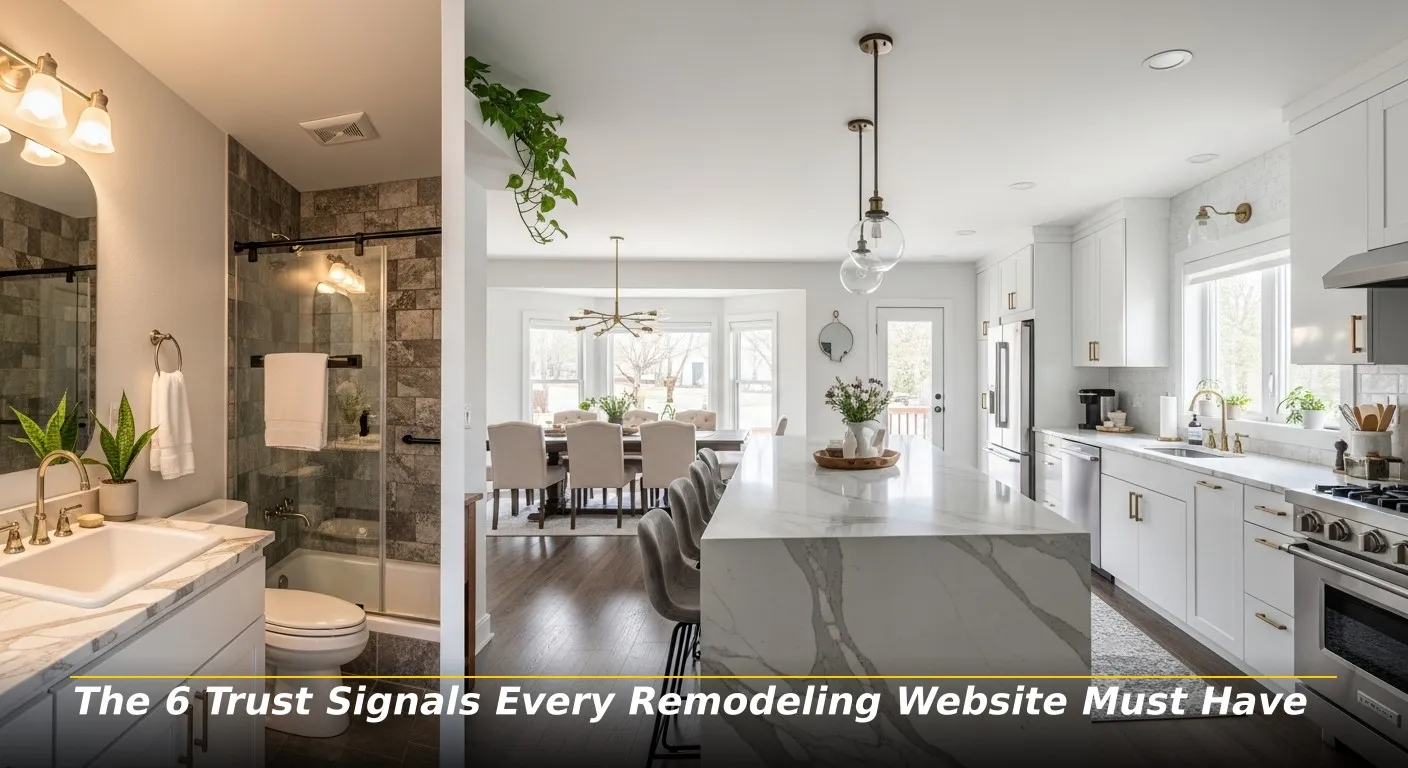
InnerSpark Creative’s 2025 construction and remodeling marketing benchmarks verify that trust-building content, specifically high-quality photos, case studies, FAQs, and transparent pricing context, consistently improves conversion rates for high-value renovation projects. These six elements are the specific trust signals that do that work.
- Project portfolio organized by outcome and style: Generic photo galleries sorted by date tell homeowners nothing useful. Organize by project type: modern kitchen remodel, farmhouse bathroom addition, basement finishing, open-plan conversion. Each entry should be read as a case study: the challenge the customer brought, approach taken, and result delivered. This structure addresses the homeowner’s core question before they ask it: have you done this specific thing before, and did it go well?
- Substance-rich reviews with service specificity: A review reading, “They managed our entire master suite addition in Edina, finished on the day promised, and communicated every change before it happened” is exponentially more persuasive to a high-value buyer than a hundred generic 5-star ratings. Detailed reviews mentioning specific services and locations are six times more valuable for AI search visibility than simple star counts. Prompt every completed client to describe what was done, where, and what distinguished the experience.
- Visible licenses, insurance, and industry credentials: State license numbers and insurance verification must be displayed in the footer of every page. Industry association logos, includingNARI, PHCC, NATE, or the Better Business Bureau, reinforce technical authority at a glance. These are not decorative. They answer the homeowner’s safety question, is it safe to let these people into my home, before they have to ask it.
- Real team photography and named staff: A homeowner spending $30,000 to $80,000 on a renovation wants to know who will actually be in their home. Named project managers and lead carpenters with real photos, specific qualifications, and tenure at the firm reduce anonymity surrounding substantial financial commitments feeling risky. Stock photos of generic workers in hard hats are immediately identifiable as inauthentic and actively damage the credibility they were designed to establish.
- Transparent process and timeline content: 93% percent of homeowners expect challenges during a renovation project and actively prioritize contractors demonstrating preparedness. A detailed “Our Process” page explaining how communication is handled, what happens when materials are delayed, and what a typical project timeline looks like does more to convert a high-valuead than any promotional copy. It answers the fears directly rather than hoping t lehey do not arise.
- Answer-first content structure for AI search: Notable AI platforms like Google AI Overview and ChatGPT handle a growing share of local remodeling queries. To earn citations, each service page needs to open with a direct 120 to 150-word answer to the most common homeowner question on that topic alongside supporting detail. FAQ sections with schema markup and natural-language headers, like,“How long does a full kitchen remodel take in Minneapolis?” rather than generic “Timeline” headings, provide AI engines the structured data necessary to recommend the contractor by name. AI search traffic converts at 14.2%, five times higher than traditional organic. This makes the structural investment high-priority for remodelers targeting large projects.
| Trust Signal | Homeowner Question Answered | AI Search Benefit |
|---|---|---|
| Portfolio by project type | Have you done this specific job well? | Structured project data for citations |
| Substance-rich reviews | Do real clients recommend you? | 6x more visibility than star ratings alone |
| Licenses and credentials | Is it safe to let you into my home? | Entity verification for local rankings |
| Real team photography | Who will actually be in my home? | Authentic E-E-A-T signals for Google |
| Process and timeline content | Are you prepared for what could go wrong? | FAQ schema captures conversational queries |
| Answer-first content | What does this project involve? | AI citation eligibility for high-value searches |
 Related article
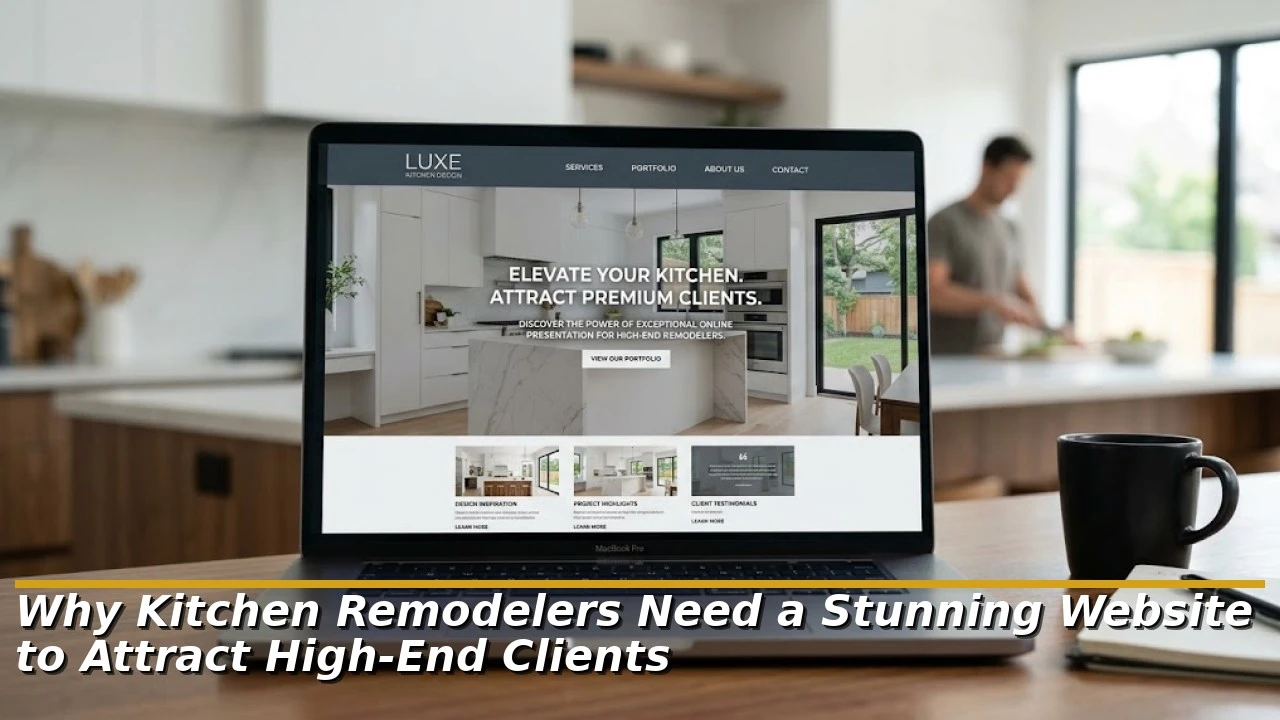
Why Kitchen Remodelers Need a Stunning Website to Attract High-End Clients
A homeowner is planning to fully renovate their kitchen. Budget: $80,000. She spends two hours reviewing five contractor websites before making the first call. Two sites use stock photos and lack pricing context. One loads slowly and shows a cluttered gallery with no project descriptions. The fourth has a polished layout, professional photography of real […]
4. How Design and Technical Performance Signal Reliability

First impressions on a contractor’s website are formed within 50 milliseconds, before a single word is read. The visual judgment the consumer makes in that moment, does this look organized, professional, and trustworthy, is a direct proxy for how they expect the physical work to be managed. Cluttered homepages, outdated designs, or a site that loads slowly all communicate the same thing: this business does not pay close attention to detail.
Technical performance is part of that first impression. Research from Site Builder Report found that 53% of mobile users abandon a site that takes more than 3 seconds to load. For someone evaluating a contractor for a $40,000 project, a slow site not only creates frustration. It signals that the business is not operating with current systems, raising doubts about whether they are operating with current construction practices.
The design standard for a high-converting remodeling website in a competitive market is a load time under 3 seconds on mobile, a clean layout guiding the eye from the value proposition to the portfolio to the call to action, and a sticky header with a click-to-call button that remains visible regardless of where the visitor is on the page. These are not stylistic choices. They are trust signals delivered through performance.
 Related article
Local SEO Drives Qualified Leads for Minnesota Kitchen Remodelers
A homeowner in Woodbury has been collecting kitchen inspiration on her phone since October. By February, she is ready to move from planning to hiring. Searching, “best kitchen remodeler near me” the top 3 results appear. One has a portfolio organized by project style, suburb-specific reviews, and a transparent cost guide. The other two show […]
5. Two Remodeling Websites, One Market, Different Outcomes
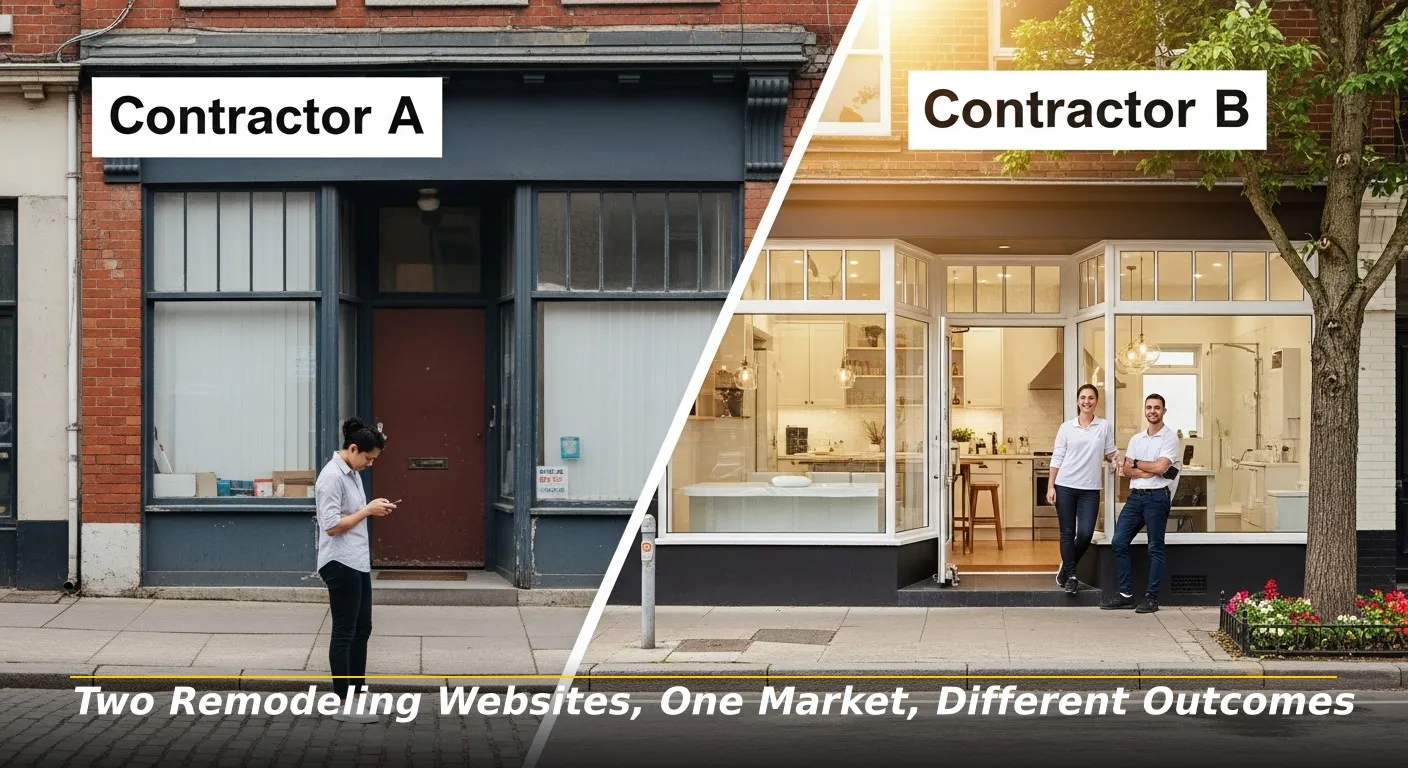
Both contractors operate in the same city, have comparable experience levels, and target kitchen and bathroom renovations in a similar price range.
- Contractor A built a website several years ago and has not updated it since. It features three stock photos, a brief service list, and a contact form. Missing are a portfolio, reviews displayed, pricing context, team information, and process explanation. The site loads in 4.7 seconds on mobile. Leads that arrive have been through extensive comparison and often open with price negotiations. Average project value: $18,000. Close rate: 24%.
- Contractor B rebuilt their site around trust architecture. The portfolio is organized by room type and style, with a case study format for each project. A live review feed shows 108 reviews averaging 4.9-stars, with descriptions mentioning specific services and neighborhoods. A “Meet the Team” page names the four lead craftspeople with photos and tenure. Transparent “Our Process” pages address the five questions homeowners most commonly ask before signing. Load time: 1.8 seconds. Leads arrive pre-sold on the firm’s credibility and rarely lead with price as the primary concern. Average project value: $27,000. Close rate: 36%.
The craft is comparable. The digital evidence of the craft is not.
| Metric | Contractor A (Minimal Trust Signals) | Contractor B (Full Trust Architecture) |
|---|---|---|
| Mobile load time | 4.7 seconds | 1.8 seconds |
| Portfolio format | No portfolio | Organized by type, case study format |
| Reviews displayed | None | 108 reviews, 4.9 avg, detailed text |
| Average project value | $18,000 | $27,000 (+50%) |
| Lead close rate | 24% | 36% |
Conclusion: The remodeling market is growing, the number of competitors is exploding, and homeowners are more thorough in their research than at any point in the industry’s history. In that environment, being a skilled contractor is necessary but not sufficient. Someone choosing between three equally capable firms will choose the one whose digital presence most effectively communicates that capability, through real project evidence, specific client testimony, transparent process, and visual professionalism.
Websites doing that work are not marketing expenses. It is the sales tool that operates around the clock, pre-qualifying leads, answering objections, and establishing the credibility that supports premium pricing. Every case study added, all reviews solicited, and each process question answered on the site compounds into an asset that generates higher-quality leads, increased-value projects, and improved close rates month after month.
Does your website earn the jobs your craft deserves? Search your own business the way a homeowner would: your service type, your city, your competitor’s name. Open your website with fresh eyes and ask three questions: Does it show a project that closely matches what I want to build? Does it explain who will be in my home? Does it tell me what happens when something goes wrong? If any answer is no, that gap is costing you jobs. Start with your portfolio and your review strategy. Those two assets alone will move the needle faster than any advertising spend. For a free review of your website, contact our web design company today!
 Related article
12 Trust Signals Every Home Improvement Contractor Website Needs to Convert Visitors into Clients
Trust is the most valuable tool for any home improvement contractor. For years, the goal was to appear up on the first page of Google. Today, we have entered the age of AI search. People now ask tools like ChatGPT and Gemini for direct advice on who to hire. These programs not only rank websites […]
FAQs About How a Website Builds Trust and Credibility for Remodeling and Renovation Contractors
1. Do remodeling contractors really need a website if their Google Business Profile generates calls?
Yes, and the reason has become incredibly urgent as AI search has grown. Your GBP generates calls from the Map Pack. Your website is what AI platforms like ChatGPT and Google AI Overview use to verify, describe, and recommend your business for conversational local queries. A contractor without service-specific pages, FAQ schema markup, and a structured content hierarchy is invisible to AI-driven search, which now handles a growing share of high-value remodeling queries. Looking beyond, research from Home Remodeler SEO confirms that nearly every referral lead now follows a Google search and website visit before making contact. One without a credible website to back it up converts at a fraction of its potential.
2. How many project photos does a remodeling website need to build real credibility?
Quality and organization matter more than volume. A portfolio of 20 well-documented projects with brief case study descriptions, organized by project type and style, outperforms a gallery of 200 unorganized photos every time. According to InnerSpark Creative’s construction marketing benchmarks, high-res photos paired with case study context consistently improve conversion rates for high-value renovation leads. The goal is for a customer researching their specific project, a master suite addition or a farmhouse kitchen renovation, to find at least two or three examples that closely match their vision. When they find that match, the trust work is largely done.
3. What is the single most important trust signal for high-value remodeling clients?
The most consequential single trust signal is review substance, not review volume. Businesses with 50 detailed, service-specific reviews describing real project outcomes in identifiable locations will consistently outperform a contractor with 200 generic five-star ratings in both local search rankings and homeowner conversion. Detailed reviews are six times more valuable for AI search visibility than star counts, and they are far more persuasive to a homeowner spending $30,000 or more. Build a system that prompts every completed client to describe what was done, where, and what made the experience worth recommending. That library of specific social proof compounds in value over time.
4. Can a trust-optimized website actually support higher pricing?
Yes, and this is one of the most direct financial returns from a website investment. Contractors with a strong, consistent online presence can charge 10% to 30% more for comparable work because their digital credibility reduces the homeowner’s perception of risk. When a website demonstrates organized project management through a detailed process page, verifiable expertise through a case-study portfolio, and genuine client satisfaction through specific reviews, their fear of a terrible outcome decreases. Less perceived risk justifies a higher price. Contractors who compete primarily on price do so because their digital presence has not given homeowners a reason to choose on value instead.
5. How long does it take to see results from a website trust overhaul?
Conversion rate improvements from design and trust signal changes are often visible within one to two months, as the same traffic begins converting at a higher rate. Improvements in search rankings and AI citation visibility typically take three to six months to compound as Google and AI platforms index and begin to trust the restructured content. Review velocity, which is the rate at which new detailed reviews accumulate, is the longest-duration investment but also the most reliable. A contractor with 100 detailed reviews and a consistent pattern of new ones arriving monthly is in a position that a competitor cannot displace quickly, regardless of ad spend.