






The U.S. plumbing industry reached $191.4 billion in 2026, growing at a compound annual rate of 3.1% over five years. But behind that figure is a more intimate reality: every dollar of that growth passes through a moment of household panic. A pipe bursts at 11 p.m. A basement drain backs up on a Sunday morning. At that moment, a homeowner reaches for their phone. The next ten seconds determine who gets the call.
Research shows that 92% of consumers research local services online before making contact, and 88% conducting a mobile local search will call or visit a business within 24 hours. In emergency plumbing, the decision window is even tighter: most homeowners select a contractor within 3 to 10 minutes of their first search. The contractor who gains trust fastest wins the job. And this year, that trust lives or dies on your website.
Key Takeaways
- Homeowners in crisis choose a plumber within 3–10 minutes of their first search
- AI search leads convert at 14.2%, five times higher than traditional organic search
- Sites loading under 3 seconds reduce panic-driven bounces and signal operational readiness
- 73% of emergency plumbing searches occur on smartphones; mobile-optimized sites get 67% more calls
- 93% of consumers say online reviews influence their purchasing decision
1. The Psychology Behind Emergency Decisions
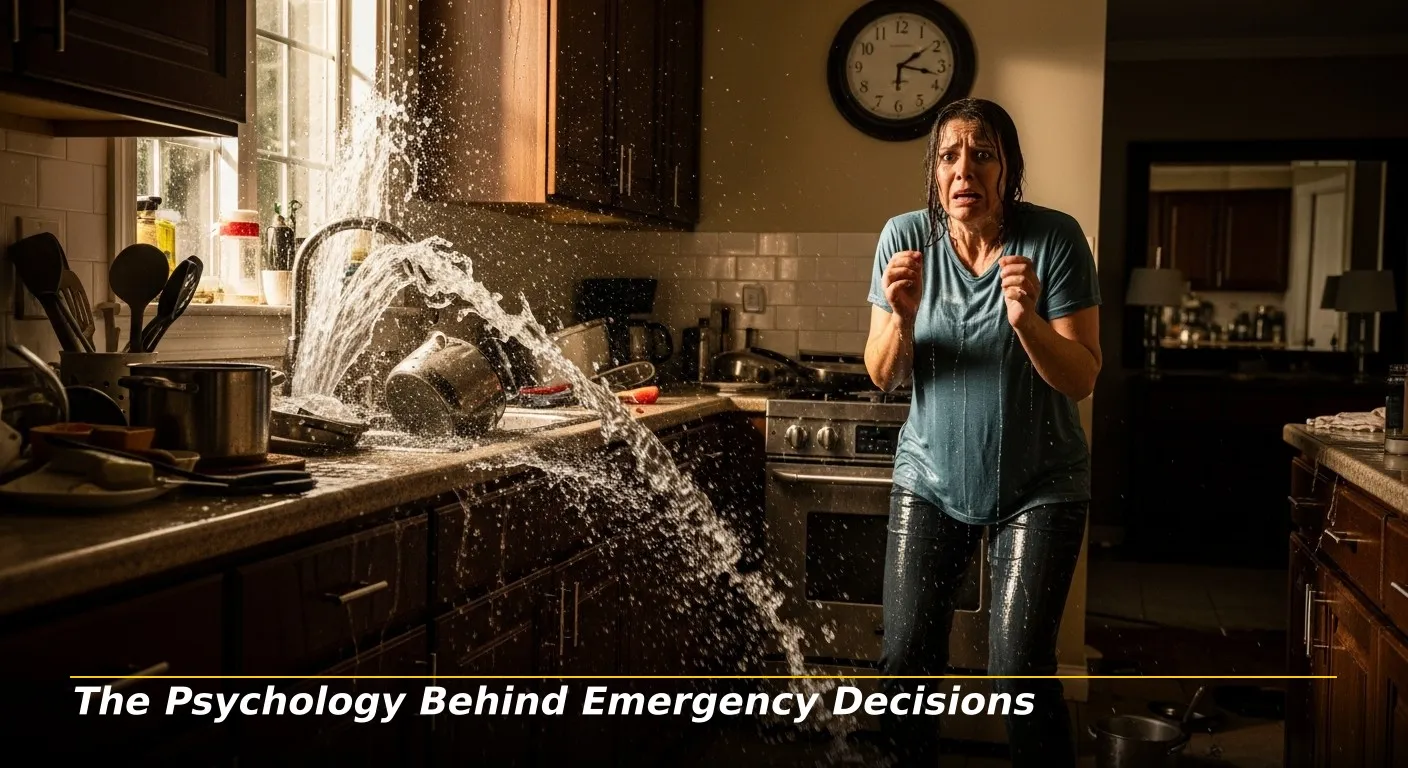
A plumbing emergency isn’t merely a logistical problem, it’s a psychological event. Psychologists describe the experience of a burst pipe or sewer backup as a perceived loss of agency. The home, representing safety and predictability, has been violated by an unpredictable event.
Under significant stress, the brain’s rational decision-making capacity is compromised. Homeowners aren’t comparing pricing tiers or reading company history pages. They’re looking for one signal: that the situation can be brought under control. Before a homeowner even lets a stranger through their door, they’re evaluating three questions almost instantly:
- Are you local?
- Can you solve my specific problem?
- Can I trust you?
Your website has roughly ten seconds to answer all three, or they’re calling your competitor.
The financial fear compounds the physical panic. Homeowners simultaneously worry about the extent of the damage, potential secondary hazards, and what the repair will cost. A professional website transcends market services, it functions as cognitive relief, providing a clear, frictionless path to action that reduces mental load during a crisis.
 Related article
How Local SEO for Plumbers Drives More “Plumber Near Me” Calls
It’s 9 PM on a Tuesday. A homeowner’s kitchen drain backs up. They grab their phone and type: “plumber near me“. The search results appearing in the next three seconds determine which plumber gets the call greater than any accolades or ads being run. More than 800,000 people search “plumber near me” on Google every […]
2. Why Speed Is a Trust Signal
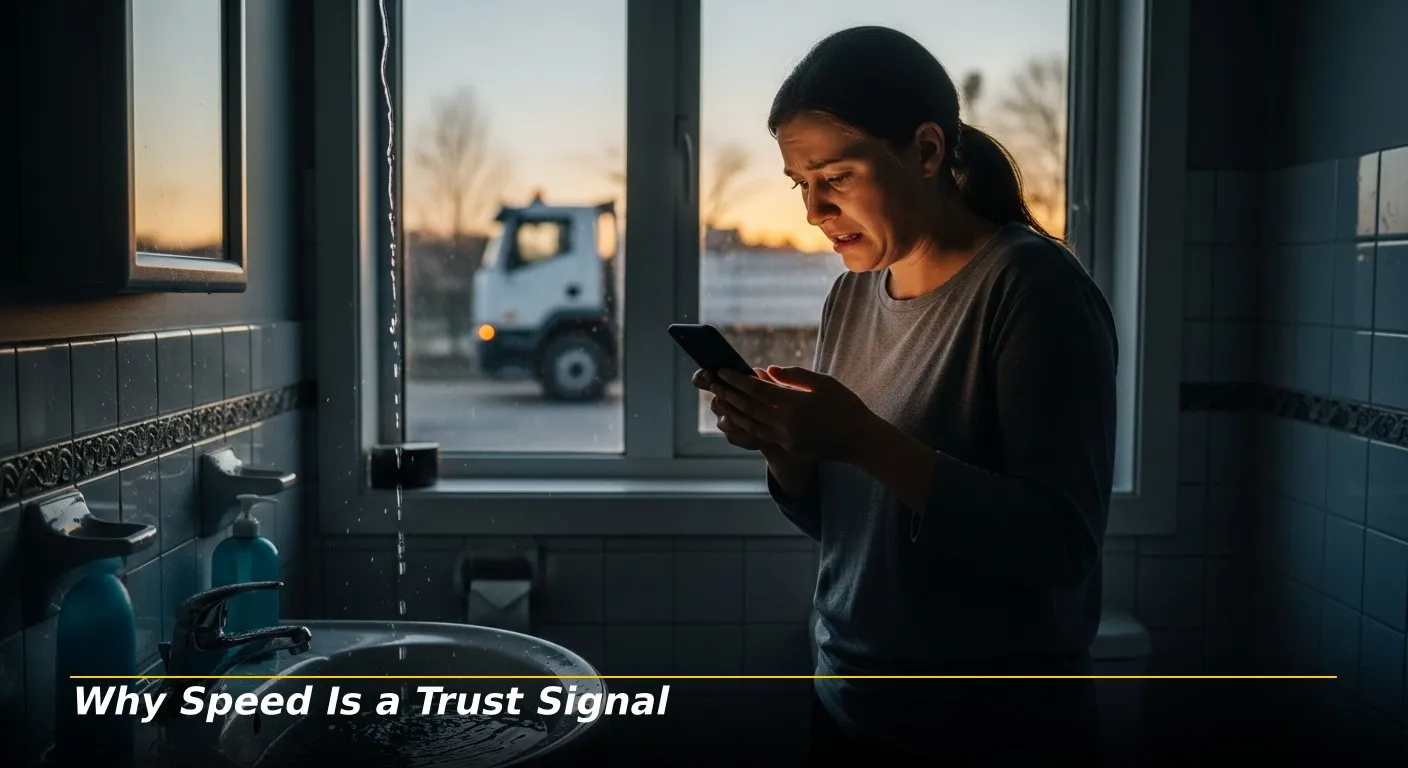
In the context of an emergency, website performance isn’t a technical metric, it’s an emotional one. Studies show 53% of users abandon a site taking greater than three seconds to load. In emergency plumbing, that rate is likely higher: every second of delay reinforces the homeowner’s sense of catastrophe.
The current standard: a Largest Contentful Paint (LCP) under 2.5 seconds, with industry-leading sites targeting sub-2.0 seconds. An Interaction to Next Paint (INP) under 100 milliseconds is equally critical. A site that responds instantly sends a quiet but powerful signal: this contractor is ready.
Mobile-first design is non-negotiable. Between 64% and 73% of emergency plumbing searches happen on smartphones, and a mobile-optimized site generates 67% more calls than a desktop-only design. For emergency mobile UX, that means:
- A sticky header with a click-to-call button visible at every scroll position
- Touch targets of at least 48×48 pixels to prevent tap errors when fingers are shaking
- No more than 3–4 form fields for any service request, every extra field costs calls
- A 90+ Google PageSpeed score to ensure consistent performance under pressure
| Technical Feature | Target Benchmark | User Experience Impact |
|---|---|---|
| Load Time (LCP) | < 3.0 seconds | Reduces panic-driven bounce rate |
| Mobile PageSpeed | 90+ | Improves ranking and reliability perception |
| Touch Target Size | 48px × 48px | Prevents frustration during navigation |
| Form Fields | 3–4 maximum | Accelerates service requests |
| First Input Delay | < 100ms | Signals professional responsiveness |
 Related article
The Importance of a Fast-Loading Website for Plumbing Businesses
A homeowner runs Google Ads. He pays $75 for a click from a homeowner searching “emergency plumber near me” at 2 AM. She lands on his website. It takes five seconds to load. They hit the back button and call the next result. That money was essentially spent for nothing. This scenario plays out dozens […]
3. Eight Trust Signals Every Emergency Plumbing Website Must Have
Trust, in an emergency context, is not a single feature. It’s an accumulation of signals collectively answering the homeowner’s three core questions. The following elements are non-negotiable:
- Hyper-visible click-to-call button: Your phone number belongs in the top-right corner of every page alongside a persistent sticky header. Google’s own data shows 60% of smartphone users contact a business directly from search using click-to-call.
- 24/7 emergency badge: A clear, high-contrast badge in the hero section, not buried in navigation, signaling real-time availability.
- Google Reviews integration: A live feed of verified reviews, ideally highlighting the customer’s neighborhood and specific service performed. According to Podium research, 93% of consumers say online reviews influence their purchasing decisions. A competitor with 150 reviews will outperform one with 15 at an identical star rating.
- Professional affiliations: Logos from the PHCC (Plumbing-Heating-Cooling Contractors Association), NATE, and the Better Business Bureau signal institutional legitimacy at a glance.
- License and insurance visibility; State license numbers and insurance verification in the footer establish legal authority, reducing the homeowner’s perceived risk of hiring you.
- Authentic team photography: Real photos of your crew and branded vehicles humanize your business. Stock photos are immediate red flags, eroding the trust you’re attempting to build.
- Localized service area content: Neighborhood-specific landing pages and references to local landmarks answer the homeowner’s first question, Are you local?, before they have to ask.
- Schema markup: Adding Local Business and Service schema helps Google display your credentials directly in search results, extending trust signals before the click even happens.
 Related article
How Website Design Impacts Lead Generation for Plumbing Companies
A homeowner finds water pooling under her kitchen sink at 7 AM. She searches for a plumber on her phone. Three results appear. The first is clicked on. Their site is slow to load, the phone number is buried at the bottom, and the photos look like they were taken in 2009. They hit the […]
4. Color, Design, and the 50-Millisecond Judgment

Research found that visual trust judgments are made within 50 milliseconds of landing on a page. Two factors drive that snap judgment: prototypicality (does this look like what a plumber’s site should look like?) and cleanliness (does this look organized and professional?).
For plumbing websites, color psychology plays a direct role:
- Blue signals trust, calm, and professionalism. It is the preferred color for 33% of service industry branding and has been shown to increase perceived trustworthiness on service websites by up to 34%.
- Red triggers urgency and action, ideal for emergency CTAs like “Call Now” buttons, but should be used sparingly to avoid heightening user anxiety.
- White space communicates cleanliness and care. In a trade that often involves messy situations, a well-spaced, uncluttered design subconsciously reassures the homeowner that the contractor will respect their property.
A site that is too avant-garde or outdated creates cognitive dissonance. Homeowners in crisis bounce from anything that doesn’t match their mental image of a reliable professional. Design that converts emergency traffic isn’t flashy, it’s familiar, fast, and clean.
 Related article
12 Trust Signals Every Home Improvement Contractor Website Needs to Convert Visitors into Clients
Trust is the most valuable tool for any home improvement contractor. For years, the goal was to appear up on the first page of Google. Today, we have entered the age of AI search. People now ask tools like ChatGPT and Gemini for direct advice on who to hire. These programs not only rank websites […]
5. The AI Search Factor

The way homeowners find plumbers is evolving. AI platforms like Google AI Overview, ChatGPT, and Perplexity are increasingly the first stop for local service queries. AI search traffic converts at 14.2%, five times higher than traditional organic search leads at 2.8%.
A. To earn those AI citations, plumbing websites need to adopt an answer-first content architecture: direct, 120–180 word authoritative answers to the homeowner’s most common questions. Narrative, detailed reviews correlate six times greater with AI visibility than simple star ratings.
B. The implication is significant: a library of specific, story-driven customer testimonials is now both a human trust signal and an AI ranking factor.
Since late 2025, Google has significantly increased paid ad placements in local results, making strong organic and AI presence more important than ever as a complement to any paid strategy.
6. Two Plumbers, One Emergency Call
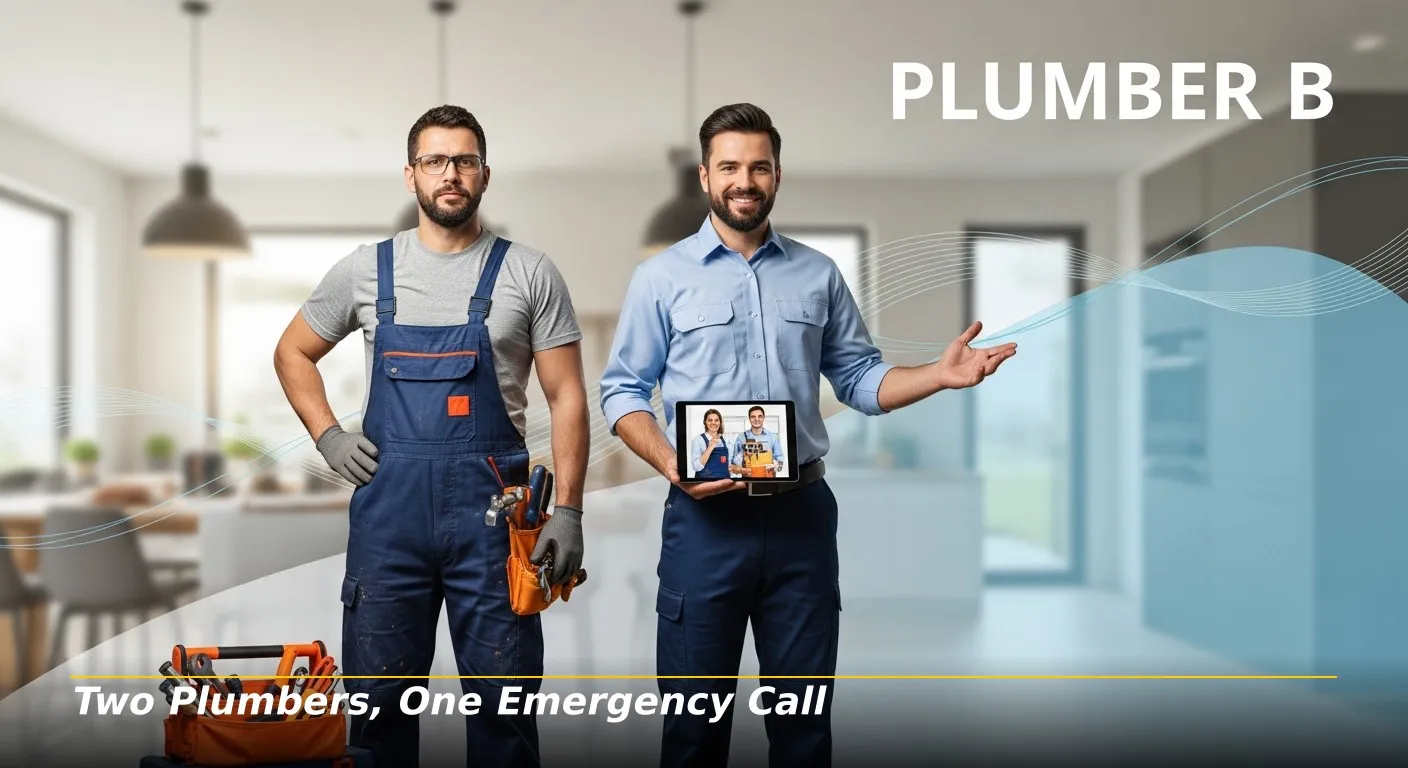
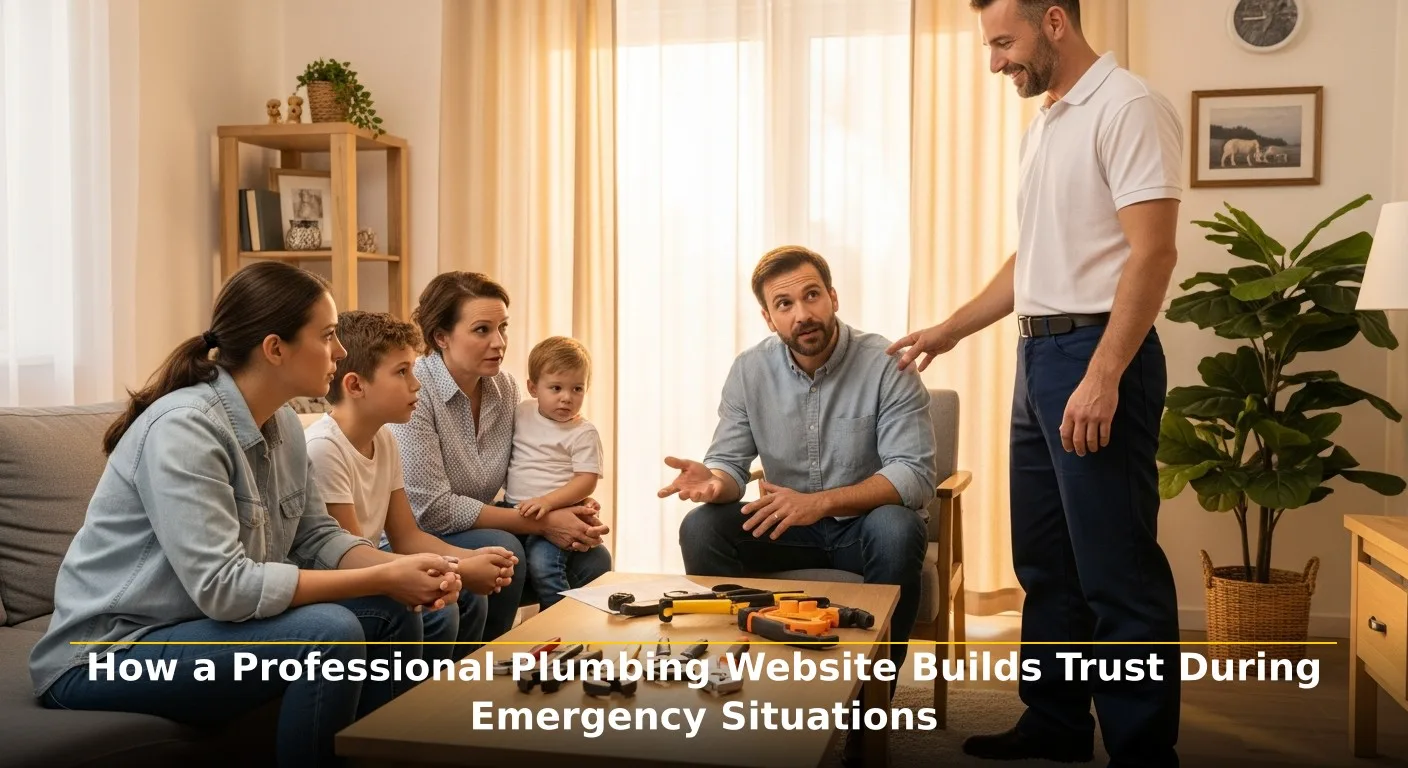
Consider two contractors serving the same neighborhood. Plumber A has a dated website, buried contact information, and only stock photos. Plumber B has sub-3-second load times, real team photos, a prominent 24/7 badge, and a sticky click-to-call button.
In an emergency, Plumber B captures 60%–70% of answered calls, not because they’re necessarily better at the job, but because their platform eliminates the need for price comparison. They’ve already answered all three of the homeowner’s questions before a single word has been exchanged.
Case studies from 2024–2025 confirm the returns. One plumbing firm tripled its revenue in 12 months by shifting to a conversion-focused digital presence. Another doubled its leads in 60 days by improving its website conversion rate from 1.8% to 4.3%. Neither achieved this by increasing ad spend: it was done by improving the architecture of trust.
Conclusion: A professional plumbing website is the first responder your business sends to every emergency call, before your van leaves the driveway. By combining sub-3-second load times, mobile-first UX, verified social proof, and strategic trust signals, contractors close the anxiety gap for homeowners in crisis.
Trust isn’t a single feature. It’s the cumulative result of every design decision, review displayed, and millisecond saved. In an AI-driven local search landscape, this investment is the highest-ROI action a plumbing contractor can take to grow market share.
Is your website leaking leads?
Audit your site today. If it isn’t mobile-optimized, fast-loading, and trust-verified, you’re already losing high-value emergency calls to competitors who are. The technology exists: the question is whether your website is using it. For a free website audit, contact our plumbing website design team today at (612) 590-8080!
 Related article
The Contractor’s Website Checklist: 15 Features That Turn Visitors into Paying Customers
A contractor’s website is no longer a digital brochure. This year, it’s the most influential salesperson in the business. 84% of homeowners leverage Google and AI answer engines to research a contractor before making contact. 58.5% of searches now end without a click because AI provides answers directly on the results page. When the user […]
Frequently Asked Questions Homeowners Have During Plumbing Emergency Situations:
1. “How do I know this plumber is trustworthy right now?”
A professional plumbing website builds instant trust through visible social proof and credibility signals
- Verified customer reviews and star ratings
- Before-and-after project photos
- Certifications, licenses, and guarantees
- Clear branding and consistent company identity
Why it matters: Over 99% of customers check reviews before choosing a business. In emergencies, people don’t research deeply; they scan quickly for reassurance.
👉 Trust trigger: “Others trusted them and had a good experience.”
2. “Can I reach someone immediately in an emergency?”
Trust increases when a website makes contact fast, obvious, and frictionless:
- Click-to-call buttons (especially mobile)
- 24/7 emergency availability clearly stated
- Sticky headers with phone numbers
- Live chat or instant booking options
Why it matters: Over 60% of emergency plumbing searches happen on mobile; users need immediate action, not navigation.
👉 Trust trigger: “I can get help right now without hassle.”
3. “Do they actually handle my specific emergency problem?”
High-trust plumbing websites clearly explain services in plain language, especially for urgent issues:
- Dedicated “Emergency Plumbing” pages
- Lists of common problems (burst pipes, leaks, no hot water)
- Simple explanations of what happens next
Why it matters: Content that answers real customer questions positions the company as knowledgeable and helpful, building credibility before contact .
👉 Trust trigger: “They understand my exact problem.”
4. “Will they show up quickly and reliably?”
Websites build confidence by setting clear expectations and transparency:
- Service area maps or “near me” targeting
- Response time promises (e.g., “arrive within 60 minutes”)
- Upfront pricing or “no hidden fees” messaging
Why it matters: When people search “emergency plumber near me,” they prioritize proximity, availability, and clarity over everything else .
👉 Trust trigger: “They’re nearby and won’t waste my time.”
5. “Why should I choose this plumber over others?”
A strong plumbing website differentiates through brand trust and human connection:
- Team photos and real technician bios
- Company story and years of experience
- Guarantees, warranties, and service promises
- Ongoing helpful content (tips, maintenance advice)
Why it matters: Trust is built when customers feel they “already know you” before calling .
👉 Trust trigger: “This feels like a reliable, professional company; not a random listing.”
6. Why does referencing local plumbing codes build trust?
Citing standards like the Minnesota State Plumbing Code (Chapter 4714) positions a contractor as a knowledgeable expert rather than a general laborer. Detailing code requirements for pipe slope, ventilation, and air gaps demonstrate a clear commitment to public health and long-term compliance. This is a differentiator that national franchises rarely offer and that AI search platforms increasingly reward with citation visibility.