








A homeowner runs Google Ads. He pays $75 for a click from a homeowner searching “emergency plumber near me” at 2 AM. She lands on his website. It takes five seconds to load. They hit the back button and call the next result. That money was essentially spent for nothing. This scenario plays out dozens of times every month for plumbing contractors running paid campaigns on slow websites, but it costs just as much in organic traffic too, without the invoice to prove it.
Website speed is not a technical detail that only developers need to care about. It is the first test every potential customer unconsciously runs on your business. According to Site Builder Report research, 53% of mobile users will abandon a page taking longer than 3 seconds to load. For a plumber whose average job ticket runs between $500 and $1,500, every bounce is a significant and measurable loss.
Our article explains exactly why speed matters for plumbing lead generation, what the data says about the cost of a slow site, and the five technical fixes that deliver the fastest return.
Key Takeaways
- 53% of mobile users abandon a site that takes more than 3 seconds to load
- Conversion rates drop by 4.42% for every additional second of load time (HubSpot)
- Pages loading in 1 second convert at 3x the rate of pages loading in 5 seconds
- Sites meeting Core Web Vitals are 30 to 47% more likely to appear in AI search results
- Top-ranking Google results for plumbing searches load in an average of 1.65 seconds
1. Why Speed Feels Different During a Plumbing Emergency

Plumbing emergencies collapse the homeowner’s decision-making window to minutes, sometimes seconds. Psychologists describe this state as a perceived loss of agency: the home, which is meant to be safe and predictable, is suddenly uncontrolled. The brain’s rational deliberation shuts down, and the drive for the fastest available solution takes over.
In that state, a three-second load delay does not feel the same. The vibe is that business is already failing the homeowner before they’ve exchanged a word. Data from Marketing LTB shows that 70% of consumers say website speed directly influences their purchase decision. For emergency services, that influence is amplified as 78% of customers hire the first company that responds to them. A slow website disqualifies you from being that company before your phone ever rings.
Speed is also a trust signal. A contractor’s website is a proxy for how that contractor operates in the field. A site that loads instantly signals readiness, organization, and professionalism. Lagging sites communicate the opposite, before the viewer reads a single word.
 Related article
How a Professional Plumbing Website Builds Trust During Emergency Situations
The U.S. plumbing industry reached $191.4 billion in 2026, growing at a compound annual rate of 3.1% over five years. But behind that figure is a more intimate reality: every dollar of that growth passes through a moment of household panic. A pipe bursts at 11 p.m. A basement drain backs up on a Sunday […]
2. What Slow Sites Actually Cost: The Numbers
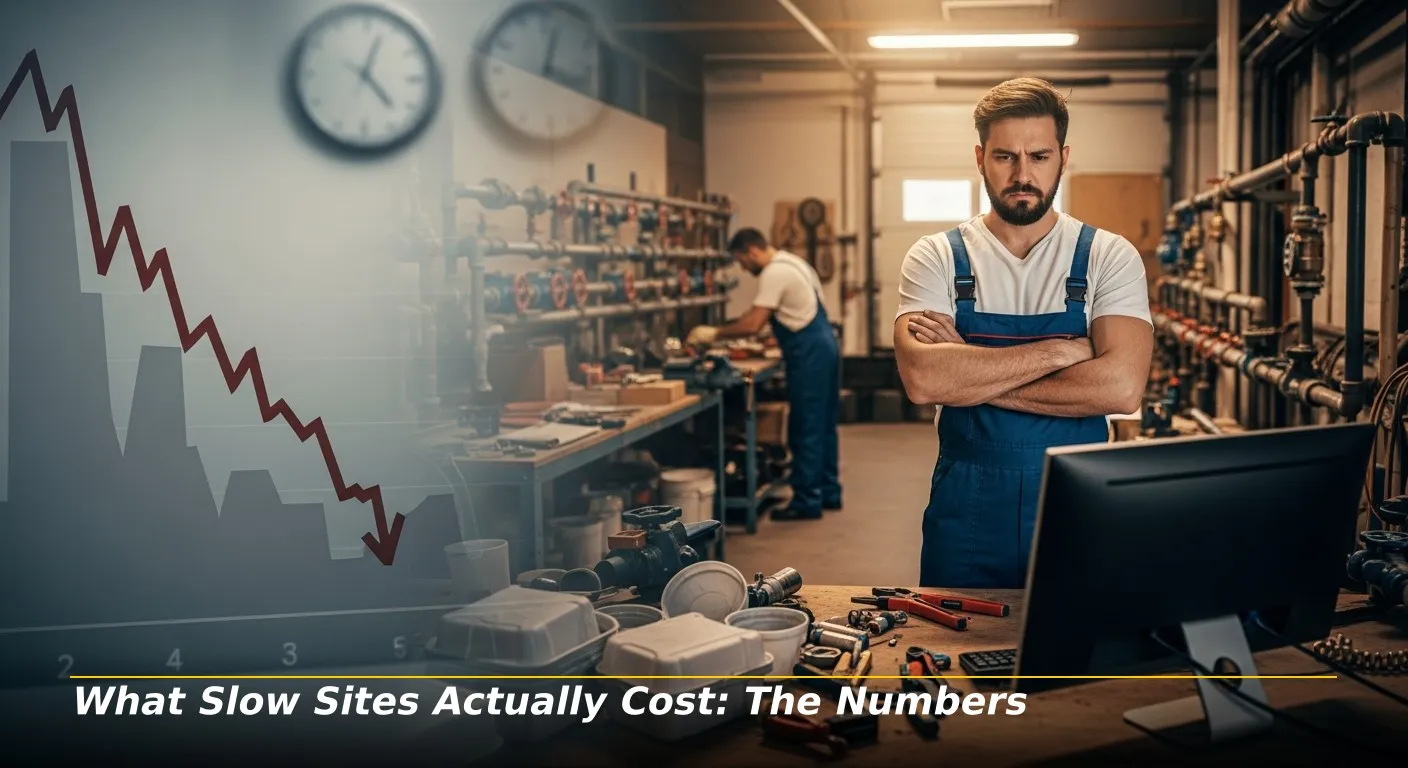
The financial case for speed optimization is straightforward once the data is laid out. HubSpot research found that conversion rates drop by 4.42% for every additional second of load time. Kanuka Digital’s 2025 analysis, citing Reboot Online, noted that a one-second delay produces a 7% reduction in conversions, an 11% drop in page views, and a 16% decrease in customer satisfaction scores.
Put those numbers against a real plumbing business. Contractors with a site generating 100 visits per month at a 4% conversion rate books 4 jobs. If load time increases by two seconds and conversions drop to 3.1%, that contractor books 3 jobs from the same traffic. At an average ticket of $800, that’s $800 in lost monthly revenue from a problem that costs under $90 per month to fix with the right tools.
The bounce rate math is equally stark. Marketing LTB data highlights that a 2 to 5 second delay increases bounce probability by 90% compared to a 1-second load time. For a plumber spending $1,500 per month on Google Ads, half that budget is likely being wasted on visitors who leave before the page finishes loading.
| Load Time | Bounce Rate Impact | Conversion Rate Impact |
|---|---|---|
| Under 1 second | Lowest bounce rate | 3x higher than 5-second sites |
| 1 to 2 seconds | Near-optimal | Highest sustained conversion range |
| 2 to 3 seconds | +32% bounce probability | Drops 4.42% per additional second |
| 3 to 5 seconds | +90% bounce probability | Significant lead loss |
| Over 5 seconds | Majority of users gone | Conversion rate near floor |
 Related article
How Local SEO for Plumbers Drives More “Plumber Near Me” Calls
It’s 9 PM on a Tuesday. A homeowner’s kitchen drain backs up. They grab their phone and type: “plumber near me“. The search results appearing in the next three seconds determine which plumber gets the call greater than any accolades or ads being run. More than 800,000 people search “plumber near me” on Google every […]
3. Core Web Vitals: Google’s Speed Report Card

Google measures page speed through a framework called Core Web Vitals, three metrics quantifying user experience. These are not technical checkboxes for developers. They are ranking factors determining whether your site appears at the top of search results or gets buried behind faster competitors.
- Largest Contentful Paint (LCP):This measures how long it takes for your main visible content, typically your hero image or headline, to fully load. Google’s threshold for an ideal score is under 2.5 seconds. The top-performing plumbing websites target under 1.65 seconds, according to Revved Digital’s analysis of Google’s first-page results.
- Interaction to Next Paint (INP): This measures how quickly your page responds when a user taps a button or menu item. For a potential client trying to tap your “Call Now” button under stress, a sluggish response is a direct conversion killer. Google’s optimal threshold is under 200 milliseconds.
- Cumulative Layout Shift (CLS): This measures visual stability. If elements shift around as your page loads, a homeowner trying to tap your phone number may accidentally hit an ad or a navigation link instead. A good CLS score is under 0.1. This is the metric most plumbing sites fail silently.
Currently, only 43.4% of mobile sites meet Google’s Core Web Vitals benchmarks, according to Debugbear’s 2025 analysis. There exists a significant competitive opportunity, pass all three thresholds and you are automatically ahead of more than half your local competitors in Google’s ranking algorithm. Research from Result Calls also shows that sites meeting Core Web Vitals are 30 to 47% more likely to appear in AI search results, which is where an increasing share of local plumbing queries now begin.
 Related article
How Website Design Impacts Lead Generation for Plumbing Companies
A homeowner finds water pooling under her kitchen sink at 7 AM. She searches for a plumber on her phone. Three results appear. The first is clicked on. Their site is slow to load, the phone number is buried at the bottom, and the photos look like they were taken in 2009. They hit the […]
4. The 5 Fixes That Move the Needle Fastest

If your current site is underperforming on speed, these five actions deliver the highest return in the shortest time. Begin with an audit using Google PageSpeed Insights to establish your mobile baseline, then work through these in order.
- Compress and convert your images: Images account for the majority of a webpage’s total file size. Plumbers regularly upload full-resolution smartphone photos directly to their sites, with some running several megabytes each. Compress them using a tool like TinyPNG and convert to WebP format. Doing so can reduce time-to-interaction by 15 to 45%, according to Marketing LTB. This single step often delivers a 1 to 2 second improvement with no developer needed.
- Upgrade your hosting environment. Shared hosting, where your site sits alongside hundreds of other businesses on the same server, is the most common cause of slow server response times (Time to First Byte). For a business where a single missed emergency call can mean $500 to $1,500 in lost revenue, managed WordPress hosting with server-level caching is a non-negotiable investment. The cost difference is typically $45 to $60 per month.
- Install a caching and optimization plugin. Tools like WP Rocket or NitroPack automate the most impactful technical optimizations: browser caching, code minification, and lazy loading of below-the-fold images. They install in minutes without coding knowledge and typically reduce load time by 20% to 50%, according to Marketing LTB. At $10 to $50 per month, these tools have the best cost-to-impact ratio of any speed investment available.
- Implement a Content Delivery Network (CDN). A CDN like Cloudflare stores copies of your site on servers distributed globally. When a homeowner in your city searches for a plumber, they receive your site’s files from the nearest server node rather than a distant data center. Cloudflare’s free tier alone reduces global latency by 30% to 60%. For local plumbers, this translates directly to faster load times for your highest-intent audience.
- Audit and remove non-essential plugins and scripts. Every plugin adds JavaScript and CSS that must load before your page becomes interactive. Tracking pixels, animation libraries, and social media widgets that load in the page header delay your core content from appearing. Identify non-essential scripts using PageSpeed Insights’ “Eliminate render-blocking resources” recommendation and defer them to load after the main content. Eliminating unnecessary plugins alone shortens load time by 1 to 4 seconds, according to Marketing LTB.
 Related article
How Your Contractor Website Should Prepare for Minnesota’s Spring Search Surge: A Seasonal SEO Checklist
Minnesota’s construction season is compressed into roughly six months, meaning the digital competition for spring projects is heavily front-loaded. By the time the ground thaws in April, the most in-demand contractors are already booked. Homeowners who fill those schedules started their search in February, and the contractors who captured them had websites that were optimized […]
5. Two Plumbers, One Market, One Load Time Difference
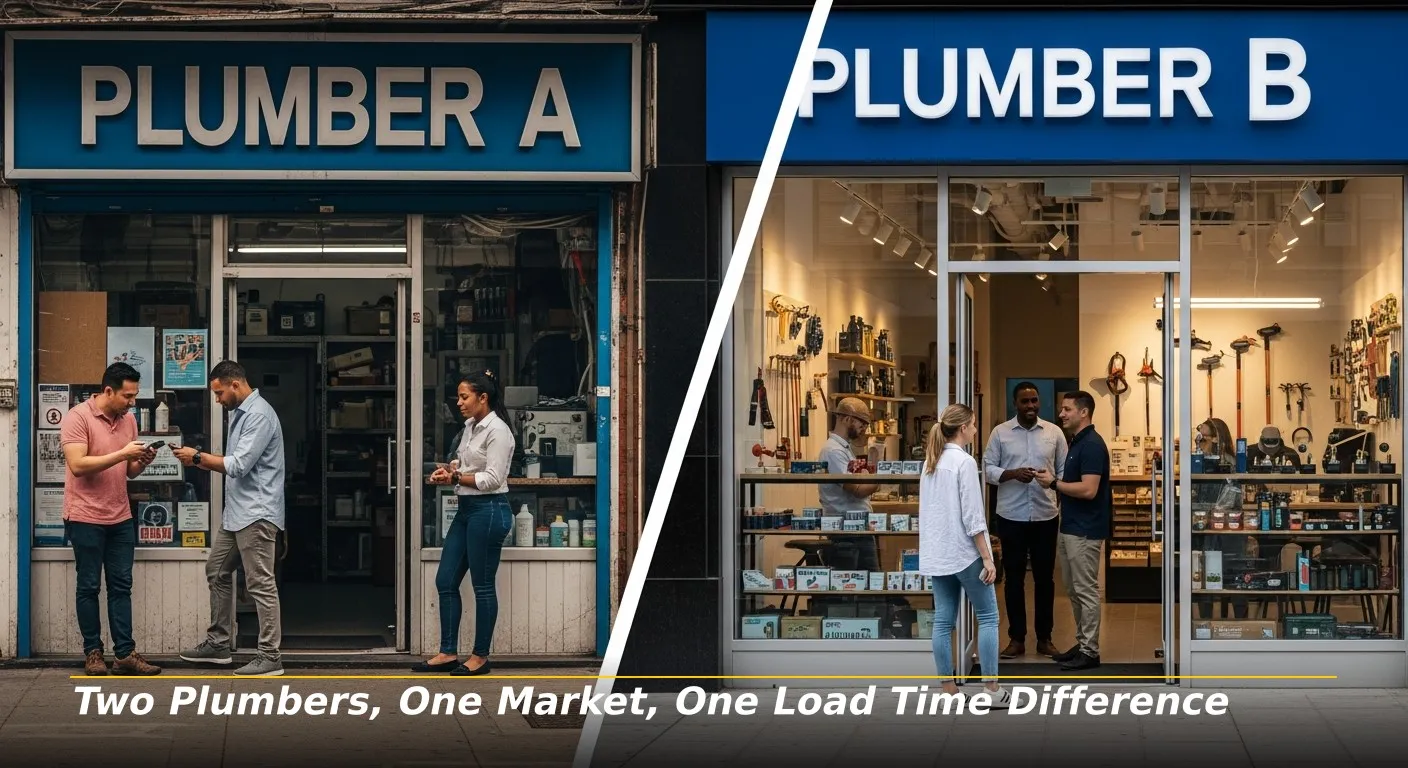
Both contractors operate in the same city, run Google Ads targeting the same emergency keywords, and have comparable reputations and pricing.
- Plumber A’s site was built four years ago. It uses uncompressed job site photos, a shared hosting plan, and three social media widgets that load in the header. Mobile load time: 4.5 seconds. Since 53% of mobile users leave at the 3-second mark, more than half his paid traffic bounces before seeing his phone number. Conversion rate: 1.8%. Cost per lead: $78.
- Plumber B invested in performance optimization. Compressed images in WebP format. Managed hosting with server caching. WP Rocket installed. Cloudflare CDN active. Mobile load time: 1.7 seconds. Users land, the page appears instantly, a sticky click-to-call button is visible before anything else loads. Conversion rate: 4.3%. Cost per lead: $41.
Same market. Same budget. Same keywords. The only variable is how fast the digital front door opens.
| Metric | Plumber A (Slow Site) | Plumber B (Optimized Site) |
|---|---|---|
| Mobile Load Time | 4.5 seconds | 1.7 seconds |
| Monthly Traffic Bounced | 53%+ before page loads | Under 10% |
| Conversion Rate | 1.8% | 4.3% |
| Cost Per Lead (Ads) | $78 | $41 |
| Core Web Vitals | Failing | Passing all three |
Conclusion: Website speed is not a technical problem, but rather, a revenue problem. Every second of delay costs conversions, erodes trust, and hands emergency calls to competitors whose sites simply open faster. Homeowners bouncing at the 3-second mark are not making a considered judgment about your business. They are responding to frustration, and that signal is entirely within your control to eliminate.
The fixes are not complicated, and the most impactful ones cost less per month than one Google Ads click. For a plumbing business where each answered call represents hundreds of dollars in potential revenue, speed optimization is the highest-return investment available. The contractors who address it now build a compounding advantage: quicker sites rank higher, convert more, cost less per lead, and create a digital presence that improves month over month.
Find out what your site speed is costing you: Go to Google PageSpeed Insights right now and test your site on mobile. If your score is below 70 or your load time is above 2.5 seconds, you are losing calls every day. The three fastest fixes, image compression, a caching plugin, and a CDN, can be in place by tomorrow. Start there, then measure the difference in your conversion rate over the next 30 days. Call our Plumbing website design team to get your website up to speed today at (612) 590-8080.
 Related article
The Contractor’s Website Checklist: 15 Features That Turn Visitors into Paying Customers
A contractor’s website is no longer a digital brochure. This year, it’s the most influential salesperson in the business. 84% of homeowners leverage Google and AI answer engines to research a contractor before making contact. 58.5% of searches now end without a click because AI provides answers directly on the results page. When the user […]
FAQs About The Importance of a Fast-Loading Website for Plumbing Businesses
1. What is a good website load time for a plumbing business?
The current benchmark for a high-performing plumbing website is under 3.0 seconds on mobile. Google’s formal Largest Contentful Paint threshold is 2.5 seconds, but Revved Digital’s analysis of Google’s first-page plumbing results found that top-ranking sites load in an average of 1.65 seconds. If your mobile load time is above 3 seconds, you are likely losing the majority of emergency traffic before the page finishes rendering. Run a free test on Google PageSpeed Insights using a cellular connection, not office Wi-Fi, to see what your customers actually experience.
2. How does website speed affect my Google Maps ranking?
Directly. When users click your Map Pack listing and immediately bounce because your site is slow, Google interprets that as a relevance signal meaning this business did not satisfy the searcher. Over time, a high bounce rate from Map Pack clicks can reduce your position in the Local 3-Pack. Speed also affects your standard organic rankings through Core Web Vitals, which are confirmed ranking factors. Passing all three thresholds puts you ahead of more than half of local competitors based on Debugbear’s 2025 mobile analysis.
3. How much does professional speed optimization cost?
There is variability depending on what the site needs. A self-managed optimization, installing a caching plugin, compressing images, and switching to a better hosting plan, typically costs $70 to $120 per month in tools and upgraded hosting. Professional technical audits and speed-focused rebuilds from an agency run from $750 to $3,000 for an existing site. Full custom builds designed for maximum speed and conversion from the ground up typically ranges from $5,000 to $15,000. For context: if a single plumbing job averages $800 and a speed optimization generates even one additional call per month, it pays for itself in month one.
4. Can I improve my site speed without a developer?
Yes, if you a little tech savvy. For the most impactful fixes. Installing WP Rocket or NitroPack requires no coding and can cut load time by 20% to 50%. Compressing images using TinyPNG before uploading is a five-minute task. Activating Cloudflare’s free CDN takes under an hour. These three actions alone can move a site from the 3 to 4 second range into the 2 second range for most plumbing websites engineered on WordPress. For more advanced issues, such as render-blocking scripts in the site header or server-level configuration problems, a developer is worth the cost.
5. Does a fast website help with AI search tools like ChatGPT and Google AI Overview?
Yes, and this is increasingly important as more homeowners start their search with an AI assistant rather than a traditional Google query. Research from Result Calls found that sites meeting Core Web Vitals are 30 to 47% more likely to appear in AI search results. AI platforms use your website as a primary source for verifying business information, service descriptions, and credibility signals. Fast, well-structured sites provide AI engines clean, accessible data to work with. A slow or poorly organized one gets skipped in favor of competitors whose digital presence is easier to read and trust.