






A couple in Orono has spent four months on Houzz, Pinterest, and builder websites saving ideas for a custom home. They need to somehow balance a design direction with staying within a budget. By February, they are ready to shortlist builders and schedule consultations. They search for “custom home builder near me” and “luxury home construction Orono MN.” Three builders appear in the Map Pack. One has a portfolio organized by community and build type, a suburb-specific page for the Orono market, and 42 detailed reviews. They booked a consultation with that firm. The other two builders in that search result never knew the inquiry existed.
Custom home builds in Minnesota are long-cycle, high-stakes decisions. Clients discovering a builder through a search in February may not break ground until May or later. But the person they hired was chosen at the beginning of the year. Local SEO is the system that determines whose name appears at that moment and whose portfolio earns the call. This article explains how in-state home builders can build that digital visibility before the spring planning surge and sustain it through every subsequent season.
Key Takeaways
- 84% of homeowners use Google and AI tools to vet a builder before first contact: digital authority is the prerequisite for getting on any shortlist
- Custom home clients spend an average of 2.5 hours researching before reaching out: the contractor builder website must sustain that research journey, not just capture the click
- Minnesota’s Spring Parade of Homes runs March to April: builders who finalize their digital presence before that surge fill their consultation calendars first
- Organic SEO leads average $74 versus $135 or more for shared aggregator leads, and they arrive pre-qualified by the homeowner’s own 2.5-hour research session
- AI search leads from ChatGPT and Google Gemini convert at 14.2%, five times higher than traditional organic, rewarding structured portfolio and suburb-specific content
 Related article
How a Home Builder Website Turns Local Search Traffic into Qualified Construction Leads
The home building business is rapidly transitioning. As the standard, builders only had to worry about being found on a list of links on Google. That all changed recently. People are not only looking at lists anymore. They are asking smart AI assistants like ChatGPT, Gemini, and Perplexity to search out and locate the best […]
1. Why Custom Home Leads Require a Different SEO Strategy

Emergency trade searches and custom home searches could not be more different. An electrician competing for a furnace repair call needs to convert a homeowner in four minutes. Home builders competing for a custom build consultation need to sustain credibility across a research journey that may span several months and dozens of website visits. SEO and content infrastructure required for each are entirely different.
Custom home clients search in layers. Early-stage searches are broad and inspirational, looking like “custom home styles Minnesota,” “energy efficient homes Twin Cities.” Mid-stage searches narrow to specific builders: “best custom home builders Orono,” “luxury home construction Edina.” Late-stage searches are transactional: “custom home builder near me,” “home builder consultation Maple Grove.” Someone whose website and local SEO infrastructure appear at every stage of that journey, with content addressing the questions of each phase, is the one who earns the consultation the competitor missed.
This layered research pattern means content investment compounds differently for home builders than for emergency service contractors. A well-structured community page for Orono or Wayzata, published in October, earns authority through the winter and is positioned to capture the February-to-April planning surge that precedes Minnesota’s build season.
 Related article
What Homeowners Look for on a Home Builder’s Website Before Requesting a Quote
Homeowners preparing to invest four to six figures in new construction no longer rely on a single referral. They research. Before picking up the phone, most will spend ample time scouring a builder’s website looking for specific signals of competence, legitimacy, and trustworthiness. A polished homepage is the bare minimum. Big-game homeowners most worth winning […]
2. The Minnesota Build Season Creates a Predictable SEO Opportunity
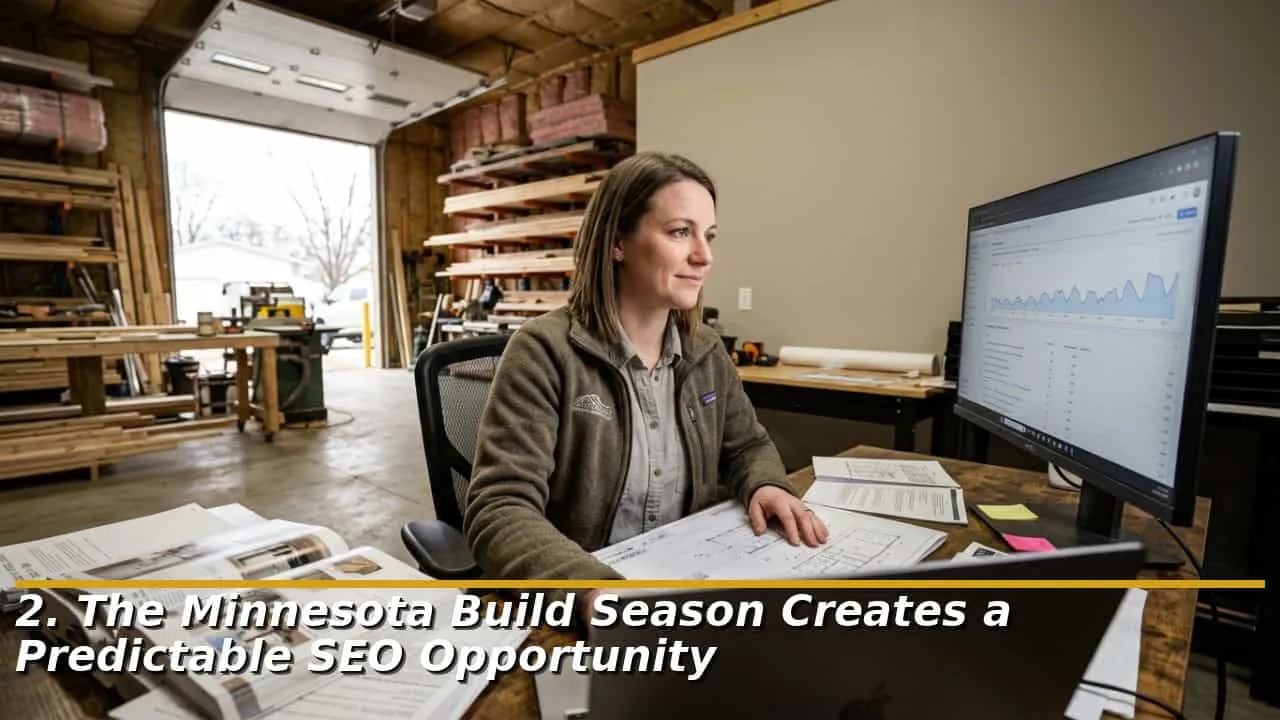
Minnesota’s outdoor construction season is compressed by climate in a way that most other markets do not experience. Ground typically does not thaw for foundation work until April or May. Customers wanting a custom home completed before the following winter must begin their builder search months earlier. That search surge concentrates in February and March, reaching its peak during the Spring Parade of Homes, when prospective buyers walk through model homes and actively shortlist builders.
Builders who have established their local SEO authority before that surge, with suburb-specific pages indexed, reviews accumulated, and GBP active with regular photo updates, appear prominently in those February searches. Those beginning their SEO investment in March are building authority for the following season. The calendar is the most important strategic variable in Minnesota contractor marketing.
The shoulder seasons, September through November and January through February, are the preparation window. Content published during those months earns ranking authority that produces leads during the build season. This is the inverse of the reactive marketing pattern most builders default to.
 Related article
How Your Contractor Website Should Prepare for Minnesota’s Spring Search Surge: A Seasonal SEO Checklist
Minnesota’s construction season is compressed into roughly six months, meaning the digital competition for spring projects is heavily front-loaded. By the time the ground thaws in April, the most in-demand contractors are already booked. Homeowners who fill those schedules started their search in February, and the contractors who captured them had websites that were optimized […]
3. Seven Local SEO Strategies That Attract Ready-to-Hire Minnesota Clients

A. Treat your GBP as a living portfolio, not a business directory listing. Select precise primary and secondary categories, including Custom Home Builder and Construction Company. Upload professional photos of completed builds organized by community, with captions referencing the suburb and build style. GBP profiles with compelling visuals receive 42% more direction requests and 35% greater website clicks. Post updates before and during the Spring Parade of Homes season to signal activity to the algorithm during peak search volume.
B. Build suburb-specific landing pages for every high-income market you serve. A page titled “Custom Home Builder in Orono, MN” that entails a completed project in that community, review from an Orono client, and references to the area’s architectural character and lot sizes outranks generic service pages for every Orono-level search. Repeat for Wayzata, Edina, Plymouth, Maple Grove, and all other communities where your target audience lives.
C. Target research-phase and transactional keywords with separate content. Research-phase content, including“How much does a custom home cost in the Twin Cities” or “cold-climate building materials Minnesota,” captures homeowners months before they are ready to hire. Transactional content, such as “custom home builder near me Orono” or “luxury home construction Edina,” captures those ready to schedule a consultation. Both require dedicated pages. Neither is served by a generic homepage.
D. Structure your portfolio by community, build style, and budget tier. Consumers planning a transitional-style home in a North Shore suburb want to see a project like theirs. Organize your portfolio to make that match findable: by suburb, by architectural style, and by approximate budget range. Each project entry should describe the design challenge, client’s priorities, and outcome. This case-study format converts research-phase homeowners at rates that undescribed photo galleries cannot match.
E. Publish Minnesota-specific educational content consistently. Blog posts addressing topics that only a locally knowledgeable builder can answer, notably energy code requirements for new construction, how Spring Load Restrictions affect foundation delivery schedules, or how cold-climate building techniques improve efficiency in the North Star State’s climate, position the builder as the regional expert that a national production builder cannot replicate. This content also earns AI citations for research-phase queries.
 Related article
How a Website Builds Trust + Credibility for Remodeling and Renovation Contractors
A homeowner shortlists three kitchen remodeling contractors. All three come recommended by neighbors. Each holds a sound reputation in the community built over years of good work. She searches each one on her phone. The first has no website. Option #2 has a site that loads in five seconds and only shows stock photos. The […]
F. Build review velocity with project-specific prompting. Ask every completed client to describe the community, build style, and one specific outcome they valued most. A review reading “custom build in Orono completed on schedule, team navigated the lot’s setback variances, result exceeded our design expectations” carries far more weight in local rankings and AI search recommendations than an empty five-star rating. Target 10 to 15 new reviews per quarter, distributed across your key communities.
G. Implement LocalBusiness and FAQPage schema across your service and suburb pages. AI platforms use your website’s structured data to generate local recommendations. FAQ sections on your suburb pages, answering questions like “What does a custom home cost in Orono?” and “How long does a full custom build take in Minnesota?” with concise 120 to 150-word answers and FAQPage schema, earn AI citations converting at 14.2%, five times higher than traditional organic traffic.
| Strategy | Search Stage It Captures | Minnesota-Specific Application |
|---|---|---|
| GBP with community build photos | All stages: visibility + first impression | Photos by suburb; Parade of Homes timing |
| Suburb-specific landing pages | Mid and late stage: comparison and hire | Orono, Wayzata, Edina, Plymouth, Maple Grove |
| Research + transactional keywords | Early through late stage | Cost guides for Twin Cities; near-me builds by suburb |
| Portfolio by community + style | Research and comparison phase | Match homeowner’s suburb and style in one click |
| Educational MN-specific content | Early research: pre-shortlist awareness | Energy code, Spring Load Restrictions, cold climate builds |
| Project-specific reviews | Late research: final shortlist decision | Community + style + outcome in every review prompt |
| FAQ schema markup | AI search citation eligibility | 14.2% AI lead conversion; cost and timeline FAQs |
 Related article
Spring Is When Minnesota Homeowners Hire Contractors: Here Is What They Search for First
The first thaw of late February triggers a predictable and powerful shift in Minnesota’s home services market. While construction season runs April through October, the digital planning phase begins months earlier. By the time the snow melts, established contractors in the Twin Cities are already finalizing their May and June schedules. Homeowners who secure the […]
4. Two Builders, Same Market, Different Digital Investment

Both firms operate in the western Twin Cities metro. Each holds current Minnesota Residential Building Contractor licenses and have comparable portfolios of completed custom homes.
Builder A markets primarily through the Spring Parade of Homes and relies on referrals for the rest of the year. Their site has a generic portfolio gallery with no suburb organization, cost guidance, or suburb-specific pages. Reviews: 9, none describing a specific community or build type. During the February planning surge, they appear on page two of Google for searches in their target communities. New project consultations: 4 to 6 per quarter, primarily from existing client networks.
Builder B invested in local SEO over 14 months. Suburb pages for six communities, each with a completed project reference and client review. Portfolio organized by build style and community. A cost guide describing investment ranges for three build tiers. Reviews: 44, averaging 4.9 stars, most describing specific communities and outcomes. They appear in the Map Pack for the top three searches in their target communities. Consultation pipeline: 14 to 18 per quarter, arriving with a 2.5-hour research session already completed. Close rate of consultations: 38%.
Same license. Same market. The builder who filled their consultation calendar in February built their digital infrastructure in October.
Conclusion
Minnesotan custom home builds are won during the research phase, often months before the homeowner conducts outreach. The builder who appears consistently, credibly, and specifically across the February planning surge owns those consultations before the first Parade of Homes ticket is sold.
Every suburb page built, every project case study organized by community and style, and every review earned that names a specific neighborhood compounds into a local authority asset that generates exclusive, pre-qualified consultation requests across every season. Those filling their schedules in May committed their digital investment in October. For Minnesota custom home builders serious about growing their pipeline with ready-to-hire clients, that is when the most important work begins.
Is your business visible when Minnesota homeowners start planning their custom build?
Search “custom home builder near me” from within your top target community right now. If your business is not in the top three Map Pack results, homeowners planning builds this season cannot find you. Start this week: add two project photos to your GBP organized by community, update your most visited suburb page with a recent review reference, and check whether your site has a dedicated page for your highest-value market. Those three actions begin compounding before the next Parade of Homes.
 Related article
The Minnesota Contractor’s Spring Website Checklist: 15 Updates That Turn Spring Searchers into Booked Jobs
In Minnesota, late February marks the end of the deep freeze and the beginning of the most competitive search cycle of the year. Crews may not break ground until May, but the digital race for those projects is already underway. 84% of homeowners use Google to find and validate a contractor before outreach, and the […]
FAQs About How Local SEO for Home Builders Attracts Ready-to-Hire Clients in Minnesota
1. What does the Minnesota Residential Building Contractor license require, and why should it be displayed on the website?
Minnesota requires any contractor who works directly with homeowners on residential construction involving more than one special skill area to hold a Residential Building Contractor license issued by the Department of Labor and Industry (DLI). The license requires the firm to designate a Qualifying Builder (QB), who must pass the DLI licensing exam and complete 14 hours of DLI-approved continuing education every two years, including at least one hour on the Minnesota Energy Code. Their license number must, by law, appear on all contracts, advertising, and websites. Displaying it prominently on a site, particularly in the footer and on your consultation request page, is both legally required and a trust signal. It confirms to homeowners that they are dealing with a licensed professional, and it differentiates your firm from unlicensed operators who cannot legally perform the work.
2. How does Minnesota’s Contractor Recovery Fund work, and why is it more relevant to clients than a bond?
The state does not require residential building contractors to post a surety bond. Instead, the state operates the Contractor Recovery Fund, which reimburses homeowners who suffer financial losses due to a licensed contractor engaging in fraudulent, deceptive, or dishonest practices, misappropriating funds, or failing to complete contracted work. The fund is paid for through licensing fees and provides consumer protection comparable to bonding without the contractor needing to obtain a separate bond. For clients evaluating custom home builders, this distinction matters: a builder who explains the Contractor Recovery Fund on their website and links to the DLI verification page demonstrates transparency about the state’s consumer protection framework. Most competing websites never mention it, making this a credibility signal that costs nothing to add but meaningfully differentiates a builder who wants clients to feel protected.
3. How does Minnesota’s Spring Parade of Homes affect SEO timing for custom builders?
The Spring Parade of Homes, typically running from late February through April, is the largest homebuyer event in the Upper Midwest and generates a concentrated surge in search activity for custom home builders across the Twin Cities metro. People who attend the Parade frequently follow up with targeted Google searches for the builders whose homes impressed them, and they use those same searches to shortlist builders for their own project. The SEO implication is specific: builders who have indexed, authoritative suburb pages and active GBP profiles before the Parade begins capture the direct name searches and the broader “custom home builder near me” queries from attendees who were inspired but not immediately in contact. Builders who begin SEO optimization in March are building authority for the following year’s Parade, not the current one.
4. How do Spring Load Restrictions affect custom home building timelines, and how should this be addressed on a builder’s website?
MnDOT implements Spring Load Restrictions (SLR) annually during the frost-thaw period, typically from early March through late April, to prevent road damage from heavy vehicle traffic. For custom home builders, SLR affects the delivery schedules of heavy equipment including concrete trucks, structural steel, and lumber. Foundation work that was planned for early April may be delayed if SLR prohibits the delivery vehicles from reaching the site. Builders whose websites include a plain-language explanation of how they plan around Spring Load Restrictions, calling out how this affects their project start timeline in a typical year, demonstrate the kind of Minnesota-specific operational knowledge that a national production builder cannot replicate. This content also earns local search visibility for homeowners who search for related terms after encountering scheduling conversations with other contractors.
5. What Minnesota Energy Code requirements affect new custom home construction, and why is this valuable website content?
Minnesota has adopted and locally amended the International Energy Conservation Code (IECC), which sets minimum efficiency standards for insulation, windows, air sealing, mechanical systems, and lighting in new residential construction. Minnesota’s climate zone designation, primarily Zone 6 and 7 in the northern regions, needs higher R-values for walls, attics, and foundations than most other states. The DLI requires that the firm’s Qualifying Builder complete at least one continuing education hour on the Energy Code at each two-year renewal. For custom home builders, publishing content describing how their construction standards meet or exceed Minnesota’s Energy Code, and what this means for the homeowner’s long-term utility costs, addresses a question that high-income buyers researching custom builds genuinely want answered. It also signals technical competence and regulatory fluency that distinguishes an engaged professional from a builder who treats code compliance as a minimum rather than a marketing asset.