







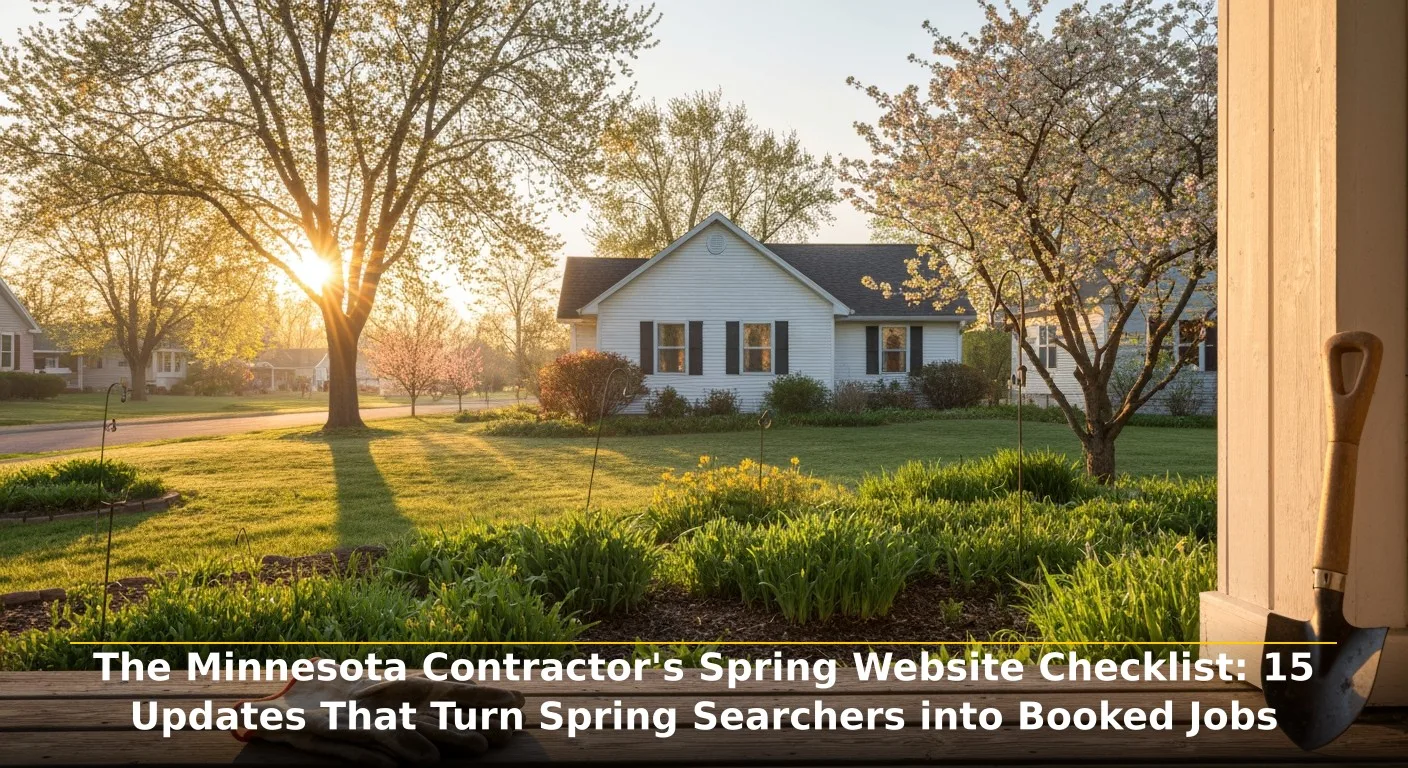
In Minnesota, late February marks the end of the deep freeze and the beginning of the most competitive search cycle of the year. Crews may not break ground until May, but the digital race for those projects is already underway. 84% of homeowners use Google to find and validate a contractor before outreach, and the ones who book the best work are those who began looking in February. A website that sits idle through winter is a liability. One that is updated, fast, and locally relevant is a lead-generation asset that fills schedules before competitors know the season has started.
This checklist covers 15 targeted updates that align your site with how Minnesota homeowners research and hire in the spring.
Key Takeaways
- Minnesota’s spring planning window opens in February, giving contractors a three-to-four-month lead before construction begins in May.
- 84% of homeowners Google a contractor before calling, and 30% will not consider a business without a dedicated website.
- Sites loading in under 1 second convert 3.5 times more visitors than those taking 5 seconds.
- Displaying a Minnesota DLI license and maintaining a 4.5-star or higher rating are non-negotiable trust signals for 92% of consumers.
- Online booking tools increase average annual revenue by 23%, capturing leads around the clock.
I. Why Spring Is the Most Important Season for Minnesota Contractors

Minnesota’s compressed building season teaches homeowners a hard lesson, waiting until the snow melts to call a contractor usually means waiting until fall to start the project. By the time the ground thaws in April, established remodelers and roofers across the Twin Cities have already finalized their early summer schedules. Homeowners who secure the best contractors are the ones who acted in February.
The planning window runs February through April. During those months, homeowners finalize designs, confirm budgets, and begin the municipal permit process. Early-season leads are also the most profitable as they’re generally organized, realistic about timelines, and less likely to be purely price-driven. Late spring leads, by contrast, are often reactive, arriving after visible winter damage and expecting an immediate start that is already impossible to schedule.
Deck building, siding replacement, and roofing repair see the sharpest search volume increases as homeowners assess post-winter damage. Contractors capturing that intent early build a resilient backlog carrying the business through the entire active season, while competitors scramble to fill gaps with whatever leads remain.
 Related article
How Your Contractor Website Should Prepare for Minnesota’s Spring Search Surge: A Seasonal SEO Checklist
Minnesota’s construction season is compressed into roughly six months, meaning the digital competition for spring projects is heavily front-loaded. By the time the ground thaws in April, the most in-demand contractors are already booked. Homeowners who fill those schedules started their search in February, and the contractors who captured them had websites that were optimized […]
II. Why Your Website Decides Whether Homeowners Call You or a Competitor

Even when a homeowner receives a direct referral, 84% still Google the contractor to check the website and reviews before making contact. A professional website is a fact-check layer that 58% of consumers use to verify claims they encountered on social media or in directories. If that layer is missing or unconvincing, the lead goes directly into a competitor’s funnel.
Trust operates as a binary filter this year. 92% of homeowners will only hire a contractor with at least a four-star rating and a credible online presence. For high-ticket projects like additions or luxury remodels, a well-built website signals technical competence and business stability. 46% of consumers perceive businesses without websites as temporary or illegitimate. Among Gen Z and Millennial homeowners, who now make up half the market, digital evidence outweighs a salesperson’s pitch by a significant margin.
The practical consequence is clear: a static or outdated website. It actively dismays leads to competitors whose sites answer the homeowner’s questions faster, more credibly, and with better visual proof.
 Related article
Minnesota’s Building Season: 7 Months. Here’s How to Books Jobs Year-Round
Minnesota’s contractors work within one of the tightest build windows in the country. Exterior construction is effectively limited to May through October by frost depth, frozen ground, and road weight restrictions that delay material deliveries into mid-spring. That leaves just five months where physical work stalls but overhead keeps running, skilled workers look for stability […]
III. The 15 Spring Website Updates

1. Replace Homepage Hero Images with Spring Project Photos
Swap out winter-themed or generic stock backgrounds for high-resolution images of active spring projects, notably decks, patios, fresh siding, and recently completed interiors. First impressions form in 50 milliseconds, and visual cues entice the homeowner into picturing this for their own home. Compress all images to WebP or AVIF format to maintain load speed alongside the improved visual quality.
2. Refresh Seasonal Service Pages
Create or update dedicated pages for the services that surge in spring demand including deck building, siding installation, roofing repair, gutter replacement. Each page should explain the Minnesotan “why now” angle, reference local building codes or permit requirements for cities like Minneapolis or St. Paul, and close with a direct call to action. Precision search queries require dedicated pages to rank.
3. Create Spring Landing Pages with Seasonal Offers
Build a dedicated page featuring a specific seasonal incentive, ideally a free spring inspection or pre-season scheduling discount. Nearly 30% of consumers partner with a business specifically because of a promotion or special event. Dedicated landing pages also improve conversion rates for local ads by providing visitors a direct path to a single offer rather than a general homepage.
4. Update Your Google Business Profile
Your GBP is the first stop for most local searchers before they visit your site. Update service categories, spring and summer hours, and your service list to reflect active seasonal offerings. Complete profiles are 2.7 times more likely to be trusted and rank higher in the Map Pack. Post a weekly project update to signal operational activity to both homeowners and the algorithm.
 Related article
Spring Is When Minnesota Homeowners Hire Contractors: Here Is What They Search for First
The first thaw of late February triggers a predictable and powerful shift in Minnesota’s home services market. While construction season runs April through October, the digital planning phase begins months earlier. By the time the snow melts, established contractors in the Twin Cities are already finalizing their May and June schedules. Homeowners who secure the […]
5. Add FAQ Content and Schema for Seasonal Questions
Write concise answers, 40 to 60 words each, to the questions your team hears most during the planning phase. Some of these may be how long does a deck build take in Minnesota, what permits are required for a bathroom addition in Hennepin County, when is the best time to schedule a roof inspection after winter. Apply FAQ schema in JSON-LD so AI engines like Gemini and Perplexity can extract and cite your answers directly.
6. Verify Mobile Page Speed Under 3 Seconds
70% of home service leads come from mobile. 53% of those visitors abandon pages taking longer than 3 seconds to load. Run a PageSpeed Insights test and address render-blocking resources, uncompressed images, and heavy third-party scripts. Even a 0.1-second improvement meaningfully increases conversion rates, and fast mobile performance is a direct ranking signal for AI-driven local results.
7. Add Online Booking or Consultation Scheduling
94% of customers are more likely to book when online scheduling is available, and contractors implementing report average annual revenue increases of 23%. An integrated scheduling tool captures leads at any hour without requiring a staff member to answer. Every hour your site cannot accept a booking request is an hour a competitor’s site can.
8. Display Your Minnesota DLI License and Insurance
Place your active DLI license number and insurance certificate details prominently in your site footer and on a dedicated trust page. 66% of homeowners say they are more likely to hire a contractor whose credentials are easy to verify online. For projects over $100,000, license and insurance verification ranks among the top three deciding factors. Removing this friction point eliminates the leading reason hesitant homeowners move on without calling.
9. Build City-Specific Pages for Twin Cities Suburbs
A single generic service page cannot rank for “remodeler near me” across Edina, Woodbury, Lakeville, and Maple Grove simultaneously. Build dedicated landing pages for each priority market with unique local content incorporating neighborhood architectural context, nearby landmarks, and city-specific permit references. 79% of homeowners prefer hiring contractors with a clear local presence. Duplicate pages with only the city name swapped trigger search penalties and reduce authority.
10. Integrate Recent Google Reviews
Add a live review widget or a curated section of reviews from the past season. 85% of consumers ignore reviews older than three months, making recency as important as volume. Reviews mentioning specific services and local city names also assist AI engines understand current capabilities and recommend your business in relevant queries. Authentic, recent social proof is the strongest conversion trigger outside of price.
 Related article
The Minnesota Small Business Website Checklist for 2026 (SEO + Conversions + Accessibility)
The digital landscape of this year for small businesses in Minnesota is more competitive and regulated than ever before. With state GDP growth currently at 1.6 percent (ranking 40th in the nation) and the highest corporate tax rate in the country at 9.8 percent, Minnesota business owners must ensure their digital presence is an efficient […]
11. Add Energy Rebate Information to HVAC and Window Pages
Nearly 19% of recent remodels were motivated by energy efficiency goals. Providing clear information on local utility rebates or federal incentives for qualifying HVAC systems, windows, or insulation upgrades gives homeowners a financial reason to act now rather than defer the project. It also positions your business as an informed resource rather than just a vendor, which strengthens trust before financial conversations begin.
12. Test Click-to-Call Functionality on Every Mobile Page
28% of consumers call a business directly after a mobile search. Every phone number on your site should be a large, high-contrast tappable button, not plain text. Phone calls convert 30% faster than web forms and generate significantly more revenue per contact. Test each button on multiple devices before the spring surge begins, since a broken click-to-call on a high-traffic service page is a silent lead killer.
13. Add Before-and-After Project Galleries from Recent Local Jobs
Sites with compelling original visuals are 42% more likely to lead to direction requests. Upload before-and-after sets that tell a clear job story: the problem, the work, and the finished result. Include location-specific captions including,”Deck Addition in Edina, MN” or “Kitchen Remodel in Woodbury.” Homeowners buy results. A local transformation documented in photos is more persuasive than any written claim regarding craftsmanship.
14. Install Live Chat for After-Hours Inquiries
56% of homeowners want the ability to communicate or schedule outside of traditional business hours. Emergency home service queries peak between 6 PM and midnight. A chat widget or AI assistant captures those leads while everyone else is offline. A homeowner whose basement is flooding at 10 PM will contact whoever responds first, and live chat puts your business in that position 24/7.
15. Submit an Updated Sitemap to Google Search Console
After making multiple content updates, manually submit your sitemap through Google Search Console to prompt faster crawling and indexing of new spring pages, project photos, and FAQ content. If Google does not index these updates promptly, you will not rank for new keywords during the peak February-to-April demand window. Faster indexing is a direct competitive advantage when every contractor in your market is updating simultaneously.
 Related article
SEO vs. Angi vs. HomeAdvisor vs. Thumbtack: Which Generates Better Leads for Contractors?
For years, third-party lead aggregators (Angi, HomeAdvisor, and Thumbtack) dominated the home services market, acting as the primary bridge between homeowners and contractors. As we move into the AI age, that dominance is being challenged. Rising platform costs, deteriorating lead quality, and the compounding value of organic search have shifted the calculus. This analysis cuts […]
IV. How These Updates Work Together

Each update on this list is independently valuable, but the compounding effect is what fills a spring schedule. Quick load speed keeps high-intent visitors on the page long enough to encounter your reviews, project photos, and credentials. City-specific pages bring locally relevant traffic to content that confirms you work in their neighborhood. FAQ schema makes answers extractable by AI assistants precisely when homeowners ask a voice query. Online booking converts that trust into a committed appointment without a phone call.
54% of homeowners choose a home services provider within four hours of beginning their search. That decision window is too short for a slow, outdated, or incomplete website to recover from a bad first impression. The updates in this checklist collectively close the gap between the moment a potential client identifies a need and the moment they book a consultation with your business specifically.
Quick-Reference: Update Priority and Primary Benefit
| Update | Priority | Primary Benefit |
|---|---|---|
| Mobile page speed under 3 seconds | Critical | Prevents 53% abandonment rate |
| Google Business Profile refresh | Critical | 2.7x more likely to be trusted |
| DLI license and insurance display | Critical | Removes top hiring hesitation |
| Seasonal service page refresh | High | Ranks for specific spring queries |
| FAQ schema markup | High | Feeds AI-driven featured results |
| Recent project gallery | High | 42% more direction requests |
| Online booking integration | High | +23% average annual revenue |
| City-specific landing pages | High | Captures hyper-local search intent |
| Google Reviews integration | Medium | Recency-driven conversion lift |
| Sitemap resubmission | Medium | Faster indexing of spring content |
 Related article
Why Every Electrician Needs a Professional Website to Capture “Electrician Near Me” Searches in Minnesota
The electrical contracting industry in Minnesota has evolved into a digital first battlefield. Traditional word of mouth is now overshadowed by a complex journey starting with a search engine. The “electrician near me” query is the modern homeowner’s first move during a winter power outage or a home renovation. For in-state contractors, professional websites have […]
V. Common Mistakes That Cost Contractors Spring Leads

The most damaging mistake is leaving a website idle through winter. Search engines reward sites appearing active. A gallery full of projects from two seasons ago, unresponsive Google Business Profiles, and reviews that have gone unanswered for months all signal to algorithms and homeowners alike that the business may not be currently operating at full capacity.
The second most common mistake is using generic content where local specificity is required. A blog post about “tips for hiring a contractor” does not capture searches for “storm damage roof repair in Saint Paul.” Missing city-specific pages, absent permit and code references, and no locally named project photos all reduce both search relevance and the trust that converts a visitor into a lead.
The third mistake is hiding the path to contact. 44% of visitors leave a site immediately when contact details are difficult to find. “Call for a quote” as the only pricing option drives homeowners toward competitors who provide at least a ballpark range. Slow, friction-heavy contact forms on mobile lose leads that a visible click-to-call button would have captured in a single tap.
Conclusion
The spring surge in Minnesota is an annual opportunity rewarding preparation and punishes delay. By the time homeowners are ready to call in April, the contractors with full schedules have already been found, vetted, and booked. The 15 updates in this checklist are the difference between a website participating in that process and one that watches it happen from the sidelines.
Commence with mobile speed and your Google Business Profile. Add your DLI license, recent project photos, and a seasonal FAQ section. Submit your updated sitemap and let the content begin building authority before the Home + Garden Show drives the first spike in search volume. Each update builds over the weeks that follow, filling your spring schedule with organized, high-intent homeowners who chose you because your website gave them every reason to.
A full spring schedule is built in February. Make sure your website is doing the work before your competitors think to start. Call our Minnesota web design team today at (612) 590-8080.
 Related article
Website Redesign in Minnesota: A “Before You Rebuild” Audit Checklist (Strategy, SEO, Tracking, Migration Risks)
The digital landscape for Minnesota businesses in 2026 is defined by a shift toward AI search overviews, elevating website redesigns to high-stakes endeavors. Many leaders impulsively prioritize aesthetics, yet ignoring the overarching strategy and technical migration plan risks a catastrophic loss of organic traffic and local visibility. This audit provides a pedagogical framework to ensure […]
FAQs About Updates That Turn Spring Searchers into Booked Jobs
1. When should Minnesota contractors prepare their website for spring?
January or early February is the target. That timing aligns with the three-to-four-month planning window homeowners follow before starting major projects in May. Updates made in February have time to index, build ranking authority, and attract traffic before search volume peaks in March and April.
2. What is the single most important website update before spring?
Mobile page speed is the foundation. If a site does not load instantly on a smartphone, most visitors leave before encountering your reviews, credentials, or project photos. Every other update on this list depends on the visitor staying long enough to see it. Fix speed first, then build on top of it.
3. How fast should a contractor website load?
Under 3 seconds on mobile is the minimum standard. Under 2 seconds is the competitive target. Conversion rates drop sharply between a 3-second and 5-second load time, and AI assistants favor faster sites when returning answers to urgent voice queries about emergency home services.
4. Do seasonal service pages actually improve SEO?
Yes, consistently. They allow you to rank for specific, high-intent phrases that a generic homepage cannot capture: “Minnesota storm damage repair,” “Twin Cities deck builder,” or “Woodbury siding replacement.” Each dedicated page also pre-qualifies the visitor by explaining your process, timeline, and local expertise before an initial phone call.
5. Should contractors update their Google Business Profile for spring?
Without question. Regularly updated profiles rank significantly higher in local Map Pack results and are far more likely to be trusted by homeowners evaluating multiple options. Update hours, include spring service categories, post weekly project updates, and respond to every review. An active GBP signals a business that is open, responsive, and worth contacting.