







Search “roofing contractor Maple Grove” on your phone right now. The first three results in the Map Pack receive the overwhelming majority of calls. Slotted below, a contractor with no website, reviews, and local pages sits invisible. They may be the most skilled roofer on the list. This does not matter. In an oversaturated market where the majority of homeowners search online before contacting anyone, being hard to find online is the same as being out of business to a growing share of the market.
Minnesota’s home improvement market adds a layer of urgency that other states do not possess. Their outdoor build season is compressed by frozen ground and a short spring, meaning the contractors who fill their schedules earliest win disproportionately. That race begins online, often in February, when homeowners start planning spring projects. A professional website determines whether a Minnesotan contractor is in that consideration set when the planning starts.
Key Takeaways
- Majority of homeowners search online before calling a contractor, and 78% who search on mobile hire within 24 hours
- Contractors without websites are automatically disqualified by a significant portion of homeowners before a single call is made
- Minnesota’s compressed build season means digital visibility in February and March directly determines schedule fill rate through summer
- A well-optimized site with local service pages and genuine reviews can outrank national chains in specific suburb searches
- AI search platforms use website content to recommend contractors: no structured website means no AI citations
1. Minnesota’s Build Season Makes Early Visibility Non-Negotiable

Most states have a year-round exterior build season. The North Star State is an outlier. Frozen ground eliminates outdoor foundation work from November through March. Spring load restrictions, which MnDOT implements each year to protect roads during the thaw, limit heavy equipment delivery windows. The result is a six-month peak season where contractors compete intensely for a fixed pool of projects.
Those dominating that season do not win it in April. They win it in February, when homeowners in Edina, Lakeville, and Rogers start researching who will be replacing their roof or building their deck when the ground thaws. Workers invisible online during that planning window lose those projects entirely, regardless of how exceptional their work is. ProWeb365’s research confirms that online visibility before the spring search surge is directly tied to schedule fill rate across the state’s construction trades.
 Related article
Home Improvement Contractor Website Structure: Pages That Rank and Convert Local Homeowners
The way homeowners find contractors online is changing rapidly. For years, the goal of a construction company was simple: show up on the first page of Google. But today, we are in the thick of the era of AI search. People are no longer just sorting through a list of links. They are asking smart […]
2. How Minnesota Homeowners Find and Vet Contractors

A traditional path for hiring a contractor in MN now looks like this: a homeowner identifies a need, opens Google Maps, searches for a service in their suburb, reviews the top three Map Pack results, and clicks the one whose profile and website look most credible. The follow up site visit is a trust verification exercise, not a browsing session. They want to confirm that the contractor is licensed, has completed this specific type of work nearby, and earned positive reviews from clients they can relate to.
According to a Minneapolis SEO agency’s research, a local roofing contractor saw a 50% increase in leads after optimizing their website content for local search. A remodeling contractor in the same market saw a 30% boost in business after claiming and optimizing their Google Business Profile alongside a structured website. What both cases share: the website was the proof point that converted a map listing into a phone call. GBP gets the homeowner’s attention. The website earns their trust.
3. What Contractors Without Websites Actually Lose
Contractors relying on referrals and aggregator leads alone face compounding disadvantages. Aggregator leads are shared among multiple competitors simultaneously, forcing an immediate price war before a single conversation transpires. Referral leads, while valuable, do not scale and skew toward repeat customers rather than new market capture.
Beyond lead quality, the absence of a website creates an after-hours revenue gap. Homeowners researching contractors often do so in the evening, after business hours, when a referral cannot be confirmed and an aggregator form is the only option. Websites with an online scheduling tool or a contact form captures those high-intent inquiries around the clock. It is the only sales asset a contractor has that works while they are on a job site.
National chains rank for broad terms. But a local contractor with a well-optimized site, suburb-specific service pages, and genuine reviews will outrank them in their own market, according to ProWeb365 with over 16 years of digital marketing. You do not need a national marketing budget to win locally. You need the right local SEO company.
 Related article
12 Trust Signals Every Home Improvement Contractor Website Needs to Convert Visitors into Clients
Trust is the most valuable tool for any home improvement contractor. For years, the goal was to appear up on the first page of Google. Today, we have entered the age of AI search. People now ask tools like ChatGPT and Gemini for direct advice on who to hire. These programs not only rank websites […]
4. Six Features That Make a Minnesota Contractor Website Stand Out

A professional website for a Minnesota contractor is not defined by how it looks. It is defined by what it does. These six features drive the difference between a site that generates calls and one that generates nothing.
- Sub-3-second mobile load time: 53% of mobile users abandon a page taking longer than 3 seconds to load. For a homeowner searching from a job site or a parking lot, a slow site signals a slow contractor. Target under 3.0 seconds on mobile. This requires compressed images, clean code, and reliable hosting.
- City-specific service pages for every suburb you serve: A single generic “Services” page cannot rank for “roofer in Woodbury” and “roofer in Burnsville” simultaneously. Dedicated landing pages for each suburb, with localized content, nearby project references, and area-specific reviews, outperform generic pages in local rankings and conversion rate.
- Persistent click-to-call button in a sticky header: In an emergency or a high-urgency situation, every extra tap costs you the call. Your phone number must live in a header following the user as they scroll on mobile, formatted as a tappable button rather than plain text.
- Before-and-after project galleries organized by type: Real transformation photos organized by project type, including kitchen remodel, basement finish, or deck build, let homeowners find proof that you’ve done their specific job well. According to remodeling marketing research, sites using real project photography with case study context consistently outperform stock photo sites in both trust and conversion.
- Minnesota-specific educational content: Blog posts and FAQs addressing problems unique to Minnesota homeowners, ideally ice dam prevention, frozen pipe repair, or building permit requirements for decks in St. Paul, attract research-phase visitors and position the contractor as the regional expert. This content also earns citations from AI platforms, which increasingly handle local service queries.
- Answer-first FAQ sections with schema markup: AI platforms like Google AI Overview and ChatGPT use your FAQ content to generate local recommendations. Structure each FAQ answer as a direct 120 to 150-word response to a natural-language homeowner question. This earns AI citations that drive traffic converting at 14.2%, five times higher than traditional organic search.
| Website Feature | Problem Solved | Minnesota-Specific Application |
|---|---|---|
| Sub-3-second mobile load | Panic-driven abandonment | Emergency searches during freeze/thaw events |
| City-specific service pages | Suburb-level search visibility | Woodbury, Eagan, Maple Grove, Rogers, Burnsville |
| Sticky click-to-call header | Friction on emergency calls | After-hours HVAC and pipe freeze inquiries |
| Real project galleries | Trust gap before first call | Local job photos with neighborhood references |
| MN educational content | Research-phase lead capture | Ice dams, permit codes, spring load restrictions |
| Answer-first FAQ schema | AI search invisibility | ChatGPT and Gemini local contractor citations |
 Related article
Why Home Improvement Contractors Need a Website to Stand Out Locally in Minnesota
Search “roofing contractor Maple Grove” on your phone right now. The first three results in the Map Pack receive the overwhelming majority of calls. Slotted below, a contractor with no website, reviews, and local pages sits invisible. They may be the most skilled roofer on the list. This does not matter. In an oversaturated market […]
5. Your GBP and Website Work as One System

Google treats your Google Business Profile (GBP) and website as a unified entity. When your website mentions the same services, neighborhoods, and keywords that appear in a GBP, one’s local confidence score increases, which lifts your position in the Map Pack. When they contradict each other, such as different phone numbers or inconsistent service area language, that score drops.
A contractor who went from invisible to ranking in the top 10 on both Google and ChatGPT in five months, documented by ProWeb365, did so by aligning their GBP and website content precisely and adding structured FAQ schema. The GBP alone could not have achieved that. The website gave the GBP the authority and content depth it needed to compete.
6. Two Contractors, Same Suburb, Different Outcomes
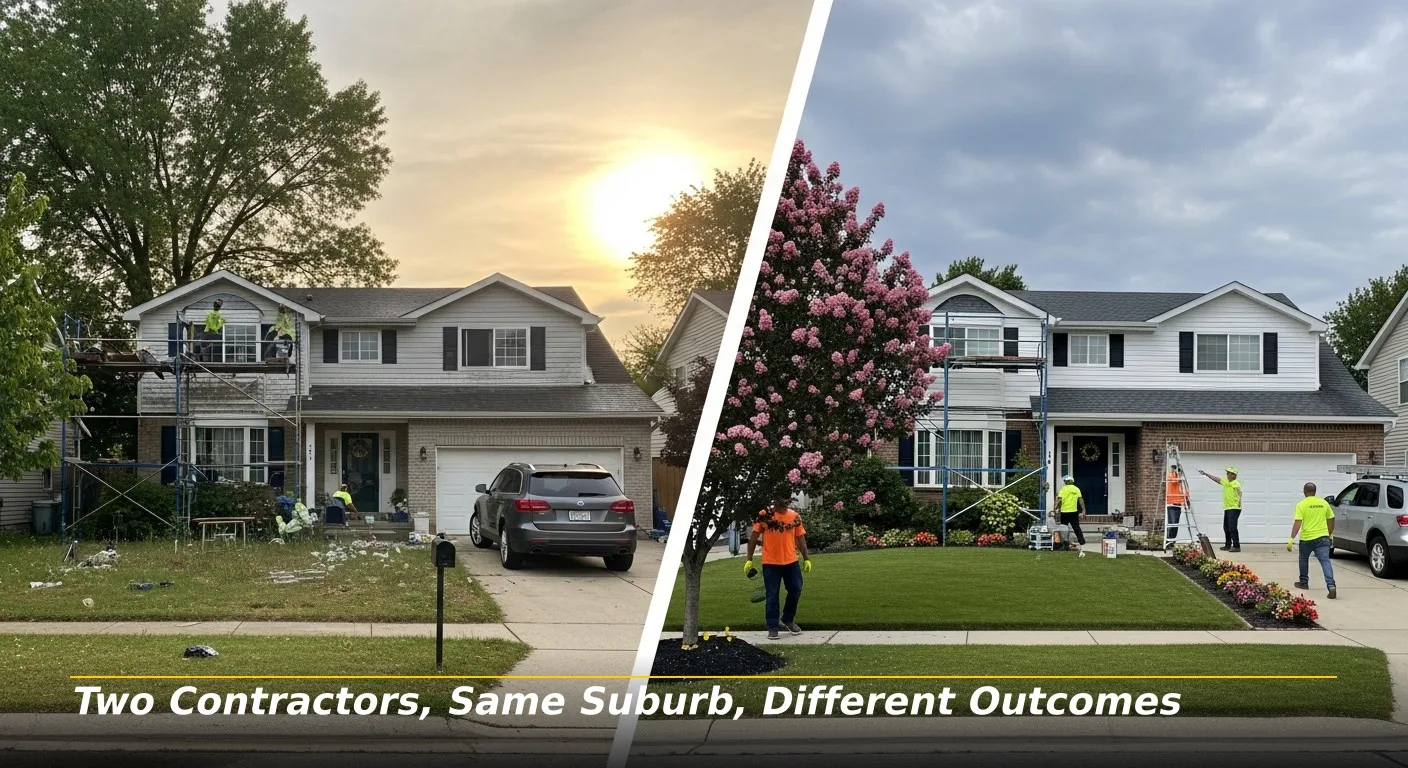
Both contractors serve the same western Twin Cities suburbs and have comparable experience in exterior remodeling.
- Contractor A relies on referrals and an outdated site with no suburb-specific pages and no reviews displayed. When a homeowner in Plymouth looks for a siding contractor after a hailstorm, Contractor A does not appear in the Map Pack. The homeowner calls two competitors who do. Contractor A does not know the lead existed.
- Contractor B invested in suburb-specific landing pages for Plymouth, Maple Grove, and Corcoran, each with local project photos and customer reviews. Their GBP is updated weekly with job photos. They have 74 reviews averaging 4.8 stars with detailed descriptions. It appears first in the Map Pack for hail damage searches in their target area. They take the call, close the job, and do so without competing on price because their website already answered the homeowner’s trust questions.
Same market. Same services. The only variable is which contractor built the digital infrastructure to be visible when it counted.
Conclusion: The Minnesota home improvement market is competitive, seasonal, and increasingly won in the digital research phase before a single call is made. A professional website is not a marketing expense for a contractor in this market. It is the infrastructure determining whether the business is visible, credible, and contactable when homeowners are ready to hire.
Every suburb-specific page built, every detailed review earned, and every FAQ answered compounds into a local authority asset generating qualified leads month after month, including through the winter months when word-of-mouth alone goes quiet. Contractors who build that asset now create a competitive advantage that grows stronger every season.
Is your business visible when Minnesota homeowners are ready to hire? Search your primary service and your top suburb on your phone right now. If your business is not in the top three Map Pack results, you are losing qualified leads every day. Start with three actions this week:
a) Update your GBP with two real job photos,
b) Respond to your three most recent reviews, and
c) Check whether your website has a dedicated page for the suburb where you win the most work.
Those actions alone will begin moving the needle within 30 days. For quicker results, call our website design company today at (612) 590-8080
 Related article
How Local SEO for Plumbers Drives More “Plumber Near Me” Calls
It’s 9 PM on a Tuesday. A homeowner’s kitchen drain backs up. They grab their phone and type: “plumber near me“. The search results appearing in the next three seconds determine which plumber gets the call greater than any accolades or ads being run. More than 800,000 people search “plumber near me” on Google every […]
FAQs About Why Home Improvement Contractors Need a Website to Stand Out Locally in Minnesota
1. What statutory warranties must Minnesota contractors provide, and why should they be on your website?
Minnesota Statutes Section 327A requires contractors to provide a one-year warranty for faulty workmanship or defective materials, two-year warranty for plumbing, heating, cooling, and electrical systems, and ten-year warranty for major structural defects. Displaying these protections prominently on your website does two things: it signals compliance and competence to homeowners who know to look, and it reassures those who do not know to ask. For high-value projects, this transparency directly reduces the homeowner’s perceived risk.
2. How do Minnesota Spring Load Restrictions affect contractor scheduling, and how can your website address them?
Each spring, MnDOT implements Spring Load Restrictions across road zones to prevent frost-thaw damage, limiting the weight of vehicles and equipment allowed on certain roads. These restrictions affect when heavy machinery and materials can be delivered to job sites, compressing the early-season schedule. Companies stating this on their website, with a brief note on how they plan around it, demonstrates the kind of regional operational knowledge that homeowners cannot find from a national chain. It is a small content investment with an outsized trust return.
3. Who is responsible for pulling building permits in Minnesota, and does it matter for your website?
Either the homeowner or the contractor can pull permits in Minnesota, but the individual who does so is legally responsible for ensuring all work meets the applicable local building codes and must be available for inspections. Contractors who handle permitting on behalf of clients remove a significant administrative burden and reduce the homeowner’s risk exposure. Stating this clearly on your website, ideally on your process page and your most relevant service pages, is a trust signal that differentiates you from competitors who leave this ambiguous.
4. What is a Designated Qualifying Person for a Minnesota contractor license, and should it appear on your site?
Many Minnesotan contractor licenses require a Designated Qualifying Person, an individual who has passed the relevant state exam and is responsible for the firm’s technical competence. This person must complete 14 hours of continuing education every two years, including required hours on the Energy Code and business management. Displaying your qualifying person’s name, credentials, and license number on a website is more than a compliance signal. It is proof that your business operates to a verified standard that anonymous competitors cannot match.
5. Can smart leak detection systems generate marketing opportunities for Minnesota plumbing contractors?
Yes. Many homeowners and insurance providers are increasingly aware that smart water monitoring devices can detect leaks early and trigger automatic shutoffs before significant damage occurs. Insurance carriers in Minnesota offer premium discounts for homes with these systems installed. Contractors who install and service smart leak detection technology can use their website to explain the insurance benefits, the installation process, and the long-term cost savings. This positions the firm as a forward-thinking specialist rather than a commodity service provider, supporting higher project values and stronger referral rates from satisfied clients.