


The Contractor's Website Checklist: 15 Features That Turn Visitors into Paying Customers

A contractor's website is no longer a digital brochure. This year, it’s the most influential salesperson in the business. 84% of homeowners leverage Google and AI answer engines to research a contractor before making contact. 58.5% of searches now end without a click because AI provides answers directly on the results page. When the user experience does lead to a click through to the website, they are already deep in the purchase funnel and have high expectations. A site that cannot meet those expectations in the first five seconds is quietly losing jobs to competitors who can.
This checklist covers the 15 features every contractor website needs to convert high-intent visitors into booked customers.
Key Takeaways
- 84% of users prefer mobile-friendly websites; sites not optimized for smartphones see a 60% bounce rate.
- A site loading in 1 second converts 3.5 times more visitors than one loading in 5 seconds.
- 50% of consumers find trust badges reassuring, and 79% watch video testimonials before choosing a provider.
- Online booking tools increase average annual revenue by 23% to 27%, capturing leads around the clock.
- SEO-generated leads from an owned website close at a rate nearly 8.5 times higher than outbound methods.
1. Why Contractor Websites Must Do More Than Look Good

Home service searches on Google grew 19% last year, and localized "near me" queries surged 25%. Discovery is increasing, but so is competition as homeowners now compare three to five contractors before making contact. A site appearing professional but lacking functional clarity will lose to a competitor whose site provides immediate answers and a frictionless path to booking.
The homeowners who click through to your site this year are not browsing casually. They have already read an AI summary, scanned multiple competitors, and narrowed their shortlist. They arrive expecting specific data: service details, real project photos, verified reviews, and a clear next step. 69% search for pricing before calling, but only 15% find a helpful answer. The contractor whose website fills that gap wins the job.
High-performing contractor sites are built around a single design principle: help the visitor make a decision as quickly as possible. That means passing the grunt test,requiring any visitor to understand what you do, where you do it, and how to hire you within five seconds of visiting the homepage.
Related article
12 Trust Signals Every Home Improvement Contractor Website Needs to Convert Visitors into Clients
Trust is the most valuable tool for any home improvement contractor. For years, the goal was to appear up on the first page of Google. Today, we have entered the age of AI search. People...2. The 15-Feature Checklist

A. Mobile-Friendly Responsive Design: 84% of visitors prefer mobile-centric browsing, and mobile searches drive 70% of all home service inquiries. A responsive design eliminates pinching and zooming, supports Google's mobile-first indexing, and increases interaction rates for the large buttons and thumb-friendly layouts that mobile users expect.
B. Hyper-Fast Page Loading Speed: 53% of mobile visits are abandoned if a page takes longer than 3 seconds to load. Sites that load in 1 second convert 3 times more visitors than those loading in 5 seconds. Modern image formats like AVIF and WebP reduce file sizes by up to 50% without quality loss, and quality managed hosting delivers load times four times faster than budget options.
C. Dedicated Service Pages: Every service you offer deserves its own page. A single homepage cannot rank for specific, high-intent searches like "emergency AC repair" or "bathroom tile installation." Individual service pages allow you to target precise keywords, walk the homeowner through your process, and pre-qualify leads before the first phone call.
D. Local SEO Optimization: 46% of all search queries have local intent. City-specific landing pages with real project photos, neighborhood references, and local landmarks signal geographic relevance to both search engines and the homeowners using them. Proximity is a primary ranking factor as well-optimized local presences position you at the top of results at the exact moment someone nearby needs help.
E. Google Reviews Integration: 92% of consumers read online reviews before hiring. A live feed of your latest Google reviews on the website provides real-time social proof that the business is active and performing well. Reviews mentioning specific services by name also help AI engines understand your capabilities and recommend your business in relevant queries.
F. Before-and-After Project Galleries: Sites with compelling original visuals are 42% more likely to receive direction requests and 35% more likely to earn a click. Before-and-after galleries demonstrate problem-solving ability through visual storytelling, assist homeowners in picturing the potential transformation of their own space, and signal that the contractor's work is worth documenting.
G. Online Booking and Scheduling: 94% of customers are more likely to book if online scheduling is available. An automated booking tool captures leads 24/7 without adding administrative overhead, and businesses implementing it report revenue increases of 23% to 27% on average. Every hour your site cannot accept a booking is an hour a competitor's site can.
H. Sticky Click-to-Call Buttons: 28% of consumers call a business directly after a mobile search. A sticky click-to-call button remaining visible as users scroll removes all friction from that action. Phone calls generate 10 to 15 times more revenue than web form submissions, making a permanently accessible phone number one of the highest-ROI elements on the page.

Related article
How a Home Builder Website Turns Local Search Traffic into Qualified Construction Leads
The home building business is rapidly transitioning. As the standard, builders only had to worry about being found on a list of links on Google. That all changed in 2026. People are not only looking...I. Trust Badges and Professional Certifications: 50% of consumers find trust badges reassuring about business legitimacy and security. Displaying your license number, insurance certificate, BBB accreditation, and trade certifications prominently reduces the hesitation that homeowners feel before inviting a contractor into their home. Sites with third-party verification badges consistently see conversion lifts above 10%.
J. Video Testimonials: 79% of people have watched a video testimonial before choosing a service provider, and video on a landing page increases conversions by up to 80%. A 60-second clip of a satisfied customer explaining what problem you solved and how the job was handled builds better emotional trust than any amount of written copy.
K. Comprehensive FAQ Section: FAQ sections serve two purposes. For homeowners, they eliminate the most common objections before the sales conversation begins. With AI engines and voice search, they mirror the natural question-and-answer format assistanting extract and read aloud as featured results. Each answer should be concise, direct, and structured around a question-formatted heading.
L. Secure HTTPS Protocol: 80% of consumers avoid websites triggering security warnings. An SSL certificate and regular malware scans are table stakes for any site asking homeowners to submit their name, address, and phone number. HTTPS is also a baseline Google ranking signal; non-secure sites are penalized in search results and flagged in the browser before a visitor reads a single word.
M. Service Area Maps and Lists: 79% of homeowners prefer hiring local companies, and they want to confirm coverage before reading any further. A clear map or list of the towns, zip codes, and neighborhoods you serve eliminates wasted inquiries from out-of-area leads and signals precise geographic relevance to AI models deciding whose name to surface in local results.
N. Structured Schema Markup: Schema markup is code (JSON-LD) that makes your business details machine-readable. Without it, an AI assistant sees your hours and services as plain text that must be interpreted. With it, Siri, Alexa, and Gemini can instantly verify your availability, service categories, and reviews. Businesses with comprehensive schema are cited in AI recommendations at significantly higher rates than those relying on text alone.
O. Prominent Call-to-Action Buttons: Websites with a clear CTA see a 45% increase in traffic retention. Action-specific buttons like Get My Free Estimate or Request Emergency Repair outperform standard Contact Us links because they match the specific intent a homeowner arrives with. Every page should have one clear next step, placed where the eye naturally lands after reading the core message.
Related article
How Your Contractor Website Should Prepare for Minnesota's Spring Search Surge: A Seasonal SEO Checklist
Minnesota's construction season is compressed into roughly six months, meaning the digital competition for spring projects is heavily front-loaded. By the time the ground thaws in April, the most in-demand contractors are already booked. Homeowners...3. How These Features Work Together
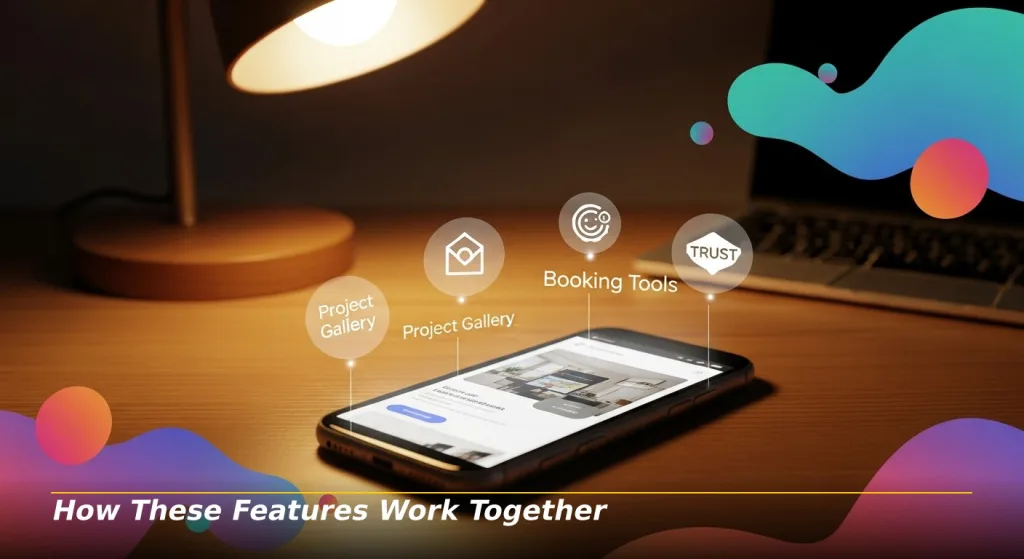
The checklist is not a list of isolated upgrades. Each feature reinforces the others. Mobile responsiveness and quick load speed create cognitive fluency: the ease of processing information that a visitor's brain interprets as trustworthiness. Service pages and local SEO ensure the targeted visitors arrive. Project galleries, reviews, and video testimonials convert their interest into confidence. Schema markup and HTTPS make the business verifiable to both humans and AI. Booking tools and CTAs close the gap between confidence and commitment.
54% of homeowners decide on a contractor in less than four hours. The features that capture urgency, specifically click-to-call buttons, online booking, and visible pricing context, are the ones determining whether a homeowner acts on your site or goes to the next result. A site missing even a few of these elements is handing a percentage of every high-intent visit to a competitor.
Key Performance Benchmarks
| Feature | Benchmark | Impact |
|---|---|---|
| Mobile optimization | 70% of leads come from mobile | Foundation for all other conversions |
| Page load speed | 1s loads convert 3x more than 5s loads | Directly reduces bounce rate |
| Online booking | +23 to 27% annual revenue | Captures leads 24/7 |
| Video testimonials | 79% watch before hiring | Up to 80% lift on landing pages |
| Trust badges | 50% find them reassuring | Over 10% conversion lift |
| Clear CTA buttons | +45% traffic retention | Reduces exit without action |

Related article
HVAC Lead Generation Strategies: Turning Website Traffic into Installation Quotes and Tune-Up Bookings in the Age of AI Search
The landscape of digital marketing for contractors has reached a pivotal turning point. For the past decade, the goal was simple, rank in the blue links of Google. However, 2026marks the definitive shift from traditional...4. Common Mistakes That Cost Contractors Leads

The most damaging issue is slow load speed. Many contractor sites carry massive, uncompressed project photos that push load times past 10 seconds. A one-second delay on mobile increases bounce rates by 123%. Heavy animations and auto-playing video compound the problem without adding any value.
The second most common mistake is relying on a single homepage rather than dedicated service pages. A homepage cannot rank for "emergency furnace repair" and "kitchen remodel" simultaneously. Each service needs its own page to target specific searches and pre-qualify the leads that arrive.
The third mistake is hiding pricing and contact information. 44% of visitors leave a site immediately when contact details are hidden, while 69% of homeowners expect to see at least a pricing range before calling. Contractors forcing homeowners to call only to learn whether a service is affordable lose those leads to competitors providing upfront context.
Conclusion: This year, a contractor's website is either working as a lead generation engine or quietly redirecting customers to competitors. The 15 features in this checklist represent the difference between a site that looks like a business and one acting like it.
The investment is straightforward to justify. 30% of homeowners eliminate any contractor without a professional website before making contact. Businesses with a modern web presence report revenue growth 2.8 times faster than their offline counterparts. And every dollar spent on advertising is partially wasted if the website it points to cannot close the visit.
Start with a mobile speed test and a review of your current contact and booking options. Those two areas alone determine whether a majority of your visitors stay or leave. From there, build out service pages, add schema markup, and put your best project photos and customer videos where they can do the most work. The goal is a site that earns trust before a competitor gets a chance to answer the phone. Call our team of Minnesota contractor website designers today at (612) 590-8080.

Related article
Kitchen Remodeling Website Ideas: How to Showcase Projects, Styles, and Budgets to Pre-Qualify Leads
The way homeowners find kitchen remodelers has changed forever. For years, the key ingredient was showing up on a list of links on Google. But this year, people are using smart AI tools like ChatGPT,...FAQs About The Contractor's Website Checklist
1. What makes a good contractor website?
Speed, mobile usability, and trust signals are the foundation. Beyond those, a high-performing contractor site clearly states what you do, where you do it, and why you are the right choice, then makes it effortless for the visitor to take the next step.
2. How much does a professional contractor website cost?
A custom-designed site for a mid-sized contractor typically ranges from $2,000 to $10,000 or more depending on complexity, number of service pages, and integrations. Template sites cost less upfront but often lack the local SEO structure, schema markup, and speed optimization needed to compete for high-value leads.
3. Do contractor websites really generate leads?
Yes. SEO-generated leads from an owned website close at a rate nearly 8.5 times higher than outbound methods. Premier sites function as a 24/7 salesperson that captures intent at the moment of need, without a per-lead fee or shared competition.
4. What is the most important feature on a contractor website?
Speed is the foundation. If websites take longer than 3 seconds to load, half of potential customers leave before seeing any of the content, credentials, or reviews that would have convinced them to call. Every other feature depends on the visitor staying long enough to encounter it.
5. How often should a contractor update their website?
Service pages and core content should be reviewed every six months. Project galleries, reviews, and blog content should be continuously updated. AI engines like Perplexity prioritize recently updated content: 82% of content refreshed within 30 days is cited in AI results, compared to 37% for older material.

Phong Nguyen
Phong brings the perfect combination of business acumen and technical expertise to digital marketing. Armed with a Bachelor of Arts degree from St. Olaf College, a master’s in business administration in Marketing from the University of St. Thomas, and SEO/GEO from “The School of Hard Knocks,” Phong founded ProWeb365.com in 2009 to help Minnesota businesses and non-profit organizations succeed online.
For over 15 years, Phong and his team’s strategic approach has combined data-driven marketing with conversion-focused design, delivering measurable results that directly impact his clients’ bottom line. Are you ready to experience what innovative digital marketing can do for your business in the age of AI search engines? Contact Us today!