






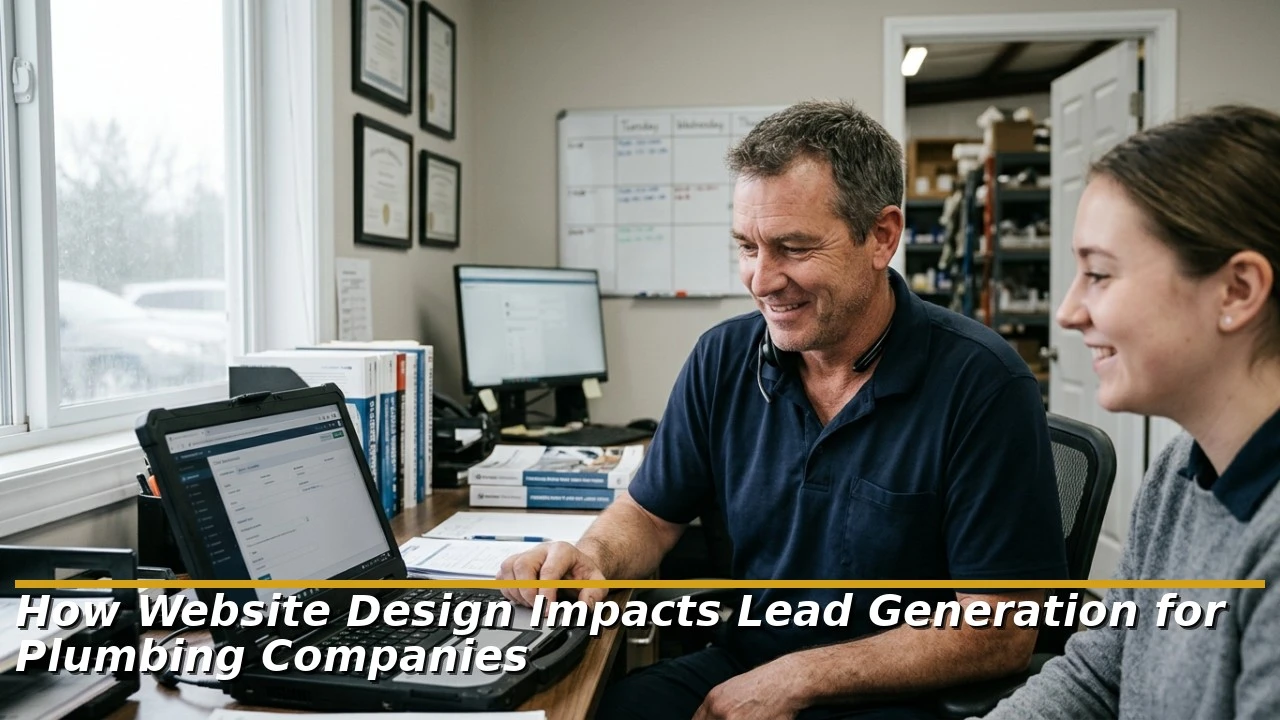
A homeowner finds water pooling under her kitchen sink at 7 AM. She searches for a plumber on her phone. Three results appear. The first is clicked on. Their site is slow to load, the phone number is buried at the bottom, and the photos look like they were taken in 2009. They hit the back button and call the second result instead. That plumber gets the job.
That scenario plays out hundreds of times daily in every service market across the country. According to Amra & Elma’s plumbing marketing research, roughly 70% of potential customers visit a plumbing company’s website before making a call. And 75% of them will judge the company’s credibility based on design alone, before reading a single word. Your website is not a digital brochure. This is the first and often only impression you get to make.
Our article breaks down exactly how website design drives or destroys lead generation for plumbing businesses, what the highest-converting sites do differently, and the eight design elements every contractor needs in place to turn traffic into booked jobs.
Key Takeaways
- 75% of users judge a plumbing company’s credibility based solely on website design
- 70% of potential customers visit your website before calling, making first impressions non-negotiable
- A well-designed site can improve conversion rates by up to 600% compared to a dated one
- Mobile-optimized sites generate 67% more calls than desktop-only designs
- Keyword-matched CTAs, such as “Get Emergency Service Now,” boost conversions by up to 87%
1. The 50-Millisecond Problem

Research from ResearchGate found that visual trust judgments are made within 50 milliseconds of a page loading. That is faster than the blink of an eye. Momentarily, the homeowner’s brain is not evaluating your years of experience or service guarantees. It is asking one question: does this look like a business I can trust?
For a plumbing service, the trust threshold is higher than almost any other industry. A plumber is someone a homeowner invites into their home during a stressful, often chaotic moment. The website must close the psychological gap between stranger and trusted professional before connecting. A cluttered layout, outdated typography, or stock photos of actors in hard hats will fail that test every time.
The inverse is equally true. A clean, fast, and well-organized site communicates that the contractor is organized, reliable, and attentive to detail. Your design is a proxy for your workmanship. Potential clients make that connection automatically, and it happens instantaneously.
 Related article
How a Professional Plumbing Website Builds Trust During Emergency Situations
The U.S. plumbing industry reached $191.4 billion in 2026, growing at a compound annual rate of 3.1% over five years. But behind that figure is a more intimate reality: every dollar of that growth passes through a moment of household panic. A pipe bursts at 11 p.m. A basement drain backs up on a Sunday […]
2. How Stressed Homeowners Actually Use Your Website

A homeowner in a plumbing emergency is not browsing. They are scanning for one thing: a fast way to make the problem stop. Psychologists describe this state as a perceived loss of agency, where stress reduces the brain’s capacity for rational deliberation and drives users toward the fastest available path to relief.
Heatmap and eye-tracking studies see two dominant reading patterns on plumbing websites. On landing pages with a single clear goal, users follow a Z-pattern: eyes move from the logo to the top-right contact area, across to a benefit statement, and then down to the call to action. On service-specific pages, users switch to an F-pattern, skimming headlines and the first few words of bullet points to confirm the service needed is offered. In both cases, any friction between the user and the phone number is a lead lost.
The practical implication: your most important information must be visible without scrolling, zooming, and hunting. Phone number in the header. Emergency availability in the hero section. Service confirmation in the first subheading. Every extra click required loses a percentage of your callers.
 Related article
The Importance of a Fast-Loading Website for Plumbing Businesses
A homeowner runs Google Ads. He pays $75 for a click from a homeowner searching “emergency plumber near me” at 2 AM. She lands on his website. It takes five seconds to load. They hit the back button and call the next result. That money was essentially spent for nothing. This scenario plays out dozens […]
3. The 8 Design Elements That Drive Plumbing Leads

The gap between a site converting at the industry average of 2% to 5% and a top-performing site converting at 8% or more comes down to architecture. These eight elements separate the lead generators from the digital brochures.
- Mobile-first design: More than 70% of plumbing searches happen on smartphones, and mobile-optimized sites generate 67% more calls than desktop-only designs, according to BrightLocal data. Build for mobile first. Use touch targets of at least 48 by 48 pixels, eliminate horizontal scrolling, and ensure text is readable without zooming.
- Sub-2-second load time: 53% of users abandon a page that takes more than 3 seconds to load. For a homeowner in a panic, that threshold is even lower. Target a Largest Contentful Paint (LCP) of under 2 seconds. Doing so entails image compression, clean code, and a content delivery network (CDN). Speed is not a technical nicety; it is a conversion requirement.
- Persistent click-to-call button: Your phone number must live in a sticky header that follows the user as they scroll. On mobile, it should be a tappable button, not text. According to Google’s own data, 60% of smartphone users contact a business directly from search using click-to-call. Make that the path of least resistance.
- Above-the-fold CTA with urgency language: Keyword-matched CTAs, notably “Call Emergency Service Now” for users who arrived via an emergency plumber search, boost conversions by up to 87%, according to Cube Creative research. A single dominant CTA outperforms a page with multiple competing buttons every time.
- Verified trust signals: Display your state license number, insurance badge, and professional affiliations, including PHCC or NATE, prominently on the homepage and every service page. These are not decorative. They answer the viewer’s core safety question: Is it safe to let this person into my home?
- Real team photography: Stock photos of generic workers in hard hats are immediately recognizable and immediately damaging to trust. Genuine photos of your crew, branded vehicles, and completed jobs establish the human connection that converts a stressed searcher into a caller.
- Service-specific landing pages: Each major service, including water heater repair, drain cleaning, sewer line replacement, and leak detection, needs its own dedicated page. These match search intent, improve local SEO performance, and allow you to speak directly to the specific concern the homeowner arrived with.
- Embedded video: Research from HVAC-Plumber SEO Webmasters shows that embedding video on service pages increases conversions by 86%. A 60-second walkthrough of how you handle a common job, filmed on a smartphone, does more to build trust than any editorial can.
| Design Element | Impact on Conversions | Priority Level |
|---|---|---|
| Mobile-first design | +67% more calls vs desktop-only | Critical |
| Sub-2-second load time | 53% of users leave at 3+ seconds | Critical |
| Persistent click-to-call | 60% of mobile users use click-to-call | Critical |
| Urgency-matched CTA | Up to 87% conversion boost | High |
| Real team photography | Reduces bounce, builds trust | High |
| Embedded video | +86% conversion rate on service pages | High |
| Service-specific pages | Matches intent, improves SEO | Medium |
| Verified trust signals | Reduces homeowner safety hesitation | Medium |
 Related article
How Local SEO for Plumbers Drives More “Plumber Near Me” Calls
It’s 9 PM on a Tuesday. A homeowner’s kitchen drain backs up. They grab their phone and type: “plumber near me“. The search results appearing in the next three seconds determine which plumber gets the call greater than any accolades or ads being run. More than 800,000 people search “plumber near me” on Google every […]
4. How Design and Local SEO Reinforce Each Other

Website design and search engine optimization are not separate disciplines for a plumbing business. They are the same system viewed from two angles. Google’s ranking algorithm treats page speed, mobile usability, and Core Web Vitals as direct ranking signals. Slow or poorly structured sites do not only hinder conversions, they suppress visibility before the homeowner even finds you.
Design also determines how effectively your site earns citations from AI search platforms. Tools like Google Gemini and ChatGPT utilize your page structure to extract and verify business information. A site with clear service hierarchy, FAQ sections with schema markup, and consistent NAP data gives AI engines the structured signals they need to recommend your business for local queries. A site without that architecture is invisible to the growing share of searches that begin with an AI assistant.
The practical outcome: 78% of plumbing leads now come from organic search and Google Maps, according to Bullseye Marketing Consultants. Design is what converts organic traffic once it arrives. SEO gets the homeowner to your door. It determines whether they knock.
 Related article
Contractor Website vs. Lead Generation Platforms: Why HVAC Companies Should Own Their Online Presence
Most HVAC business owners feel like they are caught in a trap. To keep their trucks moving and phones ringing, they feel that industry leading middleman websites like Angi, HomeAdvisor, or Thumbtack have a chokehold on their leads, having to pay for work. It feels like paying rent to a landlord who keeps raising the […]
5. Two Plumbing Websites, Same Market, Different Results

Both contractors serve the same city. Each has been in business for over eight years. Both do quality work.
- Plumber A built their site in 2019. It features stock photography, a contact page buried three clicks deep, and loads in 4.5 seconds on mobile. The phone number appears only in the footer. Their conversion rate is below 2% and they spend around $78 to acquire a single lead through Google Ads.
- Plumber B redesigned their site with a conversion-first approach. It loads in 1.7 seconds. The sticky header carries a click-to-call button and a “24/7 Emergency Available” badge. Every service has its own landing page with real job photos and a customer review from that specific type. Their conversion rate is 4.3%, their cost per lead dropped to $41, and they doubled their booked jobs from the same advertising budget.
The difference in outcome was not skill, pricing, or service area. It was architecture.
| Metric | Plumber A (Unoptimized) | Plumber B (Conversion-Optimized) |
|---|---|---|
| Mobile Load Time | 4.5 seconds | 1.7 seconds |
| Conversion Rate | 1.8% | 4.3% |
| Cost Per Lead | $78 | $41 |
| Phone Number Visibility | Footer only | Sticky header, above the fold |
| Service Pages | One generic page | Individual page per service |
Conclusion: Your website is the first responder your business sends to every potential customer, before your phone rings, trucks roll, or even a single word is exchanged. Its design determines whether a stressed homeowner stays or bounces, calls or clicks away, books a job or gives it to your competitor down the street.
The gap between a site converting at 1.8% and one converting at 4.3% is not a matter of budget. It is about intentional architecture: the right CTA in the right place, real photography instead of stock images, load times under two seconds, and a phone number that is always one tap away. These are decisions, not expenses. And the contractors who make them deliberately are the ones filling their schedules while their competitors wonder where the calls went.
Is your website turning visitors into calls?
Open your website on your phone right now. How long does it take to load? Is your phone number visible without scrolling? Do you have a button that says something other than “Contact Us”? Those three questions will tell you more about your lead generation problem than any audit report. If the answers concern you, a conversion-focused redesign is not a cost: it is the fastest way to grow your call volume without spending more on ads. If you need a professional website designed and SEO to bring you leads, call our Local SEO company in Minnesota today at (612) 590-8080.
 Related article
How Your Contractor Website Should Prepare for Minnesota’s Spring Search Surge: A Seasonal SEO Checklist
Minnesota’s construction season is compressed into roughly six months, meaning the digital competition for spring projects is heavily front-loaded. By the time the ground thaws in April, the most in-demand contractors are already booked. Homeowners who fill those schedules started their search in February, and the contractors who captured them had websites that were optimized […]
FAQs About How Website Design Impacts Lead Generation for Plumbing Companies
1. How much does a professional plumbing website cost?
Costs vary based on scope. Bare-bone DIY templates start around $800, but offer limited conversion optimization and no custom local SEO structure. For most established plumbing businesses, a custom-built, growth-ready site from a specialist agency runs between $5,000 and $15,000. Enterprise builds for multi-location operations can exceed $30,000. The more relevant benchmark is cost per lead: a well-optimized $10,000 website generating 50 calls per month at $0.50 each pays for itself in its first season.
2. How long does it take to see more leads after a website redesign?
Technical improvements, such as fixing load speed and mobile responsiveness, can show measurable gains in traffic and call volume within one month. A full redesign typically reaches its conversion potential within 3 to 6 months, as search engines re-index the new structure and review velocity compounds alongside the improved user experience. Contractors who treat a redesign as a one-time project rather than an ongoing system tend to see growth plateau. Those who continue updating content and reviews see compounding returns.
3. Does a plumbing website need SEO to generate leads?
Yes, and the relationship is inseparable. SEO drives the traffic; design converts it. A beautifully designed site with no search visibility generates zero calls. A highly ranked site loading slowly or buries its phone number wastes the traffic it earns. According to research from Ignite Visibility, local SEO leads convert at a rate 6 times higher than outbound marketing leads, but only when the site they land on is designed to receive them. Invest in both simultaneously, not sequentially.
4. Which platform is best for a plumbing website: WordPress, Webflow, or Wix?
For most plumbing businesses, WordPress remains the optimal choice due to its depth of SEO control, plugin ecosystem, and scalability as the business grows. Webflow is well-suited for contractors needing clean, fast-loading code without the overhead of plugin management. Wix offers the fastest path to a live site for solo plumbers or condensed operations, though its SEO ceiling is lower than the other two in competitive markets. The platform matters less than whether the site is actually optimized after launch. A poorly configured WordPress site will underperform a well-optimized Wix site every time.
5. Can a strong website reduce or replace paid advertising spend?
High-performing websites reduce dependence on paid ads significantly over time, but rarely replaces them entirely during the growth phase. Organic SEO leads cost between $0.50 and $2.00 each, compared to $15 to $50 for Google Ads leads. However, organic rankings take 3 to 6 months to build in most markets. The most effective approach for growth-focused plumbing businesses: run Google Local Service Ads for immediate call volume while building organic and design infrastructure to lower your cost per lead permanently. Use ads as a bridge, not a foundation.