





Two roofing contractors each spend $2,000 a month on Google Ads. Both target the same keywords, serving the same market. One averages 22 booked jobs a month. The other,11. This difference is not their ad spend, bid strategy, or service area. It is what happens after someone clicks their ad. One contractor’s website converts. The other’s leaks.
For roofing contractors, a website is the conversion engine that determines the return on every marketing dollar spent, whether that dollar goes to paid search, local SEO, or social media. Traffic without conversion architecture is waste. According to research on home service marketing, phone calls from search results convert at 40% for roofing, climbing to 60% to 70% in emergencies because urgency eliminates comparison shopping. The features on your website determine whether that call happens or whether the homeowner bounces to the next result.
This article covers the eight website features that move the needle most for roofing contractors, how they work as a system, and what the performance gap looks like when they are in place versus absent.
Key Takeaways
- Conversion rate matters more than traffic: 22 calls from 500 visitors beats 11 calls from 1,000 visitors every time
- 73% of roofing searches happen on smartphones; mobile load time and tap-to-call are the two features that drive calls
- Pages loading in 1 second convert at 3x the rate of pages loading in 5 seconds, making speed a direct revenue variable
- Dedicated service silos for repair, replacement, and insurance claims each attract distinct search intent and AI citations
- Real project galleries using a problem-proof-outcome format convert 86% better than undescribed photo grids
1. Why Calls, Not Traffic, Is the Only Metric That Scales a Roofing Business
Many contractors track their website’s visitor count as a measure of marketing success. Visitor count is a vanity metric. Those generating 1,000 visitors a month at a 1% conversion rate books 10 jobs. The same site at 4% conversion books 40 jobs from identical traffic. That gap, between 10 and 40 jobs, is the entire difference between a contractor who is growing and one who is buying more ads to stay flat.
The reason conversion rate compounds so dramatically is the nature of roofing demand. Roof replacements average $10,000 to $30,000. Each additional call that converts has significant revenue attached. Improving conversion rate from 1.5% to 3% does not require a single additional dollar of ad spend. It needs the right features in the right places on the site the homeowner is already visiting.
The features below address the specific friction points making roofing visitors leave without calling. Each one targets a distinct stage of the 50-millisecond-to-call journey: speed that keeps them on the page, trust signals that keep them engaged, and conversion architecture that turns engagement into a phone call.
 Related article
Which Website for Roofing Contractors Generates More Leads: DIY or Pro?
The roofing industry is one of the most competitive spaces in local home-related website searches. For a roofing contractor, the digital landscape has shifted from a simple list of links to a complex ecosystem where AI companions now provide direct recommendations. Homeowners facing a sudden leak or storm damage no longer just browse; they ask […]
2. The 8 Website Features That Drive More Roofing Calls
- Sub-2-second mobile load time. Pages loading in 1 second convert at 3 times the rate of pages loading in 5 seconds, according to Portent’s site speed research. For roofing, where 73% of searches occur on smartphones and emergencies dominate the query mix, load time is the most consequential single variable. Target a Largest Contentful Paint (LCP) under 2.0 seconds. Achieve it through WebP image compression, a caching plugin, and a reliable CDN. Every second above 2 costs measurable conversion.
- Sticky click-to-call button in the header. The phone number must be a tappable button following the user at every scroll position on mobile. In an emergency search, homeowners with water coming through their ceiling cannot navigate to a contact page. One tap from anywhere on the site is the standard. Plain text phone numbers in footers lose calls that the rest of the site spent resources earning.
- Emergency availability badge above the fold. A homeowner searching at 9 PM after a storm needs to know immediately that you are available. A 24/7 emergency badge in the hero section, before any scrolling, removes the most common reason storm-damage searchers move to the next result. It is the fastest trust signal a roofing website can deploy.
- Dedicated service pages for repair, replacement, and insurance claims. Each major service needs its own page with unique keyword focus, call to action, and schema markup. Clients searching “emergency roof repair Minneapolis” has different intent than one researching “roof replacement cost Eagan.” Sending both to the same homepage wastes the specificity that got them to click. Dedicated service silos also give AI platforms the structured content they need to recommend you for specific query types, and AI-referred leads convert at 14.2%, five times higher than traditional organic traffic.
- Real before-and-after project galleries with damage descriptions. Generic photo grids tell a homeowner nothing useful about whether you can handle their problem. Before-and-after galleries using a problem-proof-outcome format, describing the specific damage type, showing the repair progression, and stating the outcome, convert 86% better according to remodeling marketing research. Organize by damage type: hail, wind, ice dam, and age-related deterioration. Viewers identify with their specific situation.
 Related article
How Local SEO Helps Roofing Companies Dominate “Roof Repair Near Me” Searches in Minnesota
A hailstorm moves through the western Twin Cities suburbs on a Tuesday afternoon. By evening, homeowners in Maple Grove, Rogers, and Plymouth are searching their phones for “roof repair near me.” The three roofing companies that appear at the top of the Map Pack take calls for two weeks. Those not appearing watch a season’s […]
- Live Google review feed with service and suburb specificity. A live feed of recent reviews, showing descriptions that mention specific services and neighborhoods, provides real-time social proof that static badges cannot match. Reviews mentioning “emergency hail repair in Rogers” or “Rain ice dam removal in Maple Grove” carry six times more AI search visibility value than generic five-star ratings. Displaying near calls to action, where they reduce hesitation at the moment of decision.
- Suburb-specific service area pages. A single generic “Service Area” page cannot rank for “roofer near me” searches across five different suburbs simultaneously. Build dedicated pages for each major suburb you serve, each containing a local project reference, a review from a customer in that area, and suburb-specific content. These rank independently, capture suburb-level search intent, and confirm to homeowners that you are a permanent local business, not a storm chaser passing through.
- Simplified contact form with three to four fields for non-emergencies. Emergency callers utilize the phone number. Non-emergency inquiries, such as planned replacements or free inspection requests, convert through forms. Every additional field reduces submission rate. Name, phone number, service type, and a brief description is sufficient for a roofing inquiry. Its goal is to start a conversation, not to conduct a full intake interview.
| Feature | Friction It Removes | Measurable Impact |
|---|---|---|
| Sub-2-sec load time | Panic-driven abandonment | 3x conversion rate vs. 5-second sites |
| Sticky click-to-call | Buried contact info | One tap from any scroll position |
| Emergency badge | Uncertainty about after-hours availability | Eliminates next-result abandonment |
| Dedicated service pages | Mismatch between query intent and landing page | 14.2% AI lead conversion rate |
| Problem-proof-outcome gallery | No evidence you can handle specific damage | +86% vs. undescribed photo grids |
| Live review feed | Missing social proof at decision point | 6x AI visibility per service-specific review |
| Suburb service pages | No local relevance signal | Independent suburb-level rankings |
| 3-4 field contact form | Friction on non-emergency inquiries | Higher form completion, lower abandonment |
 Related article
How a Roofing Website Builds Trust with Homeowners After Storm Damage
A hailstorm passes through a Minneapolis suburb on a Friday afternoon. Once evening rolls around, the homeowner has water staining on her ceiling and an insurance claim she does not know how to file. On her phone, she frantically researches, “emergency roofer near me” and opens the first two results. One shows a stock photo, […]
3. How These Features Work as a Compounding System

Each feature above solves a specific friction point. Their compounding effect is what separates a contractor doing 22 jobs a month from one having 11. Load time keeps the homeowner on the page long enough to register the emergency badge. The badge triggers the first tap on the click-to-call button. The review feed visible next to the CTA confirms the decision. A suburb page ensures the homeowner arrives on a page that speaks to their specific location before any of this happens.
From an SEO perspective, the same features that convert human visitors also satisfy Google and AI search engines. Fast Core Web Vitals lift organic rankings. Dedicated service silos provide AI platforms extractable content. Suburb pages capture local search intent. Schema markup makes FAQ content eligible for AI citations. The conversion architecture and the SEO architecture are the same investment producing two parallel returns.
4. Same Budget, Different Architecture, Different Revenue

Two contractors. Same market. Same $2,000 monthly ad spend on Google Ads targeting identical keywords.
Contractor A’s site was built in 2019. One generic services page. No suburb-specific landing. Load time: 5 seconds. Phone number in the footer. Eight reviews from three years ago displayed as static text. Conversion rate: 1.8%. Cost per lead: $135 through aggregators. Monthly booked jobs: 11.
Contractor B invested in conversion architecture. Eight service-and-suburb page combinations. Load time: 1.7 seconds. Sticky click-to-call in a header that shows a 24/7 emergency badge. Live review feed with 54 recent reviews mentioning specific services and suburbs. Before-and-after galleries organized by damage type. Conversion rate: 4.3%. Cost per lead: $74 from organic. Monthly booked jobs: 22.
Same ads. Same market. Same competition. The architecture is the only variable that explains a 100% difference in booked jobs.
Conclusion
A roofing website driving calls is not built on aesthetics. It is built on specific, measurable features that remove friction at each stage of the homeowner’s journey from search to phone call. Load time keeps them on the page. The emergency badge and click-to-call button convert the urgency into action. Before-and-after galleries and live review feed close the credibility gap. Suburb-specific pages ensure they arrived on a page designed for their exact context.
These eight features are not technically complex or prohibitively expensive. All are measurable, and they compound. Contractors engineering this architecture into their site creates an advantage that builds month over month, converting more of the same traffic into revenue without increasing ad spend.
Test your own conversion architecture right now.
Open your website on your phone and time how long it takes to load. Find your phone number and count the taps to reach it. Check whether a 24/7 emergency badge is visible without scrolling. Those three tests take two minutes and will tell you exactly which of the eight features your site is missing. Fix the load time and the sticky header first. Those two changes will move your conversion rate within 30 days.
 Related article
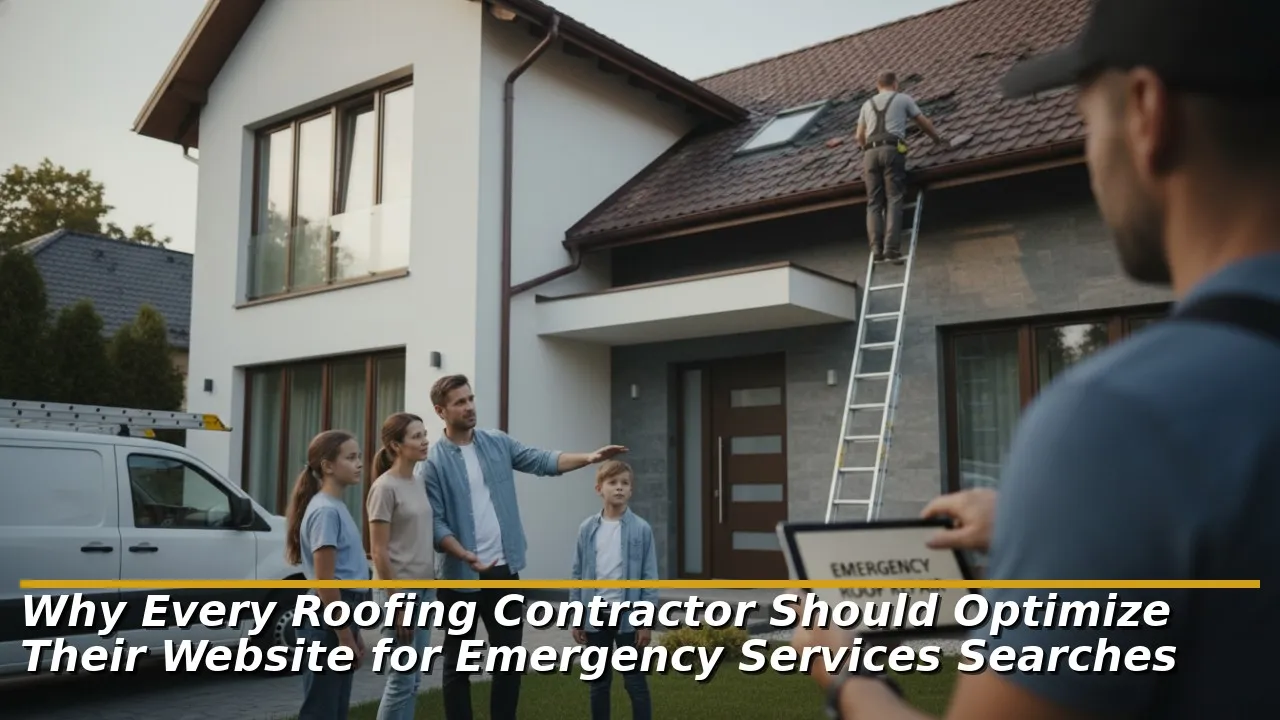
Why Every Roofing Contractor Should Optimize Their Website for Emergency Services Searches
At 11 PM on a Thursday, water is dripping through a homeowner’s kitchen ceiling. She opens Google, types “emergency roofer near me,” and calls the first result showing a 4.9-star rating, 24/7 badge, and phone number that loads before anything else. The entire decision takes under four minutes. The contractor who appears in that Map […]
FAQs About Digital Marketing for Roofing Contractors: Website Features That Drive More Calls
1. How do Google Local Service Ads complement a contractor’s website features?
Google Local Service Ads (LSAs) appear above the standard Map Pack and carry a Google Guaranteed or Google Screened badge. This adds a layer of platform-verified trust that a website alone cannot replicate. LSAs operate on a pay-per-lead model and link directly to your GBP rather than your website. The practical implication: a homeowner who sees your LSA listing, clicks through to your GBP, and then visits your website encounters three consecutive credibility signals before calling. A website with high conversion features amplifies LSA performance by ensuring that homeowners who follow that path convert at a higher rate. Contractors who invest in both strong website architecture and active LSA management consistently report lower blended cost-per-lead than those relying on either channel alone.
2. What does Google’s “Openness” signal mean for roofing call volume?
Google actively filters search results and Map Pack listings based on whether a business appears to be open at the exact moment of the search query. For roofing contractors, this is most consequential during post-storm evening searches, when demand peaks but many businesses have set their GBP hours to close at 5 PM. A contractor whose GBP accurately reflects 24/7 emergency availability, and whose website prominently states that same availability, captures a disproportionate share of after-hours storm-damage calls. The fix is straightforward: update your GBP hours to reflect true emergency availability, add a secondary phone number designated for after-hours calls if needed, and ensure your website’s emergency badge matches what the GBP states. Inconsistency between the two reduces your visibility for the highest-converting query type a roofer can capture.
3. How does drone footage and video content affect roofing website conversion rates?
Video content on landing pages increases conversions by 86% on average, according to remodeling marketing research, but the type of video matters significantly for roofing. Drone footage of a completed roof replacement, showing the scale and quality of the work from above, provides visual evidence that ground-level photography cannot. Time-lapse videos of a full-day installation answer the homeowner’s unspoken question about how disruptive the process will be. A 60 to 90-second walkthrough of a hail-damage assessment, narrated by the project manager, builds the human trust that converts high-ticket decisions. These videos do not require fancy production. A smartphone with stabilization and a basic microphone produces content that consistently outperforms polished stock footage in conversion testing for home service businesses.
4. How should roofing contractors think about website A/B testing?
Most roofing contractors skip A/B testing because it sounds technical and time-consuming. This does not need to be. The highest-impact tests for a roofing website are also the simplest: CTA button text (“Call for Emergency Service” vs. “Get a Free Inspection”), CTA button color (red vs. blue for the primary emergency action), contact form field count (four fields vs. three fields), and homepage hero image (branded crew photo vs. before-and-after transformation). Running one test per month, alternating the variable for two-week periods while tracking call volume through Google Analytics call tracking, produces actionable data within a single quarter. Contractors testing consistently learn which specific words and visuals their local market responds to, which compounds into a conversion rate advantage that competitors without testing cannot replicate.
5. What schema markup types are most valuable for a roofing contractor’s website?
Three schema types produce the most measurable results for roofing contractors. Local Business schema, implementing your business name, address, phone number, service area, and hours in machine-readable format, is the foundation that AI platforms use to verify and recommend your business for local queries. FAQPage schema on your most common question pages, covering topics like “how long does a roof replacement take” or “what does a hail damage inspection cover,” makes those answers eligible for AI citations and voice search results. Service schema on each dedicated service page, describing the specific service, price range (if disclosed), and geographic availability, grant AI search engines the structured data they need to recommend you for service-specific queries. Together, these three schema types create the machine-readable layer that makes a well-built roofing website eligible for the AI-referred leads that convert at 14.2%, five times above traditional organic traffic.