





The roofing industry is one of the most competitive spaces in local home-related website searches. For a roofing contractor, the digital landscape has shifted from a simple list of links to a complex ecosystem where AI companions now provide direct recommendations. Homeowners facing a sudden leak or storm damage no longer just browse; they ask tools like ChatGPT or Gemini questions like these: “Who is the most reliable roofer near me for a slate roof repair?”
In this new era, your website is the lifeblood of your business legitimacy. Many contractors face a difficult choice: should they build a simple site themselves using a platform like Wix or Squarespace, or should they invest in a professionally developed asset? While the low monthly cost of a homemade web presence is tempting, the long-term impact on lead generation and AI visibility is often misunderstood. Let’s explore both options to determine which one puts more jobs on your calendar in the age of AI search.
Key Takeaways
- Conversion Superiority: Professional roofing websites typically convert visitors into leads at rates 4-6 times higher than do-it-yourself templates.
- AI Discovery Gap: AI search engines like Perplexity and Google Overviews prioritize structured data and technical speed, which most homemade website builders cannot fully optimize.
- The Cost of Time: Building a DIY site often requires 40-60 hours of a contractor’s time, creating a hidden opportunity cost that can exceed the price of professional help.
- Trust and Credibility: A full 75% of homeowners judge a company’s reliability based on its website design, making a “good enough” site a liability for high-ticket replacements.
- Immediate Intent: Mobile searches for “roof repair near me” result in a call within 24 hours for more than 75% of potential customers, requiring a lightning-fast mobile experience.
1. Why Are Roofing Contractors Even Asking This Question?

Roofing is a high-ticket, high stakes purchase for homeowners. A standard roof replacement can cost between $10,000-$30,000, meaning customers research extensively before calling. Because the homeowner risk is so high, contractors are under pressure to look professional online.
The rise of easy-to-use website builders has made the DIY route seem like a viable path for saving money. However, contractors are finding that while their DIY site might look presentable, it often fails to generate phone calls. This leads to contractor confusion: is the problem the roofing market, or the website? With the added layer of AI search engines now filtering who gets recommended, the structure of your site matters more than its color scheme.
 Related article
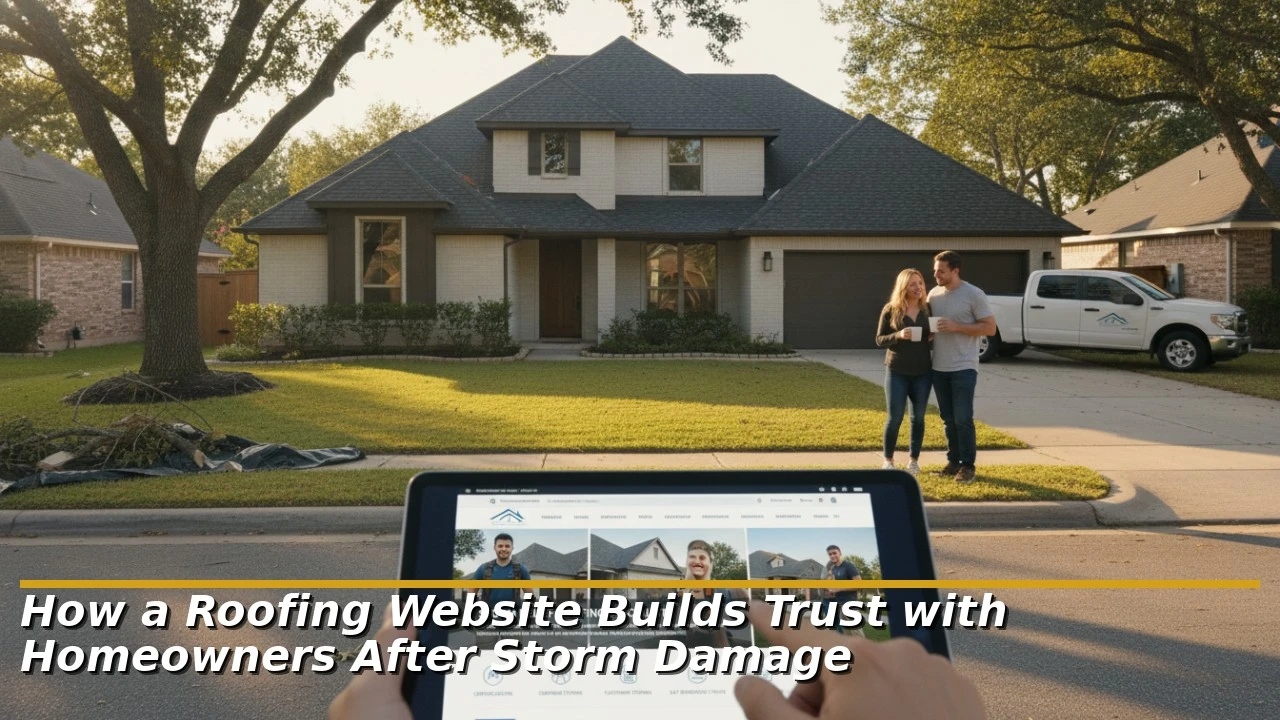
How a Roofing Website Builds Trust with Homeowners After Storm Damage
A hailstorm passes through a Minneapolis suburb on a Friday afternoon. Once evening rolls around, the homeowner has water staining on her ceiling and an insurance claim she does not know how to file. On her phone, she frantically researches, “emergency roofer near me” and opens the first two results. One shows a stock photo, […]
2. What a DIY Roofing Website Typically Includes
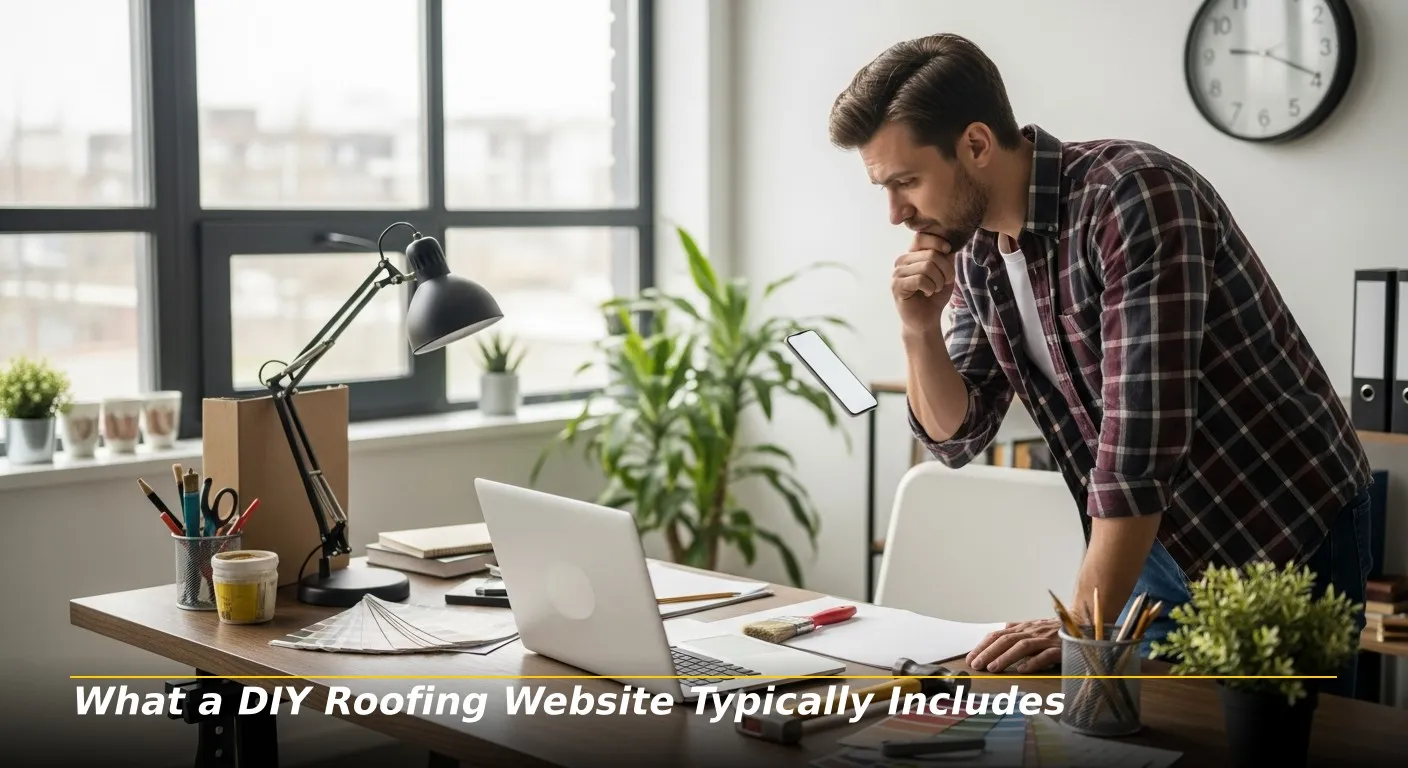
DIY platforms like Wix, Squarespace, and basic versions of WordPress offer templates specifically for contractors. These are designed for a layman’s ease of use rather than to optimize search engine performance.
A. Standard DIY Website Features:
- Drag-and-drop templates with generic roofing layouts.
- Basic contact forms that do not integrate with specialized contractor CRMs.
- Simplified search engine optimization (SEO) settings that cover only the basics like page titles.
- Limited control over the underlying code and database structure.
B. Pros of DIY Websites:
- Lower upfront financial investment (usually less than $50 per month).
- Complete control over minor text and photo edits.
- Quick to launch for very basic informational purposes.
C. Cons of DIY Websites:
- Technical SEO Debt: Limited ability to add advanced or customized markup that AI engines need to verify your business.
- Speed Issues: Many templates are bloated with unnecessary code, leading to slow load times.
- Mobile Failures: While they claim to be responsive, DIY sites often frustrate users due to issues like buttons too small or menus are too hard to navigate on a smartphone.
- Opportunity Cost: The time a contractor spends troubleshooting a broken header is time not spent on a job site or closing a lucrative contract.
 Related article
Which Website for Roofing Contractors Generates More Leads: DIY or Pro?
The roofing industry is one of the most competitive spaces in local home-related website searches. For a roofing contractor, the digital landscape has shifted from a simple list of links to a complex ecosystem where AI companions now provide direct recommendations. Homeowners facing a sudden leak or storm damage no longer just browse; they ask […]
3. What a Professionally Built Roofing Website Includes
A professional roofing website is not just about colors and design; it is a lean, mean conversion-optimizing machine. These sites are specifically built according to the exact ranking factors that Google and AI agents prioritize.
A. Advanced Professional Features:
- Custom Service Architecture: Dedicated pages for roof repair, roof replacement, storm damage, and specific materials like metal or TPO.
- Hyper-Local Location Pages: Unique content for every city and neighborhood you serve to dominate a customer’s “near me” searches.
- Proprietary Speed Optimization: Custom coding to ensure the site loads in under two seconds.
- Advanced Schema Markup: Hidden code (JSON-LD) that tells AI assistants your exact license number, service areas, and 24/7 emergency availability. Wow!
B. Benefits of Professional Development:
- Higher Close Rates: Built-in trust signals and “speed-to-lead” integrations turn more browsers into buyers.
- Asset Ownership: You own the code and the data, meaning you aren’t a tenant on a platform that can raise its prices at will.
- AI Search Ready: Professional sites are structured for extraction by Gemini and Perplexity, making your firm a “core source” for local recommendations.
 Related article
Why Every Roofing Contractor Should Optimize Their Website for Emergency Services Searches
At 11 PM on a Thursday, water is dripping through a homeowner’s kitchen ceiling. She opens Google, types “emergency roofer near me,” and calls the first result showing a 4.9-star rating, 24/7 badge, and phone number that loads before anything else. The entire decision takes under four minutes. The contractor who appears in that Map […]
4. Direct Comparison: DIY vs Professional Roofing Website
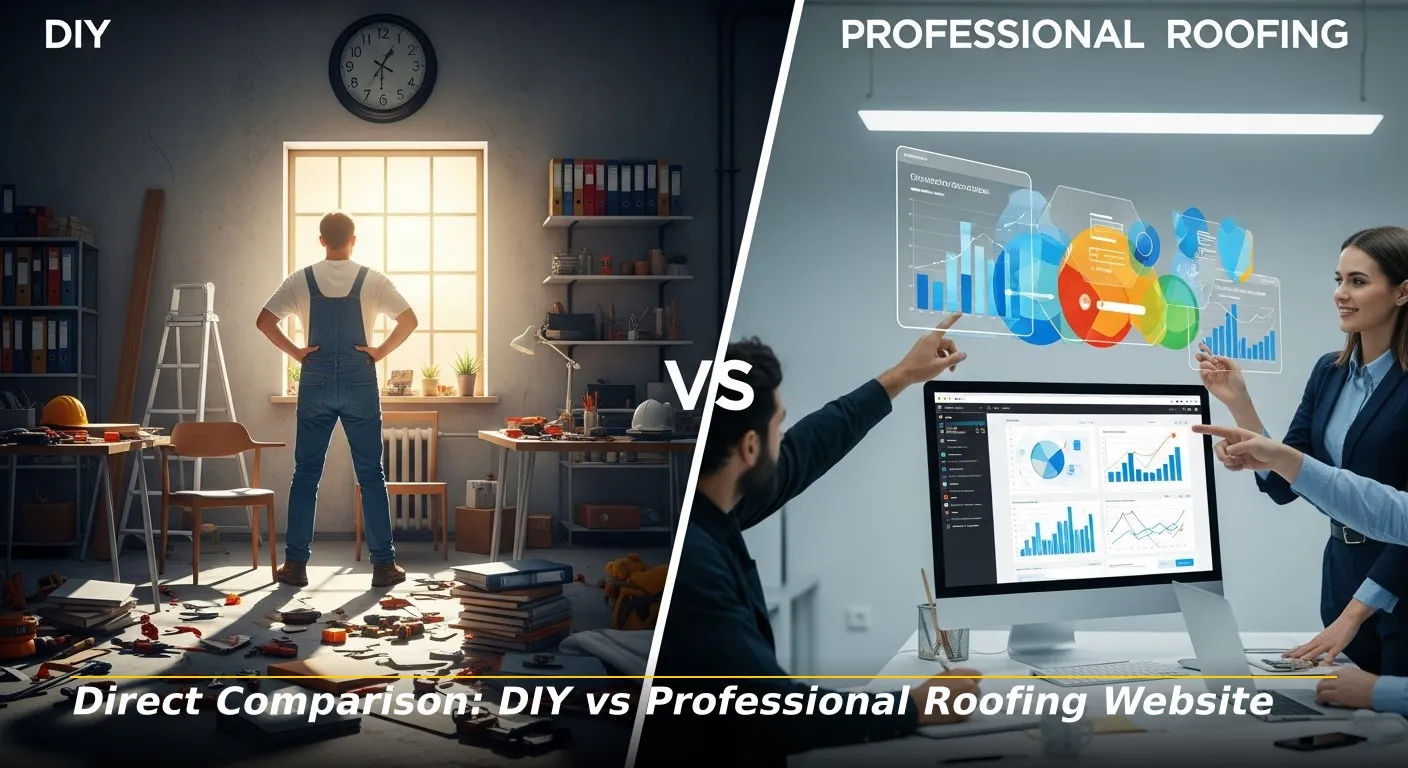
To help you decide, here is a breakdown of how both options perform across the metrics that impact your bottom line.
A. Initial and Ongoing Cost Comparison
Doing it yourself costs almost nothing upfront but carries a high monthly “marketing tax” in the form of lost leads. A professional site requires an investment (typically $2,500-$10,000) but lowers the cost-per-lead over time.
- DIY Cost: $250-600 per year plus 60+ hours of labor.
- Professional Cost: High upfront investment with low marginal cost-per-lead as your organic traffic grows.
B. Time Investment Comparison
Contractors often underestimate the time required to build a site that actually works. A professional team launches a site typically in under eight weeks with minimal input from the owner, whereas a DIY site can remain “under construction” for months.
C. SEO and AI Search Visibility
This is where the gap is widest.
- DIY Visibility: Often limited to ranking for your company name. These sites rarely show up for high-value, premium customer terms like “emergency roof leak repair.”
- Professional Visibility: Structured for “entity-based SEO.” This means Google and ChatGPT recognize your business as a verified local authority, leading to citations in AI-generated answers.
D. Lead Generation Potential
Professional websites typically convert at 10 percent or higher, whereas DIY sites hover around the industry average of two percent. For every 1,000 website visitors, a professional site might generate 100+ leads while a DIY site generates around 20.
Professional roofing websites outperform DIY sites in AI search because they utilize specialized “Roofing Contractor” schema and high-velocity publishing cadences. AI agents like Perplexity prioritize sites that provide information gain through original project data and case studies, which are difficult to implement and structure correctly on limited DIY templates.
 Related article
How Local SEO Helps Roofing Companies Dominate “Roof Repair Near Me” Searches in Minnesota
A hailstorm moves through the western Twin Cities suburbs on a Tuesday afternoon. By evening, homeowners in Maple Grove, Rogers, and Plymouth are searching their phones for “roof repair near me.” The three roofing companies that appear at the top of the Map Pack take calls for two weeks. Those not appearing watch a season’s […]
5. Which Website Actually Generates More Roofing Leads?
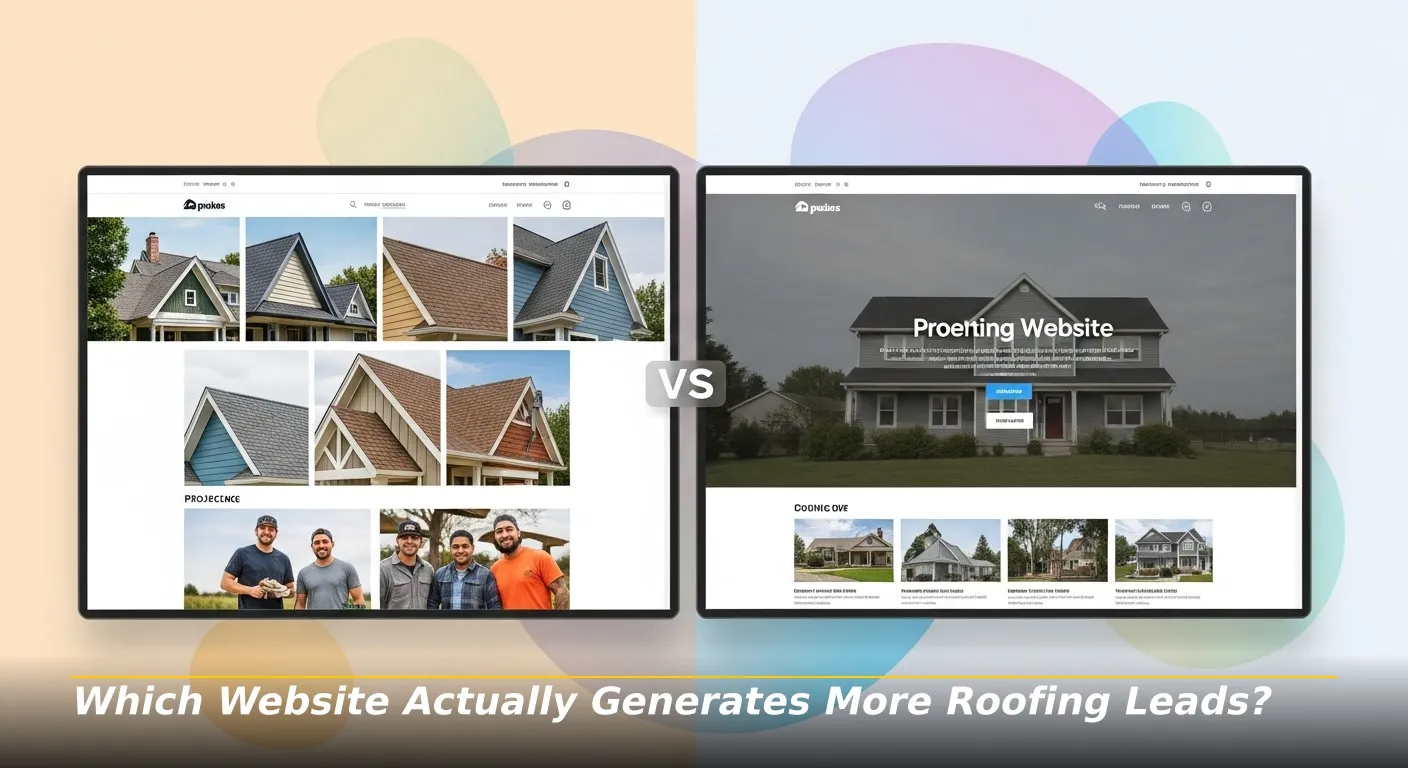
The data is clear: professional websites generate significantly more leads because they address the three primary hurdles of roofing marketing: ranking, trust, and conversion.
A. Ranking Factors and Entity Authority
In the age of AI, search engines look for “signals of expertise.” A professional site includes detailed case studies, project galleries with location tags, and deep educational content about roofing systems. This builds what Google calls E-E-A-T (Experience, Expertise, Authoritativeness, and Trustworthiness). DIY sites are usually much too thin to provide these signals.
B. Conversion Optimization
A professional site uses conversion design. This includes:
- Sticky Call-to-Action: A “Call Now” button that follows the user as they scroll on their phone.
- Visual Trust Signals: Real photos of your crew and branded trucks, which have been shown to outperform stock images by 5 to 1.
- Low-Friction Forms: Forms with only minimal response fields to maximize completions.
C. 12-Month ROI Scenario
- Contractor A (DIY): Spends $500. Gets five leads per month. Closes one job per month at an average of $10,000. Total gross revenue: $120,000.
- Contractor B (Professional Website): Spends $5,000. Gets 30 leads per month. Closes six jobs per month at an average of $10,000. Total revenue: $720,000.
Even after paying for the professional site, Contractor B generates much more gross revenue in the first year.
 Related article
Minnesota’s Building Season: 7 Months. Here’s How to Books Jobs Year-Round
Minnesota’s contractors work within one of the tightest build windows in the country. Exterior construction is effectively limited to May through October by frost depth, frozen ground, and road weight restrictions that delay material deliveries into mid-spring. That leaves just five months where physical work stalls but overhead keeps running, skilled workers look for stability […]
6. But …When does a DIY Roofing Website Make Sense?
There are a few scenarios where a DIY site is the right choice:
- Brand-New Startups: If you have zero customers and a bare-bones budget, a DIY site provides a basic “landing pad” for your business to exist online.
- Temporary Solution: If you are waiting for a major rebranding, a merger, buyout, or other significant business identification event that will change your structure.
- Testing a Side-Hustle: If roofing is not your primary source of income and lead volume is not a priority.
As a general rule of thumb, if you plan or want to earn more than $250,000 a year in revenue, a DIY site becomes a bottleneck that prevents you from reaching higher-value customers.
Conclusion: A professional website is no longer a marketing luxury; it is the core infrastructure of a modern roofing business. While DIY sites offer a low-cost entry point, they lack the technical foundation and conversion psychology needed to win in a competitive, crowded market. In today’s age of AI-guided search, visibility is earned through structured data, speed, and topical authority. Contractors who invest in a professional asset build a lead-generation engine that compounds in value, while do-it-yourselfers often find themselves stuck in a cycle of low visibility and even lower results. To capture the highest-intent leads and dominate your local market, owning an authoritative online presence is the only strategic choice.
Is your current website helping you grow, or is it holding you back? Are your competitors claiming the top spots in AI search results? If so, it’s time to evaluate your current digital asset and consider the long-term ROI of a professional build. It’s time to invest in a high-performance roofing website today to secure consistent leads, build entity authority, and watch your business thrive for years to come. Take the first step toward digital dominance now and call our Minnesota Roofing Website Design Company today at (612) 590-8080.
 Related article
12 Trust Signals Every Home Improvement Contractor Website Needs to Convert Visitors into Clients
Trust is the most valuable tool for any home improvement contractor. For years, the goal was to appear up on the first page of Google. Today, we have entered the age of AI search. People now ask tools like ChatGPT and Gemini for direct advice on who to hire. These programs not only rank websites […]
FAQs About Which Website for Roofing Contractors Generates More Leads: DIY or Pro?
1. Can I rank on Page 1 with a Wix roofing website?
While it is technically possible for your brand name, it is very difficult to rank for competitive terms like “roof replacement cost” or “roofing contractors near me.” Wix and similar platforms lack the granular control over server response times and schema depth that professional SEO requires to beat established competitors.
2. How much does a professional roofing website really cost?
A high-performance site generally costs between $2,500-$10,000. This includes strategy, custom copywriting, mobile optimization, and local SEO setup. Beware of low-cost agencies that essentially give you a “DIY template” for a fee; true professional development is custom-built for your specific service area.
3. How long does roofing SEO take to work?
Technical fixes on a professional site can show results in 1-3 months. However, building the authority required to be the top-cited source for AI agents usually takes 6-12 months of consistent content and review management.
4. Do I really need a separate page for every city I serve?
Yes. AI search tools use these pages as “grounding data” to verify you serve a specific neighborhood. Without unique location pages, you will only rank in the immediate radius of your office. Each page must have unique content about local housing types or weather challenges to avoid being flagged as a “doorway page.”
5. Will a better website increase my phone call volume immediately?
If your current site is slow or hard to use on mobile, a professional redesign can increase call volume by up to 50 percent almost instantly just from your existing traffic. For new traffic, call volume will grow as your organic search and AI-led mentions increase over time.