







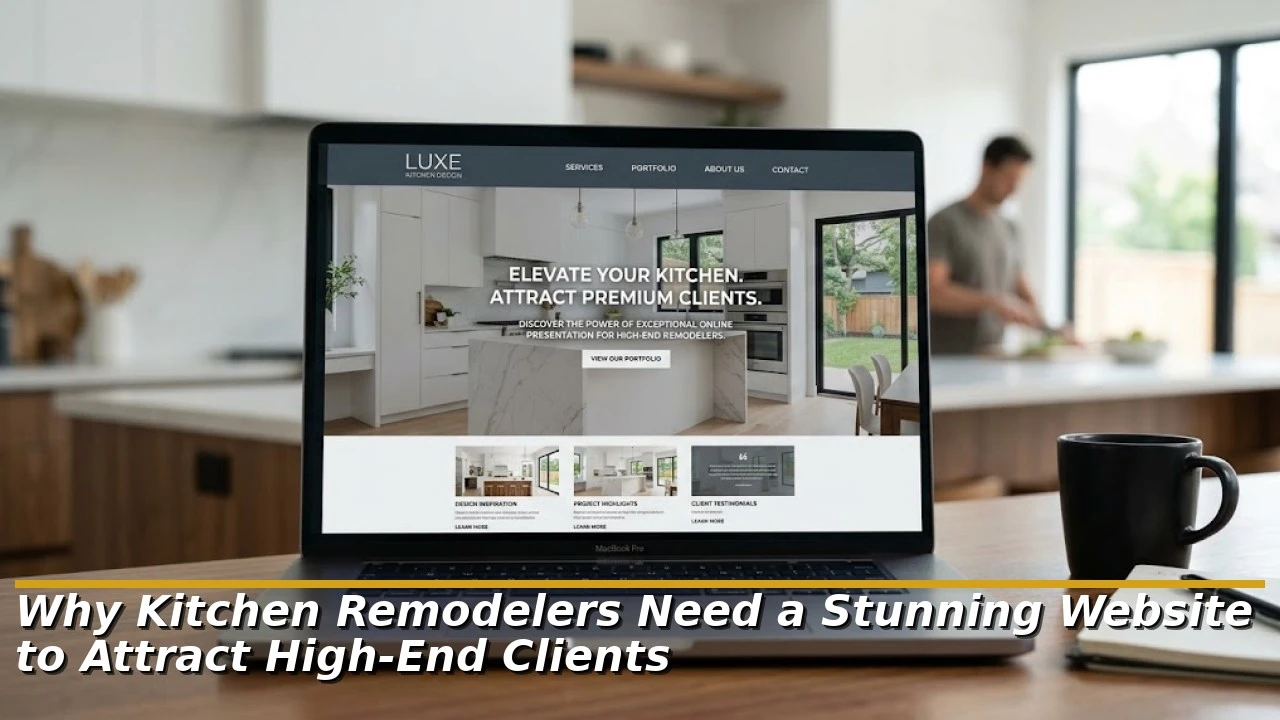
A homeowner is planning to fully renovate their kitchen. Budget: $80,000. She spends two hours reviewing five contractor websites before making the first call. Two sites use stock photos and lack pricing context. One loads slowly and shows a cluttered gallery with no project descriptions. The fourth has a polished layout, professional photography of real projects organized by style, transparent cost guide, and video walkthroughs of completed renovations. She calls the fourth firm and does not bother with the fifth.
According to the 2025 Houzz Kitchen Trends Study, the median spend on a kitchen remodel is $60,000, up from $55,000 the prior year. The top 10% of spenders invest $180,000 or more on a major kitchen remodel, triple the median. Those clients are making a substantial financial and emotional commitment. A website communicating the level of craft and professionalism that commitment requires is not a marketing nicety. It is the filter determining whether those customers contact you or your competitor.
Key Takeaways
- The median kitchen remodel spend is $60,000; the top 10% of spenders invest $180,000+, and Gen X accounts for the highest luxury-level project volume
- High-end clients spend 2.5 hours researching before first contact: the website must sustain and close that research journey
- Visual trust judgments are made within 50 milliseconds: a premium-looking site signals premium-quality work before a word is read
- Websites using real project photography and case studies convert significantly better than those relying on stock imagery
- Contractors with strong, consistent digital branding can charge 10 to 30% more for comparable work by reducing perceived project risk
1. How High-End Clients Actually Vet Kitchen Remodelers?
Homeowners planning a $60,000 to $180,000 kitchen renovation do not make impulsive decisions. According to research on high-value home improvement purchases, these consumers spend an average of 2.5 hours researching contractors online before reaching out. They compare portfolios across multiple firms, looking for a project that closely matches their vision in style, scope, and quality of finish. Checking reviews for specific service descriptions is on their list. Going over pricing transparency, process explanations, and evidence of project management competence is also a must.
Gen X homeowners represent the highest volume of luxury kitchen projects, according to Houzz’s 2025 Kitchen Trends Study, with top-tier spending reaching $150,000. They are experienced consumers who have bought homes, hired professionals, and been disappointed before. Their expertise allows them to quickly call out vague language and generic imagery signals. A website showing only finished glamour shots without describing the challenge, timeline, or process behind the project tells them nothing about whether this firm can manage a complex renovation at their standard.
The goal of a site during that 2.5-hour research window is to answer the homeowner’s underlying questions before they ask them: Have you done a project like mine? Can you manage this at this scale? Will you respect my home and timeline? A site that answers all three, with evidence, not copy, is the one that earns the consultation.
 Related article
Kitchen Remodeling Website Ideas: How to Showcase Projects, Styles, and Budgets to Pre-Qualify Leads
The way homeowners find kitchen remodelers has changed forever. For years, the key ingredient was showing up on a list of links on Google. But this year, people are using smart AI tools like ChatGPT, Gemini, and Perplexity to do their homework. Instead of clicking on ten different websites, they ask, “Who is the best […]
2. What Makes a Website Look and Feel High-End?

A premium website is not defined by decorative complexity. It is defined by clarity, restraint, and evidence. The design elements that resonate with high-income clients are the same ones that signal operational discipline: generous white space that lets the photography breathe, clean typographic hierarchy making information easy to find without hunting, and consistent branding across every page that signals a firm that operates with systems.
Visual quality is interpreted as a proxy for craft quality. Research suggests that nearly half of web users assess a company’s credibility based solely on design and imagery, and that first impression forms within 50 milliseconds. A site with stock photos of generic workers, inconsistent fonts, and a cluttered layout tells someone spending $80,000 on a kitchen that this firm does not pay attention to detail. A digital presence with professional photography of real completed work, a logical navigation structure, and a design that matches the level of finish visible in the projects tells them the opposite.
| Design Element | What It Signals to a High-End Client? | Common Failure Mode |
|---|---|---|
| Professional project photography | Craftsmanship and attention to detail | Stock photos or unlit smartphone snaps |
| Generous white space | Organization and visual discipline | Cluttered galleries with 40 undescribed photos |
| Consistent brand typography | Professional systems and stability | Mismatched fonts across pages |
| Sub-2-second mobile load | Operational competence and readiness | Slow load time signals a disorganized business |
| Clear navigation (3-click rule) | Respect for the client’s time | Buried portfolio or hidden contact options |
 Related article
How a Website Builds Trust + Credibility for Remodeling and Renovation Contractors
A homeowner shortlists three kitchen remodeling contractors. All three come recommended by neighbors. Each holds a sound reputation in the community built over years of good work. She searches each one on her phone. The first has no website. Option #2 has a site that loads in five seconds and only shows stock photos. The […]
3. The 6 Website Features That Convert High-End Kitchen Leads
- Project galleries organized by style and scope. Sort by kitchen style like, modern, transitional, or traditional, and by project scale. A homeowner planning a large-format kitchen expansion wants to see a similar project, not a random grid of every job you have completed. Each gallery entry should function as a brief case study: the viewer’s starting point, the specific design challenges, and the materials selected. According to InnerSpark Creative’s 2025 construction marketing benchmarks, high-quality photos paired with case study context consistently improve conversion rates for high-value renovation leads.
- Transparent budget ranges and cost guides. High-end clients are not looking for the lowest price. They want a contractor who understands what work costs and communicates that clearly. A cost guide outlining typical investment ranges for minor updates, mid-range full remodels, and luxury custom builds filters out misaligned prospects before a single consultation is scheduled and builds immediate credibility with clients who are ready to commit to the real number.
- Video walkthroughs of completed projects. A 60 to 90-second walkthrough of a finished kitchen, filmed professionally or even on a high-quality smartphone with nice lighting, lets watchers experience the space in a way that photography cannot. Seeing the flow of a layout, the quality of cabinet hardware, and the scale of an island converts research interest into emotional investment. It also humanizes the firm in a way that resonates with those who care about who will be in their home.
- NKBA and NARI certification badges, prominently placed. The National Kitchen and Bath Association (NKBA) and the National Association of the Remodeling Industry (NARI) are the two most recognized credentialing bodies for kitchen remodeling professionals. Displaying these certifications signals to high-end clients that the firm operates to verified professional standards, providing the institutional third-party endorsement that self-promotional copy cannot replace.
- Answer-first FAQ sections with schema markup. High-end clients ask detailed questions during their 2.5-hour research phase: what the process looks like, how long a full remodel takes, what happens when unexpected structural issues arise. FAQ sections with natural-language question headings and concise, direct 120 to 150-word answers earn AI citations and position the contractor as a transparent expert. Clients who have their questions answered before calling arrive more qualified and committed.
- A pre-qualification section or project fit guide. An “Is our firm the right fit?”, page detailing the types of projects you take on, your minimum project investment, and your process expectations does two things simultaneously: it filters out misaligned inquiries and builds confidence with clients who match those criteria. Serious buyers recognize and respect the clarity. It tells them this firm is selective, which implies they are sought after.
 Related article
Why Social Media Page Isn’t Enough: Kitchen Remodelers Need a Website
A kitchen remodeler in Minneapolis has 4,200 Instagram followers and posts polished before-and-after photos three times a week. Engagement is consistent. Comments pour in. The account looks like a thriving business. But when a homeowner in Edina searches “kitchen remodeler near me” on Google, the firm is nowhere to be seen. No website, MapPack listing, […]
4. How a Premium Website Supports Premium Pricing?

A professionally designed website with high-quality content is not a cost, but the mechanism supporting charging 10% to 30% more for comparable work. When a homeowner perceives a contractor’s brand as high-value, through consistent design, credentialed expertise, and transparent communication, their price sensitivity decreases. The research phase has already convinced them that this firm is worth the investment before the first quote is discussed.
The compounding effect is significant. Every high-end project showcased on a well-structured website raises the reference point for what prospective clients expect to invest. A portfolio showcasing three $80,000 kitchens signals to the next visitor that $80,000 is where this firm operates. A portfolio that illustrates fifteen different project types with no context signals a generalist who will take any job at any price.
 Related article
Local SEO Drives Qualified Leads for Minnesota Kitchen Remodelers
A homeowner in Woodbury has been collecting kitchen inspiration on her phone since October. By February, she is ready to move from planning to hiring. Searching, “best kitchen remodeler near me” the top 3 results appear. One has a portfolio organized by project style, suburb-specific reviews, and a transparent cost guide. The other two show […]
5. Two Remodelers, Same Craft, Different Digital Presence
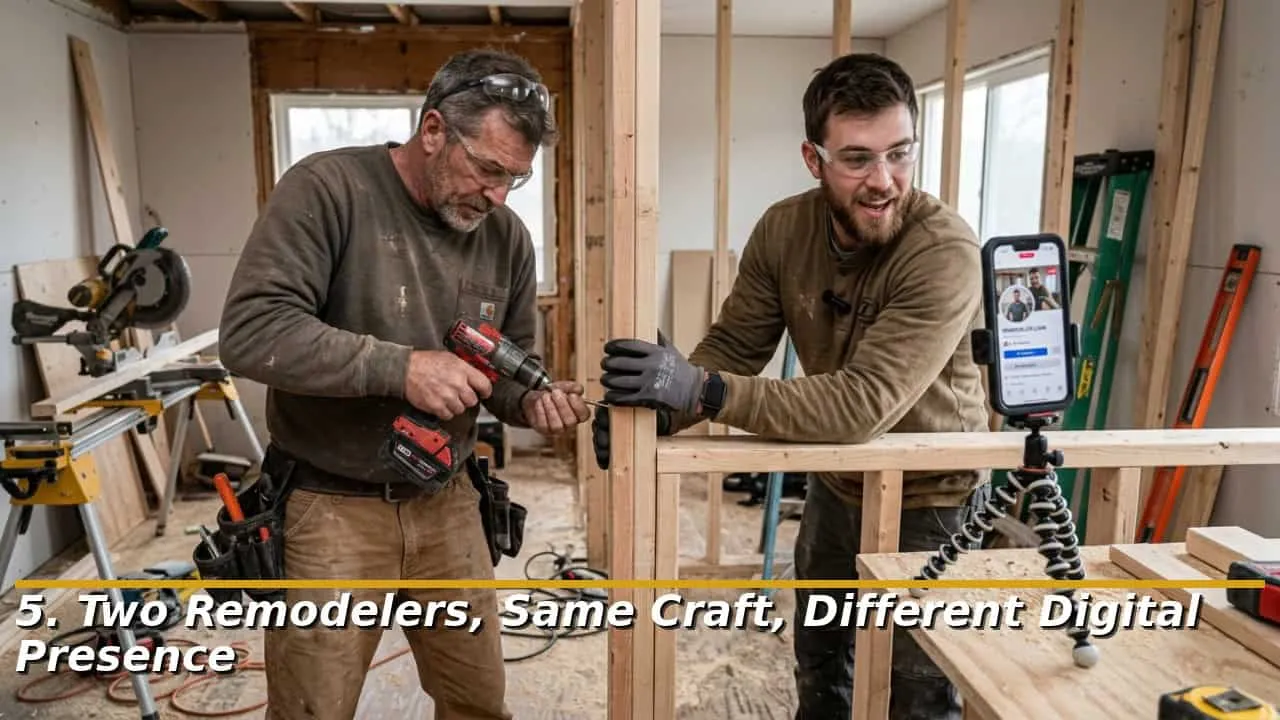
Both operate in the same metro area targeting high-income suburbs. Each touts a decade of high-quality work in their portfolio.
Remodeler A has a five-page website built in 2020. Stock photos. Lacking pricing context and case studies. A contact form and nothing else. Average project value: $18,000. Close rate on consultations: 25%. They compete primarily on price because their website gives homeowners no other basis for comparison.
Remodeler B invested in a custom site with professional project photography organized by style, a cost guide for three project tiers, video walkthroughs of two flagship projects, and NKBA credentials displayed prominently. Average project value: $28,000. Close rate: 36%, because homeowners arrive at consultations pre-sold on the firm’s approach and value. The website handled the trust-building work before the first meeting.
The same craft. The same market. The website is the only variable that explains the difference in project value and close rate.
Conclusion
A kitchen remodeling website is not a portfolio album. It is the first and most consequential conversation a high-end client has with a firm, before outreach occurs. In the time a homeowner spends comparing five contractor websites, a professionally designed site with real project photography, transparent pricing context, and verified credentials earns the consultation while the others are filtered out.
The investment is directly tied to the projects it attracts. Websites presenting $80,000 kitchens confidently draws $80,000 clients. One that presents a disorganized mix of every job type at every price point draws the same. For kitchen remodelers ready to stop competing on price and start competing on expertise, here is where that transition begins.
Does your website reflect the quality of your best work?
Open your website right now and look at it the way an $80,000 client would. Is the first project photo professional-grade or a smartphone snapshot? Is there a cost guide? Are your certifications visible? Can you find your portfolio organized by style within two clicks? Those four questions identify the gaps that are costing you high-value consultations. Start with your photography and one project case study this week. Those two additions alone will move the needle faster than any advertising spend.
 Related article
12 Trust Signals Every Home Improvement Contractor Website Needs to Convert Visitors into Clients
Trust is the most valuable tool for any home improvement contractor. For years, the goal was to appear up on the first page of Google. Today, we have entered the age of AI search. People now ask tools like ChatGPT and Gemini for direct advice on who to hire. These programs not only rank websites […]
FAQs Why Kitchen Remodelers Need a Stunning Website to Attract High-End Clients
1. How should kitchen remodelers photograph projects for maximum website impact?
Professional photography pays for itself numerous times over for high-end kitchen work, but the approach matters as much as the equipment. Shoot after the project is fully complete, not during construction. Stage the kitchen as you would for a magazine feature: fresh flowers, clear countertops, and ambient lighting activated. Capture wide-angle establishing shots, medium shots of key design features including custom cabinetry or a statement backsplash, and close-up detail shots of hardware and finishes. Have a before-and-after pair for each project to make the transformation tangible. According to the 2025 Houzz Kitchen Trends Study, 86% of renovating homeowners hire professionals and are highly attuned to finish quality. Showing those finishes at their best is the most direct way to communicate your level of work.
2. Should kitchen remodelers show specific prices on their website?
Not exact line-item pricing, but transparent ranges are a significant conversion tool for high-end clients. A cost guide identifying the investment range for a minor kitchen refresh ($15,000 to $35,000), a mid-range full remodel ($40,000 to $75,000), and a luxury custom kitchen ($80,000 and above) serves two purposes: it filters out prospects whose budgets are fundamentally misaligned, and builds immediate credibility with clients who are prepared for realistic numbers. According to InnerSpark Creative’s 2025 remodeling marketing benchmarks, transparent pricing context consistently improves conversion rates for high-value renovation leads. The goal is not to publish a price list. It is to ensure serious buyers are instilled with enough context to know they are in the right place.
3. How do current kitchen design trends affect what a website should showcase?
Actively. According to Houzz’s 2025 Kitchen Trends Study, transitional style holds the largest share of the market at 25%, but traditional style made a significant comeback, jumping 5 percentage points. Large-format slab backsplashes are surging, with full-coverage installations rising sharply. More than a third of homeowners expanded their kitchen footprint during renovation, often by incorporating the dining room. A website portfolio that visibly reflects these current preferences, rather than showcasing exclusively projects from 2018 and earlier, signals the firm is on-trend and in-demand. Labeling gallery entries with their style category, such as “transitional,” “modern,” or “traditional,” lets homeowners quickly find projects that match their own vision.
 Related article
Home Improvement Contractor Website Structure: Pages That Rank and Convert Local Homeowners
The way homeowners find contractors online is changing rapidly. For years, the goal of a construction company was simple: show up on the first page of Google. But today, we are in the thick of the era of AI search. People are no longer just sorting through a list of links. They are asking smart […]
4. What is the difference between NKBA and NARI certifications, and which carries more weight with clients?
The National Kitchen and Bath Association (NKBA) is the industry’s design-focused credentialing body. Its Certified Kitchen Designer (CKD) and Certified Bath Designer (CBD) designations are recognized specifically by homeowners evaluating remodelers for high-end kitchen projects. The National Association of the Remodeling Industry (NARI) certifies project management, business practices, and technical competence across a broader range of remodeling trades. For kitchen-specific luxury work, NKBA credentials showcase design expertise that resonates strongly with clients comparing finished kitchens. NARI credentials signal operational reliability and business accountability. Displaying both on your website, particularly on service pages and near contact forms, covers dimensions of the trust evaluation that high-end clients apply.
5. How does the target client generation affect how a remodeling website should be designed?
Gen X homeowners, who represent the highest volume of luxury kitchen projects according to Houzz’s 2025 data, tend to evaluate based on depth of evidence: detailed case studies, verifiable credentials, and transparent process descriptions. They have completed major home purchases before and are skeptical of vague promises. Millennial homeowners, whose kitchen budgets rose to a median of $20,000 in 2024 and are increasing, resonate with visual storytelling, video content, and social proof from peers in similar life stages. A website serving both demographics effectively leads with premium photography and structured project case studies (for Gen X) while also incorporating video content and an active review feed with recent, relatable testimonials (for Millennials). The design itself should be clean and restrained rather than flashy, since these groups associate visual discipline with operational competence.