





Website Conversion Tips for Contractors Offering Multi-Service Home Improvements: A homeowner searches for, “roof repair and HVAC tune-up near me.” She clicks the first result: a contractor who offers both. The homepage lists 22 services in a grid. There is no clear starting point. After scanning for three seconds and seeing nothing relevant to the problem at hand, they exit. The contractor built a site that tried to serve everyone and ended up converting no one.
This is the central paradox facing multi-service contractors online. More services should mean new opportunities. But without deliberate conversion architecture, a wide service menu becomes a liability. According to Hick’s Law, a principle well established in behavioral psychology, decision time increases logarithmically with the number of choices presented. When visitors face too many equally weighted options, many choose none at all.
The good news: the solution is not to offer fewer services. It is to present them more intelligently. This article breaks down exactly how multi-service contractors can structure their websites to reduce friction, guide homeowners to the right service fast, and convert more of their existing traffic into booked jobs.
Key Takeaways
- Hick’s Law: decision time grows with every additional choice, making service curation a conversion strategy, not a limitation
- Mobile users searching for emergency services convert 60 to 80% more than those researching planned work, requiring two distinct conversion paths
- AI search traffic converts at 14.2%, five times higher than traditional organic, rewarding contractors with structured, service-specific content
- A single dominant CTA consistently outperforms pages with multiple competing buttons across home service industries
- Detailed service-specific reviews are 6x more valuable for AI search visibility than generic star ratings
1. The Core Problem: Too Many Services, Too Little Direction
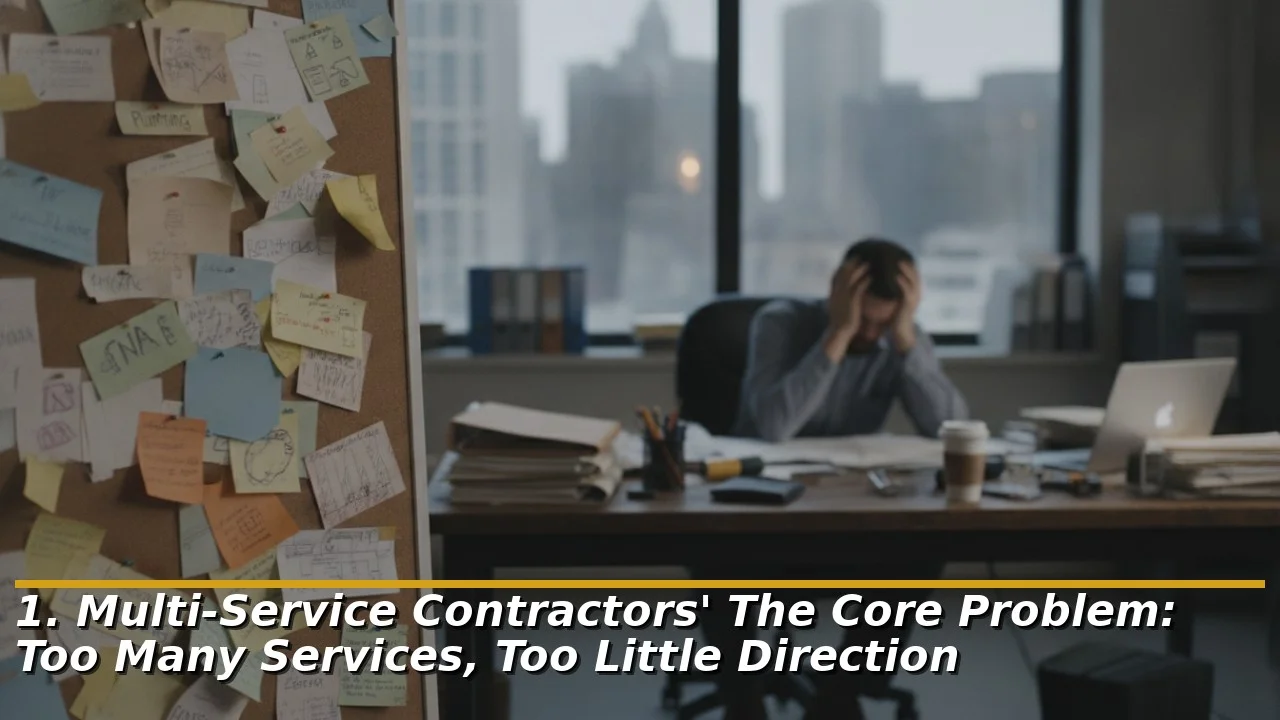
Most multi-service contractor websites were constructed to showcase everything the business does. The instinct makes sense from a sales perspective: list every service, and visitors will locate something relevant. But from a conversion perspective, this logic fails.
When someone lands on a homepage showing roofing, HVAC, electrical, plumbing, remodeling, and drainage services in equal prominence, their brain faces a triage problem. They arrived with a specific need. The site is presenting a menu. Those two things are misaligned, and the friction that results costs conversions.
The fix is not subtraction. It is a hierarchy. Multi-service websites must achieve what a standout salesperson does, quickly identify what the visitor needs and route them there directly. That requires understanding the two fundamentally different visitors who land on a contractor’s site, and building a path for each.
 Related article
Home Improvement Contractor Website Structure: Pages That Rank and Convert Local Homeowners
The way homeowners find contractors online is changing rapidly. For years, the goal of a construction company was simple: show up on the first page of Google. But today, we are in the thick of the era of AI search. People are no longer just sorting through a list of links. They are asking smart […]
2. Two Visitors, Two Conversion Paths

Not all homeowners arrive at a home improvement contractor’s website in the same state of mind. Getting conversion right for a multi-service business begins with recognizing this and designing for both.
The emergency visitor has water coming through the ceiling, a furnace that stopped working in January, or a circuit that tripped and will not reset. They are in crisis mode. Research from Cube Creative shows that mobile users searching for emergency services convert 60% to 80% higher than those researching planned work, but only when the path to contact is immediate and frictionless. They need a click-to-call button above the fold, 24/7 availability badge, and confirmation that you serve their area. Everything else is noise.
The planned-project visitor is comparing options, checking portfolios, and building trust over multiple visits. They will read service descriptions, review before-and-after galleries, and check reviews before committing. They convert on a longer timeline but often at a higher ticket value.
A homepage that tries to serve both visitors simultaneously with equal weight typically serves neither well. The architecture must account for both, routing each to the right path within the first ten seconds of a visit.
| Visitor Type | Arrival State | What They Need First | Primary Conversion Point |
|---|---|---|---|
| Emergency | High stress, urgent | Phone number, 24/7 badge, fast load | Click-to-call button |
| Planned project | Research mode, comparing | Portfolio, reviews, service depth | Quote request form |
| Returning visitor | Building trust | New reviews, recent projects | Direct booking or call |
 Related article
12 Trust Signals Every Home Improvement Contractor Website Needs to Convert Visitors into Clients
Trust is the most valuable tool for any home improvement contractor. For years, the goal was to appear up on the first page of Google. Today, we have entered the age of AI search. People now ask tools like ChatGPT and Gemini for direct advice on who to hire. These programs not only rank websites […]
3. Eight Conversion Strategies for Multi-Service Contractor Websites

These eight tactics address the most common failure points on multi-service contractor sites. Each one removes a specific friction point between the visitor and the booked job.
- Feature four to six hero services on the homepage, not all of them: Apply the 80/20 rule: your most profitable or most frequently requested services belong in the primary navigation and homepage grid. Secondary services belong in a clean dropdown or a separate “All Services” page. This is not hiding what you do, but instead, reducing cognitive load so visitors can reach a decision faster.
- Give every major service its own dedicated page: A single “Services” page listing everything you offer is both a conversion failure and an SEO missed opportunity. Each standalone service page allows you to target a specific keyword, speak directly to that service’s customer, and provide the depth of content that AI platforms like ChatGPT and Google Gemini use to confirm and recommend local contractors. One contractor who restructured their site this way grew organic monthly leads from 27 to 61, a 190% increase, according to FatCat Strategies’ documented case study.
- Use one dominant CTA per page, matched to search intent: When visitors see five buttons competing for their attention – “Get Quote,” “Call Now,” “Schedule Service,” “Learn More,” “Download Brochure” – Hick’s Law kicks in and many choose nothing. One primary CTA per page, with language matched to how the visitor searched, consistently outperforms multi-button layouts. Potential clients who arrived via “emergency plumber near me” should see “Call for Emergency Service Now,” not a generic “Contact Us.”
- Build separate landing pages for each service area: A page titled “HVAC Repair in [Neighborhood Name]” with local landmarks, neighborhood-specific reviews, and an embedded map addresses the homeowner’s most immediate question before being asked: are you actually nearby? These pages also provide AI search engines the localized, structured data they need to recommend you for “near me” queries.
- Structure content for AI extraction: AI search platforms handle a growing share of local service queries. To earn citations, each service page needs a tight header hierarchy (H1, H2, H3) and a FAQ section with natural-language questions and concise 120 to 150-word answers. Instead of a generic “Pricing” heading, use “How much does a new roof cost in Denver?” AI engines extract and surface these responses. AI search traffic converts at 14.2%, five times higher than traditional organic, making this structural investment high-priority.
- Display trust signals specific to each service: A homeowner on your roofing page wants to see your roofing certifications, not your plumbing license. Someone on your electrical page wants to see your electrical contractor’s bond and relevant project photos. Generic “fully licensed and insured” statements that appear identically across every page build less trust than service-specific credentials positioned exactly where they are most relevant.
- Shorten contact forms to three or four fields: Every additional form field is a reason for a visitor to abandon. For most service inquiries, name, phone number, service type, and a brief description is sufficient to initiate a booking conversation. The goal of the form is to start a call, not to conduct an intake interview. Reducing form fields consistently increases submission rates across home service industries.
- Add video to key service pages: A 60 to 90 second walkthrough of how your team handles a common job, filmed on a smartphone, establishes trust quicker than any editorial. Research from Plumbing Webmasters shows that embedding video on service pages increases conversions by 86%. For a multi-service contractor, one video per core service is a realistic and high-return content investment.
 Related article
How a Strong Online Presence Helps Home Improvement Contractors Win Bigger Projects
Modern homeowners demand digital proof before investing in high-ticket remodels. With nearly half of clients researching online, a polished website isn’t just a marketing nicety, it’s your primary sales tool. This article reveals how to build digital trust through case studies and reviews to consistently attract and convert high-value remodeling clients…
4. Why Trust is Harder to Earn for Multi-Service Contractors

A contractor who says they do everything risks being seen as a master of none. Homeowners know this instinctively. When vetting a business to enter their home, they are looking for evidence of specific expertise, not general capability.
The most effective way to close this credibility gap is through review substance. AI engines and homeowners both prioritize detailed, service-specific reviews over generic star ratings. A review stating,“Best emergency AC repair in Chicago, technician arrived in under an hour and explained exactly what failed” is 6 times more valuable for AI search visibility than a five-star “Great job!” according to local SEO research. Prompt customers to mention the specific service, outcome, and their location. That specificity is what converts browsers into callers.
Project galleries by service category are equally powerful. Before-and-after photos organized by job type, rather than piled into a single generic gallery, let every visitor find proof that you’ve done exactly what they need. Potential customers researching a kitchen remodel need to see kitchen remodels, not a random mix of every job type you’ve completed.
 Related article
Why Home Improvement Contractors Need a Website to Stand Out Locally in Minnesota
Search “roofing contractor Maple Grove” on your phone right now. The first three results in the Map Pack receive the overwhelming majority of calls. Slotted below, a contractor with no website, reviews, and local pages sits invisible. They may be the most skilled roofer on the list. This does not matter. In an oversaturated market […]
5. Two Contractors, Same Services, Different Architecture

Both firms operate in the same metro area offering roofing, HVAC, plumbing, and electrical services. Both have comparable pricing and a solid local reputation.
- Contractor A’s website lists all 20-plus services on the homepage with equal visual weight. The navigation has six top-level items, each opening a dropdown of additional options. Those searching for “emergency HVAC repair” lands on the homepage, cannot immediately confirm HVAC is offered as an emergency service, and leaves within eight seconds. Load time: 4.5 seconds. Conversion rate: 1.8%. Cost per lead: $78.
- Contractor B restructured around dedicated service pages, each with its own CTA matched to visitor intent. Their homepage features four hero services prominently, with a persistent sticky header carrying a click-to-call button and a “24/7 Emergency Available” badge. Each service page carries credentials and reviews specific to that trade. Load time: 1.7 seconds. Conversion rate: 4.3%. Cost per lead: $41.
Same services. Same market. Same ad budget. The architecture is the only variable that explains the difference.
| Metric | Contractor A (Unstructured) | Contractor B (Structured) |
|---|---|---|
| Homepage service count | 20+ services, equal weight | 4 to 6 hero services featured |
| Service pages | One combined page | Individual page per service |
| Emergency path to call | 3+ clicks | Sticky header, above the fold |
| Conversion rate | 1.8% | 4.3% |
| Cost per lead | $78 | $41 |
Conclusion
The multi-service contractor’s website problem is not a volume problem. It is a clarity problem. More services create greater opportunity only when the architecture routes each visitor to the right place quickly, presents the right trust signals for the specific service they need, and removes every possible barrier between their search and your phone number.
The contractors who are most fruitful in competitive markets are not the ones with the longest service lists. They are the ones who have made it easiest for every homeowner, whether in a crisis at midnight or planning a remodel on a Saturday afternoon, to find what they came for and take action. That is a design decision, a content decision, and a conversion decision. All three are within your control.
Is your website routing visitors or losing them?
Open your homepage on your phone and count the number of clickable options visible above the fold. If there are more than six, you likely have a choice overload problem. Count the steps it takes to reach a phone number from each of your core service pages. If it is more than two, you are losing emergency callers. Those two audits will tell you exactly where your conversion architecture needs work, and both can be addressed without rebuilding your site from scratch. If you need help, call our Minnesota Website Design Team today at (612) 590-8080.
 Related article
How Your Contractor Website Should Prepare for Minnesota’s Spring Search Surge: A Seasonal SEO Checklist
Minnesota’s construction season is compressed into roughly six months, meaning the digital competition for spring projects is heavily front-loaded. By the time the ground thaws in April, the most in-demand contractors are already booked. Homeowners who fill those schedules started their search in February, and the contractors who captured them had websites that were optimized […]
FAQs About Website Conversion Tips for Contractors Offering Multi-Service Home Improvements
1. How many services should a multi-service contractor feature on their homepage?
Focus the homepage on four to six primary services, specifically the ones that generate the most revenue or receive the most search volume in your market. Additional services belong in a clean dropdown navigation or a separate “All Services” page. Doing so is not about limiting what you offer. It is about reducing the cognitive load that causes decision fatigue. Visitors who quickly find the service they need are far more likely to convert than those who must scan a sprawling list before they can even begin evaluating you.
2. Does every service need its own dedicated page?
Yes, for every service that generates significant revenue or has its own distinct search audience. Dedicated pages allow you to target specific keywords, address the particular concerns of that service’s customer, and provide AI platforms the structured, service-specific content they need to recommend you in local searches. A contractor who consolidated their generic “Services” page into individual service-specific pages grew monthly home improvement organic leads by 190%, based on a documented FatCat Strategies case study. The effort compounds as each page becomes an independent lead-generation asset.
3. How do you handle SEO when offering many different services on one website?
Use a siloed content architecture. Group each service category into its own topical cluster: a primary service page supported by related blog posts, FAQ content, and location-specific landing pages. A roofing cluster might include a main roofing page, posts on “signs your roof needs replacing,” and location pages for each city or suburb you serve. This signals to both Google and AI search engines that your business has genuine depth of expertise in each area, not merely a surface-level listing. Internal links between pages in the same cluster reinforce that topical authority.
4. How long does a website conversion overhaul take to produce results?
Technical improvements, such as fixing load speed and restructuring navigation, can produce measurable gains in conversion rate within 30 days. Full structural changes, including new service pages, updated content, and review accumulation, typically reach their conversion potential over 3 to 6 months as search engines re-index the new architecture and review velocity builds. The results compound rather than plateau meaning each new service-specific review and each new location page adds to the site’s authority over time.
5. Should emergency services and planned services have separate landing pages?
Yes, and the reason goes beyond organization. Emergency and planned-project visitors arrive with entirely different states of mind, different conversion timelines, and different trust requirements. An emergency HVAC page should lead with availability, response time, and a prominent click-to-call button. A planned kitchen remodel page should lead with portfolio photos, review depth, and a detailed quote form. Sending both visitor types to the same page forces one of them through a path that was not designed for their intent, and that friction costs conversions. Separate entities for emergency versus scheduled services consistently outperform combined pages in home service markets.